
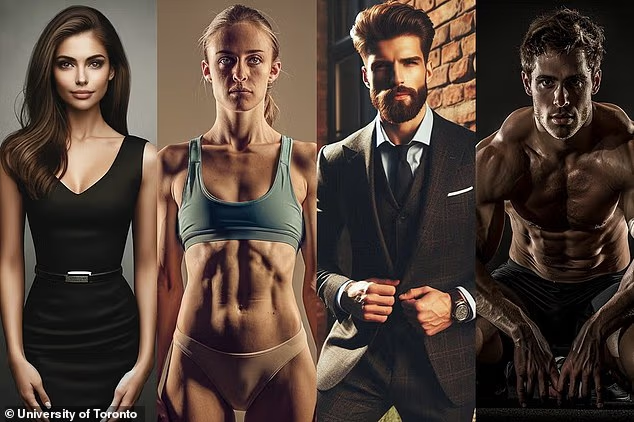
What do the perfect man and woman look like?
According to AI, the answer is young, white, and very attractive.
Scientists from the University of Toronto asked three artificial intelligence bots to create images of ideal female and male bodies.
The ultimate woman is facially attractive, young, blonde and wears ‘revealing clothing’, according to the results.
Meanwhile, the ultimate man is shirtless, has black hair, and is ‘hyper–muscular’.
‘In a systematic coding of 300 AI–generated images, we found that AI reinforces the fit ideal,’ said Dr Delaney Thibodeau, lead author of the study.
The results also revealed a clear lack of diversity, with most images showing white people – and none depicting visible disabilities.
‘Racial and age diversity were minimal,’ Dr Thibodeau added.

What do the perfect man and woman look like? According to AI , the answer is young, white, and very attractive
Ideas about the ‘perfect’ body have changed hugely through the years.
For example, in the 1950s, weight gain tablets hit the shelves as women aspired to look like Marilyn Monroe and Elizabeth Taylor, while the 90s saw ladies lusting after a thin, androgynous look dubbed ‘heroin chic’.
In their new study, the team set out to understand what AI now considers the ideal male and female body.
Three different AI platforms – Midjourney, DALL–E, and Stable Diffusion – were asked to create images of female and male bodies, including those of athletes.
In total, 300 images were generated – 120 of men, 120 of women, and 60 of athletes.
An analysis of the images revealed several key trends.
Most (66.7 per cent of male images and 62.5 per cent of female images) depicted white people, while nearly all showed a young person.
The women were most likely to have blonde hair and the men to have black hair.

The women were most likely to have blonde hair and the men to have black hair. ‘Male adults in the images were never bald,’ the researchers explained in their study, published in Psychology of Popular Media (stock image)
‘Male adults in the images were never bald,’ the researchers explained in their study, published in Psychology of Popular Media.
Both the men and women had low body fat – while none had visible cellulite or rolls of fat.
In terms of clothes, there weren’t many of them.
‘Female images were more often dressed in bathing suits and revealing apparel, while male images appeared shirtless more frequently,’ the researchers added.
Overall, the findings show that AI platforms ‘overwhelmingly reproduce and amplify narrow western body ideals’, according to the team.
‘Our findings underscore the need to investigate how emerging technologies replicate and amplify existing body ideals and exclusionary norms,’ said Professor Catherine Sabiston, co-author of the study.
‘A human-centred approach – one that is informed by considerations of factors such as gender, race, disability and age – would be advisable when designing AI algorithms.
‘Otherwise, we continue to perpetuate harmful, inflexible and rigid imagery of what athletes should look like.’













Leave a comment