
Unlock the Editor’s Digest for free
Roula Khalaf, Editor of the FT, selects her favourite stories in this weekly newsletter.
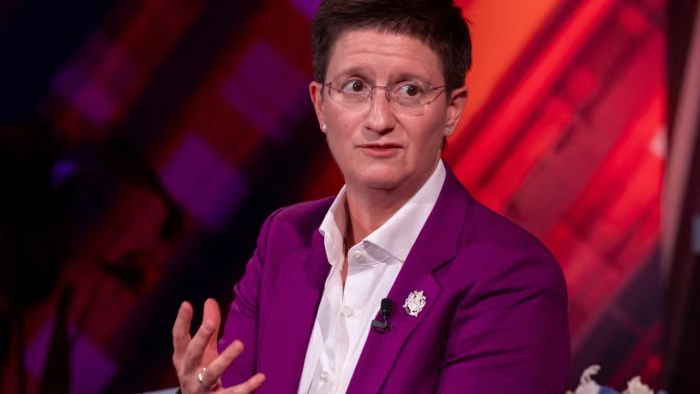
The chief executive of the London Stock Exchange said that UK companies are now more “forceful” about rewarding top executives to attract top talent, noting that pay packets do not need to be “Elon Musk-style”.
Dame Julia Hoggett told the FT’s Future of Asset Management Europe conference that boards have been firmer in ensuring executives are paid competitive packages, noting that in the past few years the UK has undergone “a pretty significant shift” on this issue.
She said: “We have seen [remuneration committee] chairs be much more forceful about saying: ‘OK if I am competing on a global basis for talent and my [competitors] are US companies or Asian companies [ . . . ] then I need to know I can attract the top talent to drive growth here,’ and they have been backed by shareholders to do so.”
The pay packages of chief executives at the UK’s biggest listed companies grew faster in the last financial year than those of American rivals. Median pay at FTSE 100 companies increased 11 per cent to $6.5mn, compared with a 7.5 per cent increase for US chief executives, according to data from Institutional Shareholder Services, a proxy adviser. Still, the US median pay figure of $16mn dwarfs that of the UK.
UK corporate governance guidelines require companies to engage with shareholders if they do not gain more than 80 per cent of investor support for company resolutions, such as executive pay increases, at annual meetings. But this has created a sort of “naughty step”, Hoggett said, by leaving these companies feeling as though they were outliers.
“If one of your children is on the naughty step it is a naughty step, but if all of your children are on the naughty step it is a play date,” she said. “It changes the mindset about the approach,” she added, referring to the notion of more companies engaging with shareholders on higher pay.
“But we have seen a pretty significant shift . . . we are not talking about Elon Musk-style pay packages here. We are talking about being able to attract and make sure we can win in the war for talent so that our companies can have the best leadership to drive the best shareholder value.”
Tesla shareholders voted in November to approve a $1tn pay packet for its CEO Musk if he hits ambitious performance targets at the electric-vehicle maker.
London Stock Exchange Group, which owns the LSE, itself suffered a significant revolt over the planned £7.8mn pay of its CEO, David Schwimmer, with 30 per cent of shareholders voting against it in May.
Hoggett’s comments come as global exchanges grapple with the broader decline of public markets, with fewer initial public offerings in recent years. Fundraising through IPOs in London slumped to a 30-year low in the first half of the year, with just five listings in the UK raising £160mn. The LSE has also had a defection of companies to the US.
“We remain the largest exchange in Europe . . . we’ve had an increasing amount of IPOs in the pipeline,” she said.
“Aim [the Alternative Investment Market] is the largest growth market in Europe by a country mile and is vying between Shenzhen and TSX for the biggest growth market in the world this year . . . so if you actually look at what London’s got, it’s got a huge amount of strengths.”
She added: “The UK has actually gone through the biggest reform agenda of its capital markets in any major market over the course of the last three years.”
Chancellor Rachel Reeves introduced a three-year stamp duty holiday on shares for new London listings in Wednesday’s Budget in an attempt to stimulate the UK’s capital markets.













Leave a comment