
One Government insider said ‘accurate water figures have historically been very hard to get from facilities of any size’
Tech firms are failing to tell the Government how much water they use in their data centres, as concerns grow that the UK does not have enough water to meet its needs.
Experts are calling on the Government to introduce tighter regulations on data centres amid warnings that new power and water-intensive supercomputers could be built in areas vulnerable to drought.
Campaigners have raised concerns that the Government is “too close” to tech lobbyists and is failing to fully consider the impact a data centre boom could have on the UK’s natural resources.
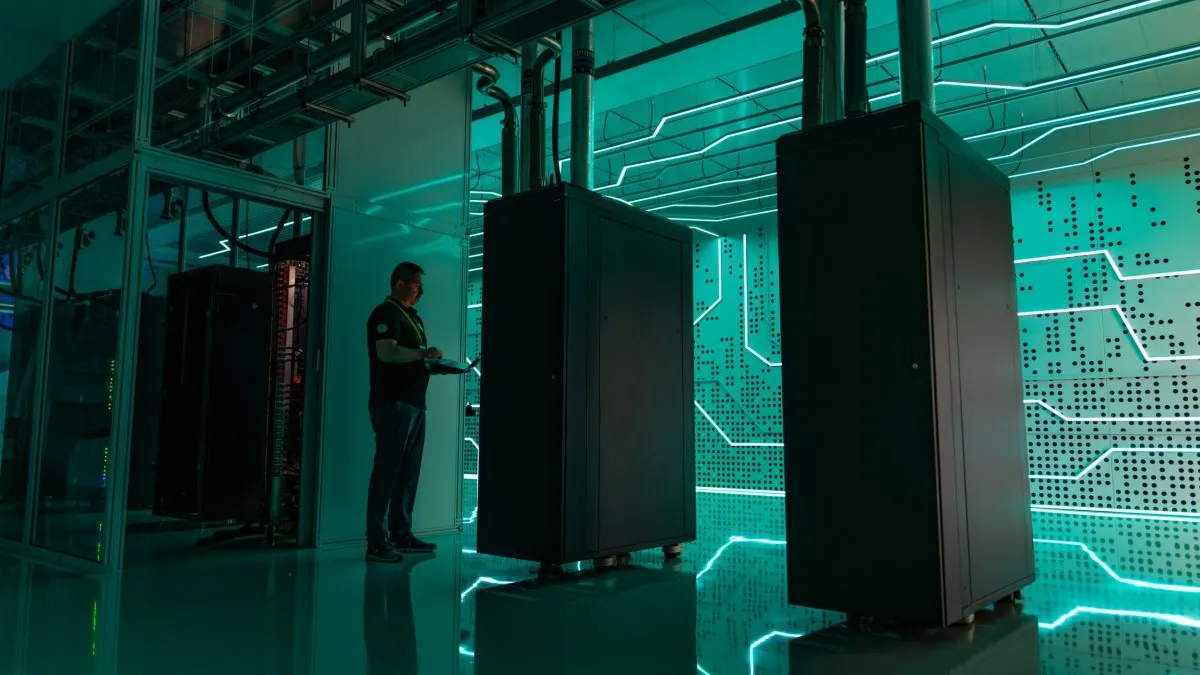
Data centres are vast warehouses used to store the servers that power the internet. There are currently around 500 data centres in the UK, but this number is expected to grow by 20 per cent over the next five years to meet the computational power demands of AI.
Environment Agency cannot get figures
Labour has been wooing big tech firms to base their infrastructure in the UK as part of its growth agenda; however, experts have been sounding the alarm about the vast amounts of power and water many data centres need.
The Environment Agency (EA) has been attempting to quantify the amount of water data centres in the UK are using, but has struggled to access the information from tech firms.
This summer, the EA worked with industry body Tech UK to assess water use by data centres via a voluntary survey, but the majority of tech firms failed to respond.
One Government insider told The i Paper that “accurate water figures have historically been very hard to get from facilities of any size… it’s not been something that has been given the attention it deserves”.

Many data centres use vast amounts of water to cool their servers, which generate a lot of heat. Thames Water has said a large data centre can use between 4 and 19 million litres of water per day, equivalent to the daily demand of 50,000 households.
Not all data centres use water for cooling; however, waterless cooling systems tend to use more electricity.
This summer, the regulator published a long-term framework of England and Wales’ future water needs and warned there could be a 5 billion litre a day shortfall by 2055 due to the impact of climate change and population growth.
This framework is being used by water companies and policymakers to model future water supply projects; however, the modelling is incomplete as it does not include an estimate of how much water data centres will need, as the EA could not obtain this information.
The EA said at the time it was “working with key representative bodies to collect data from the sector to increase our understanding of their current and future needs”, but was “experiencing barriers in gaining information about water consumption”.
“Other sectors who are working with data centres have reported the same issues,” the regulator added.
Concerns EA is ‘too close’ to industry
Since publishing the framework in June, the EA has worked with industry body Tech UK to survey its members on water use.
The results were published by Tech UK in August with the headline findings that 51 per cent of data centres use waterless cooling systems and 64 per cent use “less than a typical leisure centre”.
Tech UK said these findings “challenge assumptions that data centres are inherently water-intensive”.
However, the survey was self-selecting and only covered 73 of the roughly 500 data centres in the UK.
Tech UK refused to tell The i Paper how many of its 90 members working in the data centre sector responded to the survey, but has publicly acknowledged the research has “limitations” and was not independently assessed.
Donald Campbell, director of advocacy at tech campaign group Foxglove, said it was a “huge concern” if this survey is all that the EA has been able to obtain on data centre water use.
“It’s a report that’s done by the lobby organisation for the tech industry, so it’s hardly something unbiased and impartial,” he said.
It is understood that the EA is using the survey to aid its modelling, but believes further research is needed to fully understand the scale of the issue.
The Prime Minister has promoted AI as a key tenet of his Government’s plans to grow the economy and recently attracted investments from tech giants including Google and Microsoft as part of a £31bn UK-US “Tech Prosperity” deal.
Campbell said there were concerns about the current Government being “too close to the industry on this”.
“It’s particularly worrying if the Environment Agency, as a regulator, is in that position. They should be in a position where they can require the industry, I would assume, to turn over this stuff and to provide something a bit more comprehensive and a bit more solid than this,” he said.

Calls for tougher regulations
Experts across industries have been calling on the Government to introduce and enforce an environmental reporting system for data centre owners. The EU has already introduced regulations that require data centres to report on their water consumption.
Earlier this year, the Royal Academy of Engineering published a report calling on ministers to make reporting on energy consumption, water consumption, water resources and carbon emissions mandatory.
Alex Smyth, head of policy, infrastructures and resilience at the Royal Academy of Engineering, said this data is essential as the Government looks to create “AI growth zones” across the UK where new “hyperscale” data centres will be located.
She said data must be used to inform “decisions of where you want to site a data centre as parts of the UK head towards water scarcity”.
The Government Digital Sustainability Alliance (GDSA), which advises ministers on sustainable tech, recently warned of a “fundamental flaw in the current development trajectory” of the data centre industry, which it said “ prioritises scale over sustainability”.
It raised concerns that Culham in Oxfordshire has been chosen as the UK’s first “AI growth zone” despite being classed as an area under “serious water stress” by Thames Water.
“The siting of water-intensive infrastructure in already water-stressed areas, particularly those with existing socio-economic vulnerabilities, raises significant environmental justice concerns,” the GDSA said.
Your next read

Matthew Evans, chief operating officer and director of Markets at Tech UK, said: “Data centres are the backbone of the UK’s digital economy and will be central to delivering our AI and innovation ambitions.”
“But as demand for computing grows, we must plan ahead. We need smart policies, resilient infrastructure and stronger data to ensure digital and environmental resilience go hand in hand,” he added.
An EA spokesperson said: “The environment and sustainable development go hand in hand and we will play our part to help unlock growth.
“We are working with the technology sector to understand their water needs as well as methods to report water use and drive down consumption.”















Leave a comment