
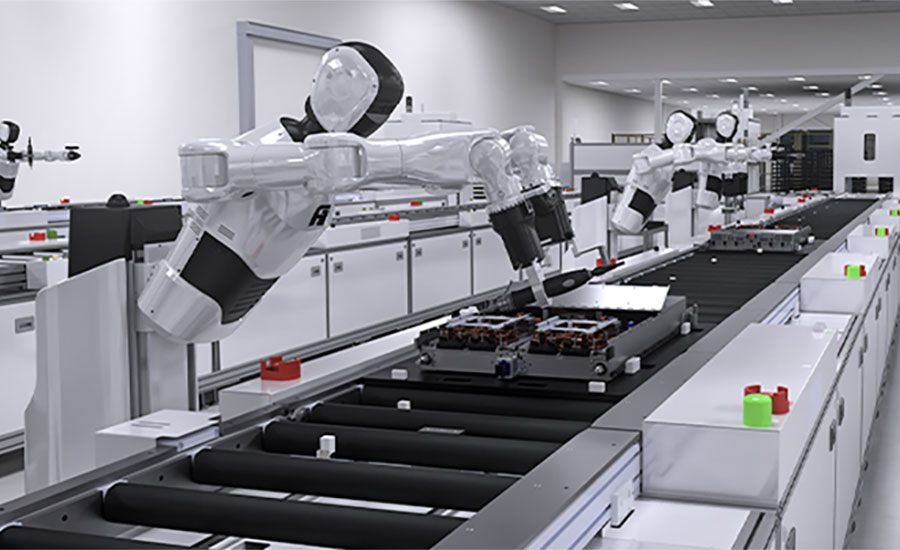
NEW YORK—The integration of artificial intelligence into robotics is poised for significant expansion in the near future, according to a new report by ABI Research. “The Landscape of AI in Industrial and Collaborative Robotics” reveals that AI-augmented machines have already achieved the technological maturity required for widespread adoption.
This pivotal moment means that factory robots will soon be tackling complex, dynamic and dexterous tasks previously unattainable with traditional automation.
“For years, the robotics industry has grappled with the ‘sim-to-real’ gap and the over-promising of nascent AI,” says George Chowdhury, senior analyst at ABI Research. “Our deep dive into the technology’s readiness confirms that robust algorithms, particularly in Dynamic Policy Adjustment (DPA) and emerging Robotics Foundation Models, are now capable of delivering on the promise of true adaptive automation.
“This isn’t about incremental improvements; it’s a paradigm shift where robots can finally adapt to the unpredictable real world, moving beyond rigid programming to genuinely intelligent, adaptive execution,” claims Chowdhury.
While existing static manufacturing processes continue to be served by traditional robotics, Chowdhury believes that the significant growth potential lies in under-automated markets and workflows requiring sophisticated, heterogeneous dexterous manipulation. This includes specialized sectors where the ability to handle variability is paramount. Potential applications range from niche high-value manufacturing applications, such as semiconductor production, to life sciences, logistics and warehousing.
According to Chowdhury, key advancements reshaping robotics include reinforcement learning, robot foundation models, large language model (LLM) interfaces for human-robot interaction (HRI), new SLAM and world models, agentic AI, DPA platforms, and machine vision algorithms. The ABI Research report assesses the maturity of these technologies and identifies leading innovators driving progress in each area.
Companies advancing adaptive automation and DPA include T-Robotics, Apera, Cambrian AI, InBolt, Nvidia, Robovision, Summer Robotics and V-SIM.
Looking for quick answers on assembly and manufacturing topics?
Try Ask ASM, our new smart AI search tool.
In machine vision hardware and vertical AI-robotics, Chowdhury says notable players include Augmentus, Basler, Cognex, Intel RealSense, Mech-Mind, Nikon, OnRobot, SICK, Solomon3D, Universal Robots and Zebra.
“Additionally, new robotics foundation models from Covariant, Dexterity, Field AI, Google DeepMind, Intrinsic, Meta, Physical Intelligence and Skild AI signal a shift toward more capable and adaptable autonomous systems,” claims Chowdhury.
“The critical challenge now is translating this technical readiness into widespread commercial adoption,” explains Chowdhury. “Vendors must prioritize usability, transparency and clear ROI metrics to overcome economic uncertainty and market skepticism.”












Leave a comment