
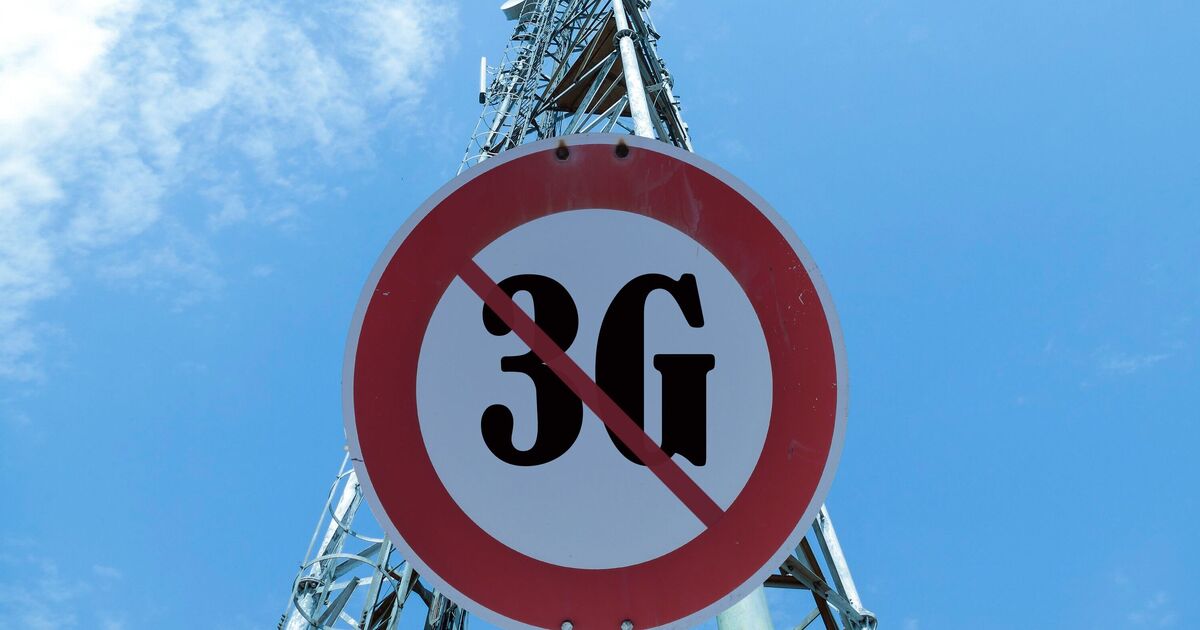
Older generations most unaware of the latest technology trends might be “very lost” if they suddenly lose phone access to their loved ones, a phone company CEO has warned. This comes as a small number of O2 customers will need to upgrade their tech to avoid losing access to mobile internet. O2, now part of Virgin Media O2, has anounced the imminent shutdown of its 3G services in 2026. The UK’s largest mobile operator claimed that 3G has become a “relic of a bygone era”, but it will continue to operate its 4G and 5G services.
Steve Athwal, CEO and Founder at The Big Phone Store, said: “When O2 turns off 3G, phones relying on it will lose mobile data as there’s no fallback for data once 3G is disabled. If the phone supports 2G, which should be around for another 5-ish years after 3G decommission, calls and texts should still go through. Anything that needs an internet connection including WhatsApp,maps, email, banking apps, and even app updates will not load.”
The change will only affect customers with an older phone using 3G-only devices. Only 2% of O2’s mobile data usage is 3G, which no longer meets the demands of modern technology. Users with these devices will have already received messages outlining upgrade options. Delays in switching to a newer device with 4G and 5G technology could leave customers without web services.
According to Mr Athwal, the risk only applies to a few models manufactures before 4G was the standard, like the Nokia classic, the Samsung early-Galaxy, and the iPhone 4 and earlier.
He said: “These phones rely on 3G for both Data and calling functionality. If a handset does not clearly mention anything about 4G of LTE in the settings or specifications, I would argue that this and similar models will most probably get retired with 3G.
“Your phone’s mobile network status can be verified quickest by switching mobile data on, and viewing the signal at the top. If you ever see 4G LTE, your phone is fine. If you only see 3G, E, or nothing, then the phone probably isn’t future-proof. You can also verify with the network provider and a quick online search of the model will confirm or a local phone shop.”
According to Ofcom’s latest Connected Nations report, there are still around two million direct customer devices reliant on 2G/3G networks, most of which are “residential devices”, such as mobile handsets. The regulator stated that the 3G switch-off appears to have gone “relatively smoothly” to date, without significant disruption related to the switch-off reported. There were also “very few complaints” from customers about the 3G switch-off.
Jeanie York, Virgin Media O2’s Chief Technology Officer, said: “We’re now more connected than ever before thanks to the significant investments made by mobile network operators like Virgin Media O2 in faster, more reliable 4G and 5G networks.
“It’s therefore not a surprise that 3G is increasingly a relic of a bygone era. It was built to support basic web browsing – not to power the high bandwidth activities like zoom calls, video streaming or browsing pictures on social media that people increasingly expect to do seamlessly on the go.
“Today the 3G network accounts for less than 2% of mobile data usage on our network. It was against this backdrop of declining usage that the industry and government agreed in 2021 that 3G networks would be withdrawn, allowing mobile spectrum to be reallocated to 4G and 5G services that give customers a better overall experience.”
3G (Third Generation) is an older mobile network technology that brought faster mobile internet. It was preceded by 2G, which primarily focused on voice calls and text messaging and offered only very limited data capabilities.
Mobile internet works by sending and receiving signals through cell towers using radio waves, letting you stay online while moving around. Unlike Wi-Fi, which only works near a router, mobile networks cover large areas, and some connections in remote places can be linked via satellites in space to carry data over long distances.
The arrival of 3G first brought reliable mobile internet to users in the early 2000s. It was followed by 4G, rolled out widely from the late 2000s.
This marked a major leap forward, powering smartphones, social media and high-quality video streaming. The latest step, 5G, which began appearing in the UK in 2019, came with even faster speeds, minimal delays and the capacity to handle millions of connected devices














Leave a comment