
January 12 – From bioacoustics capturing the sounds of the jungle, to myriad satellites sending images back from space, there is now a vast amount of environmental data that businesses can access as they seek to get to grips with their nature impacts.
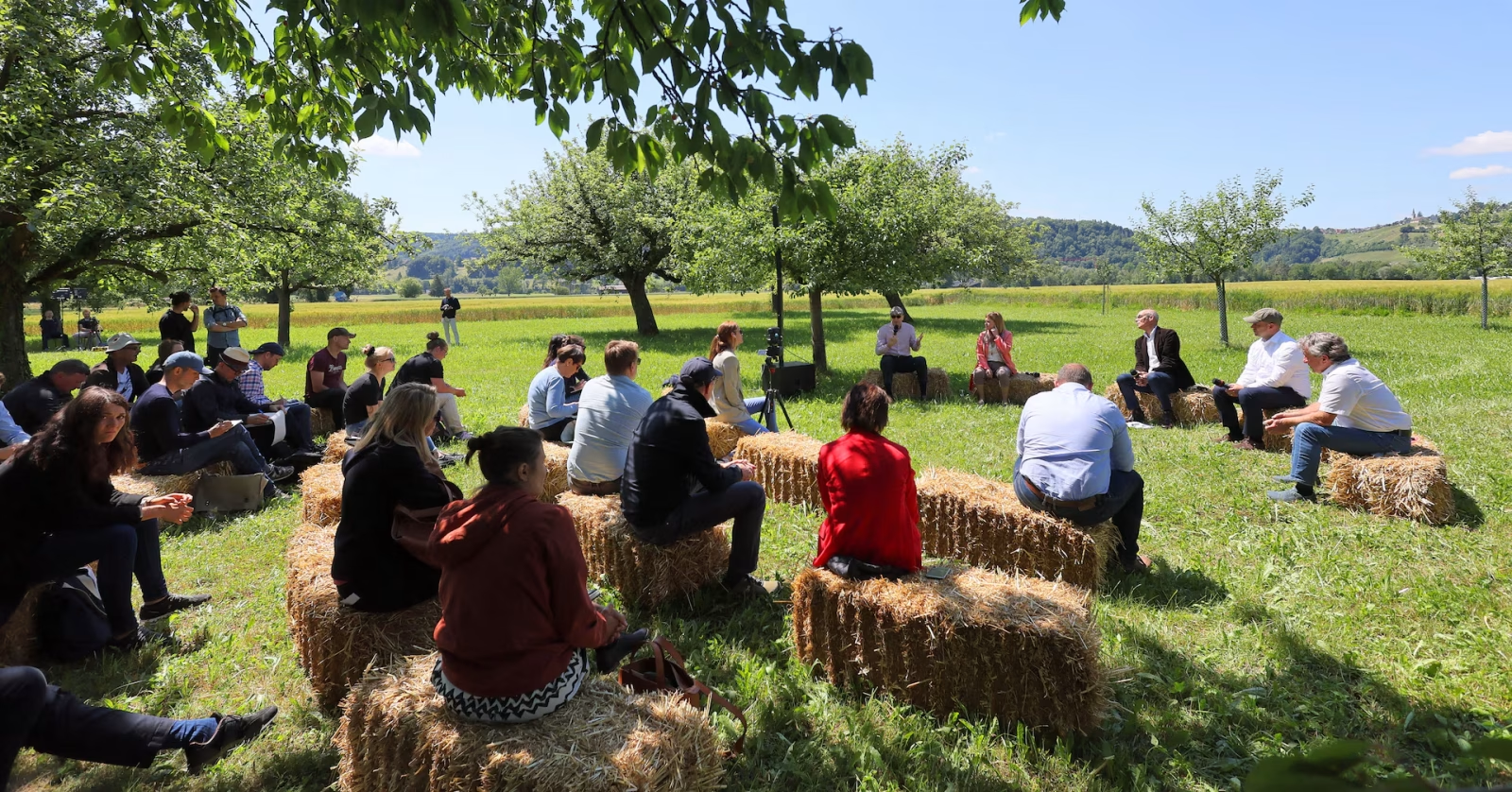
Speaking at a recent conference, Drew Purves, head of nature at Google DeepMind, explained: “We’re carrying out experiments now with 100 million times more data than we were 20 years ago.”
This is far too much information for the human brain to comprehend, he continued, but “one of the areas where this recent AI revolution really excels … is extracting salient signals from a huge, complex datasets”.
This is something that businesses are increasingly being asked to do so. The EU’s Corporate Sustainability Reporting Directive (CSRD) has made double materiality assessments, which look at business’s risks and opportunities from both a financial and non-financial perspective, mandatory, meaning that many companies must now report on their nature impacts for the first time.
Other legislation will appear as governments develop national biodiversity strategies and action plans (NBSAPs), which often include an onus on businesses to monitor and address their impacts on nature. In England, Biodiversity Net Gain (BNG) requires any development to improve nature by at least 10%.
These developments have given rise to a host of AI-enabled tools to allow companies to measure, monitor and report on their nature impacts.

David Craig, co-chair of TNFD, says there has been “a maturing of these technologies” in recent years, particularly in their use of AI to simplify data collection and carry out labour-intensive assessments.
He says AI can bring more dynamism to sustainability reporting by moving away from a reliance on retrospective data to real-time insights. It can create models that predict weather patterns, hydrological changes and even soil health, and help to detect patterns and create a “before” and “after” vision of a degraded and restored landscapes.
“Part of the power of AI is it looks at models from the past to tell you what’s going to happen in the future,” says Craig, allowing companies to gauge how future actions and interventions will impact nature.
From this year, for example, landowners will be able to access the new EU Soil Health Data Cube, a layered map that integrates hundreds of thousands of observations and datapoints on soil, climate and vegetation. It will allow farmers to explore historical and future patterns of soil health based on different climatic and land-use scenarios.
But a starting point for many businesses is to assess the biodiversity that already exists in and around their operations, Craig says. The Natural History Museum has developed the Biodiversity Intactness Index (BII), which benchmarks sites against data from the 1800s, and can tell companies the current biodiversity intactness, versus when it was pristine.
Geoverse is a similar platform operated by NatureAlpha, which analyses 8.5 million locations across the world, using geospatial layers to assess the state of nature and biodiversity, in full alignment with TNFD’s framework.
An updated version of the platform last year uses large language models to extract data from company reports and disclosures, producing 130 million monthly data points – growing to 300 million by the end of 2025.

NatureMetrics, a company well known for its use of eDNA to monitor biodiversity, has recently launched an AI-powered tool, Portfolio Assessment. It allows companies to look at their nature-related risks across multiple sites, including those in the supply chain, pulling the information together into a single dashboard, and allowing directors to look at their business through a nature lens.
Akta Somalya, chief product officer at NatureMetrics, says the tool combines eDNA monitoring, camera traps and bioacoustics, along with geospatial data layers, using AI models to analyse the data. The system shows trends across the landscape, such as potential threat to habitats, and whether any rare, protected species live there.
“It gives you a richer story and a richer understanding of what’s actually happening on the ground,” he explains, and allows organisations to pinpoint their highest-risk locations and direct resources to them.
The company is also using generative AI to analyse the impacts of future natural scenarios on its operations.
Colorado-based Boulder Imaging is working with renewable energy companies across 12 countries, including several in Europe, to meet stringent requirements set out by environmental impact assessments (EIAs).
The company’s IdentiFlight system is deployed close to wind farms, and uses AI and optical sensors to identify and track birds up to 2km away, assessing their flight paths and temporarily shutting down turbines when they predict a collision. The company’s figures point to an 85% reduction in bird fatalities, and a loss of less than 1% in power generation.

In the U.S., AI is helping to protect pollinators and safeguard the hugely lucrative crops that rely on them, such as Californian $2.6 billion annual almond harvest.
The tech company Beewise has over 300,000 specialised hives in fields across the U.S. A robotic arm and a high-tech camera monitors the hive’s health, providing a constant real time stream of information. This huge amount of data is then analysed by AI, which can spot signs of possible hive die-off, such as a lack of new larvae or the presence of mites, and alert beekeepers so they can take action.
Goggle DeepMind’s Purves says algorithms and data centres are becoming more efficient in an effort to address this, and Google has also developed tools that allow companies to estimate and manage the energy implications of their AI use.
But he also suggests that we need to look at the way AI uses resources in the same way that we accept that conservationists will need to travel by airplane and use four-wheel drive vehicles during the course of their work. “The material and energy implications are more than outweighed by the good,” he said.
Opinions expressed are those of the author. They do not reflect the views of Reuters News, which, under the Trust Principles, is committed to integrity, independence, and freedom from bias. Ethical Corporation Magazine, a part of Reuters Professional, is owned by Thomson Reuters and operates independently of Reuters News.














Leave a comment