
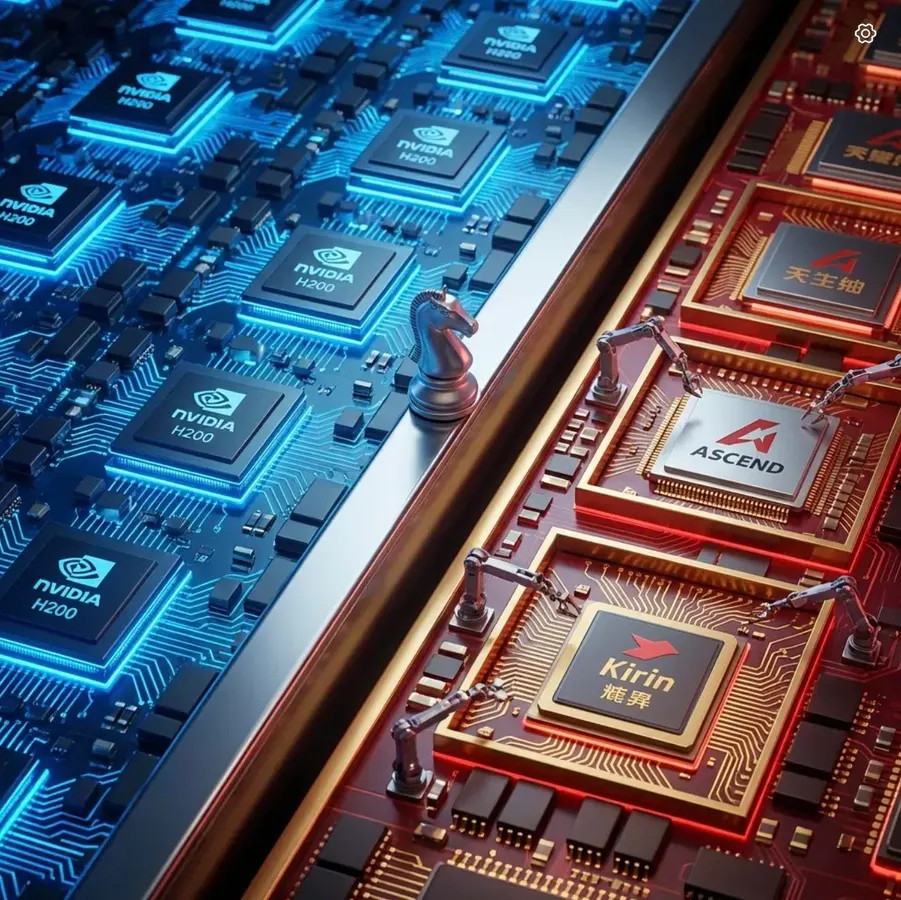

An AI generated image of chips from leading manufacturers in the United States and China
image generated by Pressmaster.ai
When Beijing asked Chinese tech firms to halt orders of NVIDIA’s H200 chips earlier this month, it appeared to signal China’s commitment to semiconductor independence. In a reversal of that decision, Chinese officials have now granted in-principle approval for Alibaba, Tencent, and ByteDance to prepare orders for the advanced AI chips.
The rapid reversal reveals a strategic tension at the heart of China’s semiconductor ambitions: while Beijing pursues long-term independence from American chip technology, near-term competitive pressures require access to the world’s most advanced products to remain competitive.
The Pragmatic Reversal
Regulators have recently granted approval for China’s largest tech firms to move to the next stage of preparations for H200 purchases, according to reports. The companies can now discuss specifics such as order quantities, though Beijing will encourage them to buy a certain amount of domestic chips as a condition for approval. No exact number has been set.
Chinese tech firms had previously indicated interest in ordering more than 2 million H200 chips for 2026 delivery, with Alibaba and ByteDance each seeking over 200,000 units. Companies were prepared to pay a 25% tariff imposed by President Trump to access the chips before the initial halt.
The decision to allow imports demonstrates what industry analysts describe as a calculated acknowledgment: China’s domestic chip capabilities cannot yet match H200 performance for the AI applications driving global competition.
The Performance Gap
The H200 represents a critical capability gap that Chinese chipmakers have yet to close. While Huawei’s Ascend processors and other domestic alternatives have made significant progress, it appears that perhaps they’re currently unable to match the performance levels required cutting-edge AI models at scale.
This performance gap has strategic implications. Chinese tech giants from Alibaba to Tencent are spending billions of dollars building data centers to develop and operate AI services. DeepSeek and other prominent Chinese AI startups are rapidly upgrading their models to compete with OpenAI and other US rivals—work that currently requires access to the most advanced hardware available.
The H200 is the predecessor to NVIDIA’s current flagship Blackwell chips and the upcoming Vera Rubin. While it represents older-generation technology by American standards, it remains significantly more powerful than currently available Chinese alternatives for AI training and inference workloads.
The H20 Precedent
The H200 approval comes after a troubled experience with NVIDIA’s H20 chip, a less powerful processor previously allowed for export to China. Chinese state media criticized the H20 for lacking technological prowess and being environmentally unfriendly, with regulators eventually halting imports over security concerns.
The negative reception to the H20 highlighted a challenge for both Beijing and Chinese tech companies: chips that are significantly downgraded from cutting-edge performance may not meet competitive requirements, forcing China to choose between accepting performance limitations or allowing imports of more capable hardware.
The Long-Term Independence Push
Despite the reversal, China’s commitment to semiconductor self-sufficiency remains clear. China’s third National IC Industry Investment Fund has committed over $47 billion for semiconductor development. Huawei’s investment arm, Hubble, now oversees operations at more than 60 semiconductor companies, building what amounts to a parallel AI software ecosystem independent of U.S. vendors.
However, the truth is that Chinese teams have operated with heterogeneous infrastructure for quite some time. That means rather than relying on best-in-class, uniform chip infrastructure as many American developers are able to do, Chinese teams that want to compete have had to build systems that combine the best of what they have available.
This means developing software that runs efficiently across multiple chip types out of necessity. When domestic chips close the performance gap, these teams will already have years of experience with flexible, optimized architectures. This approach that could prove valuable once domestic chips reach competitive performance levels.
The Strategic Signal
Industry observers interpret the halt-and-reversal sequence as a negotiating tactic that sent multiple signals. The initial pause demonstrated Beijing’s willingness to prioritize long-term strategic goals over short-term business needs. The reversal acknowledged current competitive realities while maintaining pressure on domestic chip development.
Beijing plans to approve H200 imports as soon as this quarter, though they would be barred from sensitive government agencies and critical infrastructure. This selective approach allows Chinese tech companies to access advanced chips while maintaining control over their use in security-sensitive applications.
The requirement that companies also purchase domestic chips as a condition for H200 approval reinforces this dual strategy: meeting immediate performance needs while supporting long-term independence efforts.
The Two-Track Future
The approval marks a significant development for NVIDIA, which has sought to resume business with the world’s largest semiconductor market. CEO Jensen Huang noted earlier this month that demand for H200 chips was strong from Chinese companies, though he indicated the company hadn’t spoken directly to Beijing about approval.
NVIDIA reported losing $2.5 billion in revenue from China during its fiscal first quarter, with projections of an additional $8 billion loss in the second quarter. The company’s share of China’s advanced AI accelerator market has collapsed from approximately 95% to nearly zero. That revenue historically funded the R&D that maintained NVIDIA’s technological edge.
License applications have been submitted to the U.S. government, with final approval details being finalized, according to industry reports.
The semiconductor restrictions are creating what industry observers describe as a two-track AI ecosystem. NVIDIA dominates one track with cutting-edge GPUs and a global network of developers and researchers. China builds a parallel infrastructure emphasizing independence and resilience, accepting near-term performance compromises for long-term strategic autonomy.
The outcome of this race will depend on how quickly Chinese chipmakers can close the performance gap with leading American semiconductors, and whether that timeline allows Chinese AI companies to remain competitive in global markets during the transition.
As both countries invest heavily in semiconductor capabilities, the temporary nature of China’s H200 approval underscores a broader reality: the push for technological independence continues even as competitive pressures require pragmatic compromises.













Leave a comment