
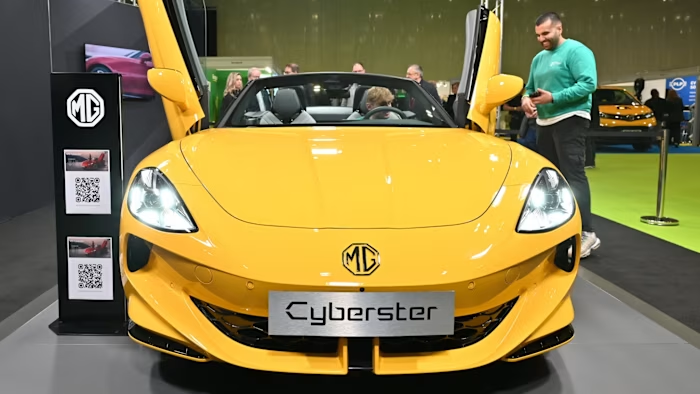
Founded in Oxford more than a century ago, MG won fans from Elvis Presley to King Charles, but by the 2000s the British marque’s fortunes were in decline with the eventual collapse of the MG Rover Group.
The brand was acquired in 2005 by Nanjing Automobile Corporation, which later merged with Chinese state-owned SAIC, and gradually shifted production from Longbridge in the UK to China.
Since then, it has undergone a revival. British drivers snapped up so many of MG’s vehicles last year that its stock ran out, cementing its position as the only Chinese-owned marque in the UK’s top 10 best-selling brands.
“We’ve actually run out of cars. I’ve never been in a situation like I am today,” said Guy Pigounakis, MG’s commercial director in the UK.

Under the ownership of Shanghai-based SAIC, the brand is now one of a growing number of Chinese carmakers that have proved popular in the UK, winning market share from established rivals.
Under a strategy put in place five years ago, it refreshed its model range and boosted its UK dealership network, a move that has been emulated by newer Chinese entrants including BYD and Chery, the owner of Omoda and Jaecoo.
In 2015, MG sold just 3,100 cars in the UK, but sales have since rocketed to more than 85,000 last year, according to the Society of Motor Manufacturers and Traders.
The marque has held the 10th-largest share of the UK market over the past few years, ahead of brands including Vauxhall, Honda and Renault, while its HS sport utility vehicle was the UK’s eighth best-selling model in 2025.
The company had underestimated demand for its affordable small cars in 2025 and was forced to cut back sales by several thousand units due to a lack of vehicles being shipped from its factories in China.
Including MG and BYD, Chinese brands sold close to 200,000 new cars in Britain last year, more than double the total in 2024, after higher EU tariffs on Chinese-built electric vehicles prompted manufacturers to pay more attention to the UK market.
“They’ve stolen a march on the rest of the market in a way we’ve never seen in the history of automotive,” said Ian Plummer, chief commercial officer at online marketplace Auto Trader.

Relocating production to China cut costs, but MG’s designs lacked pizzazz. Under Pigounakis, who previously worked for MG Rover and South Korea’s Hyundai, the company strived to combine the benefits of its owner’s financial, manufacturing and technology resources with its British heritage.
One former employee said: “People weren’t very positive about the brand — but I think they’ve managed to put themselves on the map again.”
MG’s cars have come to appeal to buyers because of their affordability and wide choice of petrol, hybrid and electric versions, while the quintessentially British brand is uniquely positioned with an extra advantage of being instantly recognisable to consumers in the UK.
Pigounakis said MG’s UK revival started gathering pace five years ago under the new model range and push to widen its dealership network to cover 90 per cent of the country.
As legacy carmakers pulled out of dealerships after the Covid-19 pandemic and followed Tesla’s model of selling directly to consumers, MG doubled down and filled the vacant spaces, drawing on its heritage to woo car dealers. “Everybody at one stage had MGs. We were re-establishing historic relationships with the brand,” Pigounakis said.
The company paired its expanding dealership network with new affordable vehicles that won over drivers. The petrol ZS started at about £15,000 and became a UK bestseller in 2021.
The MG4, released the following year with a starting price of £26,000, became the first EV to achieve “genuine price parity” with its petrol equivalent, according to Pigounakis.
In Europe, despite Brussels slapping the company with tariffs of 45 per cent, MG sales also rose nearly 40 per cent in the 11 months to November, according to European trade body Acea.

In a bid to further boost its UK market share, MG will expand its line-up to include smaller and larger SUVs and aims to sell more EVs to fleet buyers.
Sales are also rising in South America and other emerging markets such as India and MG planned to open more factories worldwide, Pigounakis added.
“The only way we can get round [the tariffs] . . . I guess is by . . . having a facility to manufacture cars in Europe at some point,” he said, noting also the current limits to responding to sudden increases in demand with only vehicle shipments from China.
While MG remains ahead for now, analysts also note the rapid expansion of other newer entrants from China, with BYD grabbing a 2.5 per cent share in the UK last year and the Chery group taking 2.7 per cent.
Pigounakis said western carmakers were now struggling with the competition posed by Chinese and other new entrants because they wrongly assumed that “brand was everything”.
“There was a lot of complacency in the industry,” he said, recalling a meeting he had held with UK car executives in 2000, “when we dismissed collectively both the Koreans and the Chinese as being irrelevant. I think now globally, people are looking for technology, they’re looking for value for money.”















Leave a comment