
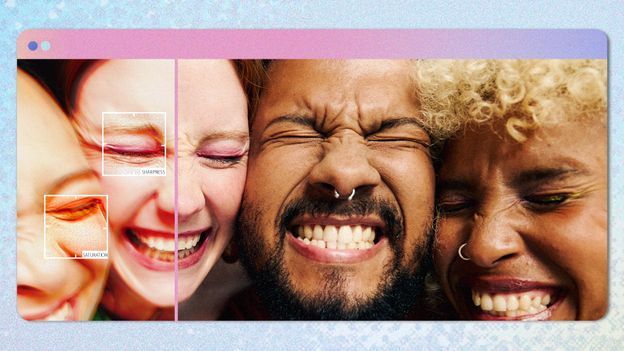
“Aesthetic refinement is not new,” says Manovich. “Retouching photographs has been a major part of photography since the 1850s and it was somewhat similar to what people are doing today, basically beautifying the face, making skin more even. But things like automatically adding new detail, which was just not there in the scene, I feel like that’s radically new… In some ways, it’s still photography. In some ways, it’s something else.”
This isn’t just a philosophical issue. Research suggests AI-edited photos and videos can plant false memories or change how we think feel our own bodies.
Even American manufacturers have introduced features that represent remarkable trends in AI photography. Google Pixel phones, for example, have a feature called Best Take. We’ve all taken a group photo where someone closed their eyes or forgot to smile. (It’s usually me, I never learned to pose.) With Google’s Best Take, you take multiple pictures and then select the prettiest faces from different shots for one final image.
It may be a nice picture, but it’s a photo of a moment that never happened. On the other hand, “that’s probably how you want to remember this moment”, says Mantiuk. After all, it’s a group photo, he says, not evidence for a crime.
“Authenticity has always been a core principle in how we develop Pixel Camera,” a Google spokesperson says. “Ultimately, we’re a team of passionate photographers. We focus on making possible what people – including us – have always wanted to do with mobile cameras.”
How to see the ‘raw’ photo
You can deactivate HDR if you don’t like it, disable beauty filters and turn off Samsung’s Scene Optimizer setting if you want real (but less beautiful) Moon photos. But if you want the pure image coming straight off the camera sensors, completely untouched by all the different forms of AI, you have to take extra steps.
The Pro Mode setting on newer Samsung phones shoots completely unvarnished photos. Despite the name, the iPhone’s ProRAW features (only available on Pro models) includes some AI processing. For truly raw iPhone photos, you need special settings in a third-party app. Some popular free options include VSCO Capture and Adobe Lightroom.
More like this
• The number one sign you’re watching an AI video
• Is it finally safe to ditch your phone case?
• The ‘blackhole’ that erased your early 2000s photos
What you get won’t be pretty in a traditional sense. It’s not that anyone’s trying to hide raw images, they’re just not as useful for most normal people (though professional photographers use them). There will be a tonne of noise, colours may not look right, it will be softer and out of focus. But raw photos do have a “bad in a retro way” feeling, if that’s your thing.
Still, Manovich is among those who believe a little raw photography is worth your time. “Just to understand what your phone normally does and for the purpose of having a clearer consciousness of what exactly your photos are and what they represent,” says Manovich.
—
For more technology news and insights, sign up to our Tech Decoded newsletter, while The Essential List delivers a handpicked selection of features and insights to your inbox twice a week.
For more science, technology, environment and health stories from the BBC, follow us on Facebook and Instagram.













Leave a comment