Expanding Regional Trade, Tech-driven Logistics, and Digital Market Platforms Further Bolster Growth Potential
February 8, 20266 Mins read216
Share
Company Logo
Key market opportunities in the agricultural commodity sector include leveraging technology for enhanced efficiency, adapting to climate and geopolitical shifts, and meeting evolving consumer demands for sustainably sourced products.
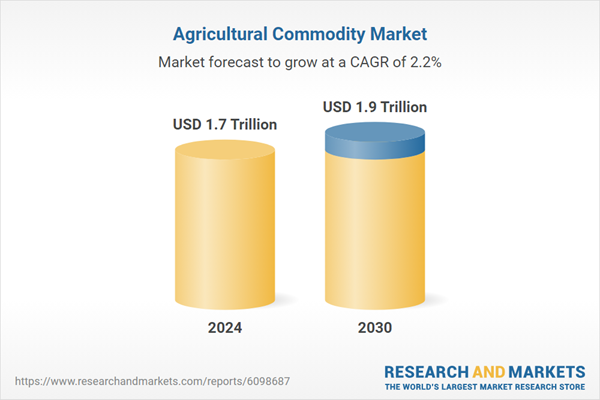
The global market for Agricultural Commodity was valued at US$1.7 Trillion in 2024 and is projected to reach US$1.9 Trillion by 2030, growing at a CAGR of 2.2% from 2024 to 2030. This comprehensive report provides an in-depth analysis of market trends, drivers, and forecasts, helping you make informed business decisions.
The global agricultural commodity market is navigating a complex interplay of structural shifts in trade policy, climate volatility, and geopolitical recalibrations that are redefining sourcing, pricing, and supply chain strategies. Trade disruptions arising from regional conflicts, protectionist export restrictions, and sanctions on key producers have caused commodity flows in grains, oilseeds, and pulses to shift dramatically.
Countries are increasingly prioritizing domestic food security over global trade fluidity, leading to rising instances of export bans, buffer stockpiling, and renegotiation of long-term agricultural supply contracts. In parallel, the rerouting of commodity shipments due to sanctions and freight instability has increased the market reliance on alternative suppliers, leading to volatility in benchmark pricing and disruptions in futures market predictability. Global trade institutions are under renewed pressure to recalibrate frameworks that promote resilience without distorting access for food-importing countries.
Furthermore, climate change is introducing systemic unpredictability in agricultural yields, especially in climate-sensitive regions such as South Asia, Sub-Saharan Africa, and parts of Latin America. Prolonged droughts, untimely floods, and erratic monsoons are not only reducing crop output but also forcing commodity traders and governments to revise their demand and pricing assumptions more frequently. These disruptions are reshaping seasonal trade flows, storage behavior, and import strategies.
In response, countries are diversifying their import portfolios and investing in regional food corridors to hedge against future climate-induced production risks. Moreover, the strategic importance of agricultural commodities in ensuring national food sovereignty is leading to enhanced diplomatic engagements over cross-border grain corridors, cold-chain connectivity, and access to agro-inputs like fertilizers and genetically resilient seeds. This environment is fostering the emergence of new regional commodity hubs and creating demand for real-time trade intelligence and predictive weather-linked procurement models.
How Is Technology Transforming Agricultural Commodity Production and Pricing?
Technology adoption in farming, logistics, and market access is transforming the core value chain of agricultural commodities, leading to higher transparency, efficiency, and traceability. Precision agriculture tools, including satellite monitoring, drone surveillance, and AI-driven crop health analytics, are helping producers improve yield predictability, optimize resource inputs, and reduce post-harvest losses. These digital insights are being fed into commodity pricing models, improving forecast accuracy and reducing speculation-driven price volatility.
Additionally, blockchain-led traceability is being introduced into commodity transactions, allowing downstream buyers to verify source authenticity, sustainability compliance, and fair trade standards – elements that are increasingly being rewarded with price premiums in developed consumer markets. Governments and commodity exchanges are also adopting digital platforms to modernize price discovery mechanisms, streamline procurement processes, and increase farmer participation in formal markets.
Which Consumer and Sustainability Trends Are Altering Commodity Demand Profiles?
Changing consumer preferences and regulatory frameworks around sustainability are reshaping demand trends across major agricultural commodities. In high-income markets, the rise of plant-based diets, clean-label products, and regenerative agriculture is shifting demand away from conventional bulk commodities toward sustainably sourced, identity-preserved grains, oilseeds, and legumes.
Organic, non-GMO, and climate-smart certification labels are increasingly influencing purchasing decisions, prompting upstream producers to modify crop selections and adopt environmentally resilient farming practices. These shifts are fueling demand for traceable commodities such as organic wheat, quinoa, and high-oleic oilseeds, as well as specialty legumes like lentils and chickpeas with defined nutritional profiles. Moreover, ethical sourcing and carbon footprint disclosures are gaining traction across food and beverage companies, encouraging vertical integration and direct grower engagement to ensure compliance and build brand trust.
Simultaneously, emerging markets are witnessing rising per capita consumption of protein-rich cereals and oilseeds due to population growth, urbanization, and changing dietary habits. This demand surge is placing upward pressure on feedstock commodities such as maize, soy, and rapeseed, intensifying competition between human consumption and livestock feed applications. In Asia and Africa, growing middle classes are driving demand for higher-value fruits, nuts, and pulses, prompting shifts in land use and export prioritization.
The Growth in the Agricultural Commodity Market Is Driven by Several Factors.
It is supported by expanding global food demand, rising population pressures, and heightened focus on food system resilience. One of the core growth drivers is the increasing consumption of cereals, pulses, oilseeds, and horticultural commodities in developing economies where rising incomes and urbanization are altering dietary compositions. Additionally, food security concerns are prompting governments to invest in strategic grain reserves, cross-border food corridors, and self-sufficiency programs – all of which are boosting trading volumes and regional commodity exchange activity. Climate-induced disruptions and yield variability are also driving speculative trading and futures contract volumes, further expanding market liquidity. The shift toward export diversification and regional sourcing strategies is creating new trade lanes and price benchmarks, unlocking demand for real-time analytics, hedging instruments, and integrated logistics platforms.
Consumer-driven sustainability mandates are contributing further to market expansion. Retailers and food processors are sourcing commodities with verifiable environmental and social credentials, which is fostering transparency across the entire agricultural value chain. Technological integration – from remote sensing in cultivation to digital clearinghouses in trading – is improving market efficiency and enabling micro-participation by smallholders and cooperatives.
Additionally, the growing relevance of agri-commodities in producing biofuels, bioplastics, and green chemicals is expanding the market’s industrial demand base. Institutional capital inflows into farmland investment, agri-fintech platforms, and commodity ETFs are also reinforcing structural growth. Taken together, these supply-side transformations, demand diversification trends, and digital infrastructure developments are steering the agricultural commodity market into a new phase of resilience, inclusivity, and cross-sectoral relevance.
Key Insights:
Market Growth: Understand the significant growth trajectory of the Cereals segment, which is expected to reach US$792 Billion by 2030 with a CAGR of a 2.8%. The Grains segment is also set to grow at 2% CAGR over the analysis period.
Regional Analysis: Gain insights into the U.S. market, valued at $452 Billion in 2024, and China, forecasted to grow at an impressive 4.4% CAGR to reach $360.7 Billion by 2030. Discover growth trends in other key regions, including Japan, Canada, Germany, and the Asia-Pacific.
Geographic Regions/Countries: World; United States; Canada; Japan; China; Europe (France; Germany; Italy; United Kingdom; Spain; Russia; and Rest of Europe); Asia-Pacific (Australia; India; South Korea; and Rest of Asia-Pacific); Latin America (Argentina; Brazil; Mexico; and Rest of Latin America); Middle East (Iran; Israel; Saudi Arabia; United Arab Emirates; and Rest of Middle East); and Africa.
Report Features:
Comprehensive Market Data: Independent analysis of annual sales and market forecasts in US$ Million from 2024 to 2030.
In-Depth Regional Analysis: Detailed insights into key markets, including the U.S., China, Japan, Canada, Europe, Asia-Pacific, Latin America, Middle East, and Africa.
Company Profiles: Coverage of players such as Airbus CyberSecurity, Astronautics Corporation of America, Atos SE, BAE Systems plc, Boeing Defense, Space & Security and more.
Complimentary Updates: Receive free report updates for one year to keep you informed of the latest market developments.
Key Attributes:
Report Attribute
Details
No. of Pages
380
Forecast Period
2024 – 2030
Estimated Market Value (USD) in 2024
$1.7 Trillion
Forecasted Market Value (USD) by 2030
$1.9 Trillion
Compound Annual Growth Rate
2.2%
Regions Covered
Global
MARKET OVERVIEW
Trade Shocks, Uncertainty, and the Structural Rewiring of the Global Economy
World Market Trajectories
Agricultural Commodity – Global Key Competitors Percentage Market Share in 2025 (E)
Competitive Market Presence – Strong/Active/Niche/Trivial for Players Worldwide in 2025 (E)
FOCUS ON SELECT PLAYERS
ADM (Archer Daniels Midland)
Agrex Inc.
Amaggi Group
Bunge Limited
Calaway Trading, Inc.
Cargill, Inc.
CHS Inc.
COFCO Corporation
CSC (Commodity Specialists Company)
ECOM Agroindustrial Corp. Ltd.
Gavilon Group, LLC
Glencore Agriculture (Viterra)
Golden Agri-Resources Ltd.
GrainCorp Limited
Itochu Corporation
JBS S.A.
Louis Dreyfus Company
Marfrig Global Foods S.A.
Mitsui & Co., Ltd.
Nidera S.A.
MARKET TRENDS & DRIVERS
Global Population Growth Drives Demand for Key Agricultural Commodities
Climate Change and Weather Variability Intensify Focus on Climate-Resilient Crop Production
Expansion of Biofuel and Bioplastics Markets Strengthens Commodity Crop Utilization
Geopolitical Tensions and Export Restrictions Create Volatility in Global Trade Patterns
Technological Advancements in Precision Agriculture Improve Yield and Resource Efficiency
Supply Chain Digitization Enhances Transparency in Commodity Sourcing and Pricing
About ResearchAndMarkets.com ResearchAndMarkets.com is the world’s leading source for international market research reports and market data. We provide you with the latest data on international and regional markets, key industries, the top companies, new products and the latest trends.
Attachment
CONTACT: CONTACT: ResearchAndMarkets.com Laura Wood,Senior Press Manager press@researchandmarkets.com For E.S.T Office Hours Call 1-917-300-0470 For U.S./ CAN Toll Free Call 1-800-526-8630 For GMT Office Hours Call +353-1-416-8900



















Leave a comment