
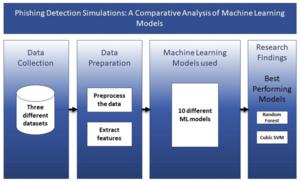

image:
The figure shows a data-driven approach to phishing detection, using three datasets to train and compare multiple machine-learning models. Random Forest and Cubic SVM achieved the highest detection accuracy.
Credit: The Journal of Engineering Research, SQU
Febraury 10, 2026—Phishing websites remain a persistent cybersecurity threat, exploiting users by imitating trusted online services. New machine-learning tools could help organisations flag more phishing sites before they harm users and steal credentials. A Sultan Qaboos University study shows data-driven models substantially outperform traditional approaches.
Published in The Journal of Engineering Research (Vol. 22, Issue 2, 2025), the research evaluated ten classifiers across three public phishing datasets using URL, domain, and content features.
Random Forest and Cubic SVM consistently achieved accuracy exceeding 95 per cent with balanced precision/recall across all datasets—critical for real-world systems where false positives and missed attacks both carry costs.
Phishing techniques evolve rapidly, outpacing static rule-based methods. “Data-driven machine-learning models are better suited to adapt to diverse phishing patterns when trained on representative datasets,” the authors note.
Unlike prior studies using single datasets or a few models, this work enables robust comparisons under identical conditions using standard metrics (accuracy, precision, recall, F1-score).
Dataset characteristics proved key: some enabled near-perfect detection, while others challenged models due to feature complexity.
Future work will explore deep learning and larger datasets for greater robustness.
Journal
The Journal of Engineering Research [TJER]
Method of Research
Data/statistical analysis
Article Title
Phishing Detection Using Data-Driven Intelligence
Article Publication Date
30-Dec-2025
Disclaimer: AAAS and EurekAlert! are not responsible for the accuracy of news releases posted to EurekAlert! by contributing institutions or for the use of any information through the EurekAlert system.














Leave a comment