
This article is provided by Allan Lagasca, smart industrials worldwide leader at STMicroelectronics.
The use of robots in industry is nothing new. For decades, factories have relied on manufacturing automation to improve speed, precision, and consistency. But where robots have previously been separated from human workers – for very good reasons – the next wave of robots will see robots and humans working in close collaboration.
Collaborative robots, or “cobots”, are reshaping the relationship between humans and technology, and are one of the fastest-growing segments of the overall robotics market. According to research, the cobot market was already worth $2.95 billion in 2025 and is projected to at a CAGR of 23.1% between 2026 and 2033.
Why cobots make sense
The opportunity for closer collaboration between robots and humans is driven by several industrial trends.
For one thing, manufacturers are facing specific skills shortages. For example, half of Britain’s welders are due to retire by 2027 which will, it is estimated, create a shortage of 35,000 workers in a sector ideally suited to robotics.
Despite what many might think, complete automation isn’t always the answer. More flexible and adaptable industrial automation can be more desirable. The combination of human creativity, knowledge, and problem solving, combined with the precision, strength, and endurance of robotics is an attractive solution.
Cobots represent one of the first large-scale deployments of embodied or “physical” AI, where sensing, compute, motion and power management combine to allow industrial systems to operate safely in the real world.
Innovations in sensors, microcontrollers, motor drivers, and edge computing are providing the foundation for cobots that can operate safely and intelligently alongside people. This aligns well with the EU’s Industry 5.0 framework, which promotes human-centric innovation, where technology enhances rather than replaces people.
Moving among us, safely
For obvious safety reasons, industrial robots have traditionally worked within cages, isolated from direct contact with humans. Cobots remove that barrier.
One of the obvious defining features of a cobot is its ability to operate safely near humans, being able to understand and react to the real world, however dynamic it might be. This level of responsiveness relies on tightly integrated real-time platforms.
New physical AI models bring a theoretical understanding of the physical environment to cobots. To bring this understanding to life, however, and operate safely and effectively, cobots must continually monitor their surroundings in real-time, for which they use numerous and diverse sensors.
Time-of-flight, imaging, force, torque, and proximity sensors create a three-dimensional view of the cobot’s immediate environment. Sensor data streams are processed locally using edge-based physical AI models, reducing latency and enabling real-time recognition of movement and distance.
This combination of sensing and local intelligence allows cobots to anticipate rather than merely react, adjusting their movements and trajectory smoothly as humans work close by.
But while cobots need to move with gentle precision, they also, where necessary, need great strength. This means balancing the high levels of torque required with equally significant sensitivity to touch. Advanced motor drivers enable smooth and adaptive motion. Embedded algorithms can adjust torque appropriately as the cobot lifts or manipulates different weights and materials.
Two factors that are easy to overlook but crucial when humans share the same workspace are the heat and noise generated by cobots. Designed to operate at temperatures below 40 °C at the surface and operate almost silently, cobots can help reinforce the sense of safety and comfort that human workers need. The psychological nature of collaborative working between humans and robots cannot be overlooked.
System integration and efficiency
What sets cobots apart from earlier forms of automation is the degree of synchronisation across their embedded systems. Every millisecond counts. Sensors, controllers, actuators and power electronics must communicate seamlessly and without any delay.
This coordination isn’t the result of any single component but rather that of tightly integrated semiconductor platforms, These combine sensing, compute, motion control, power, connectivity and functional safety into deterministic real-time architectures.
Multi-core microcontrollers and Time-Sensitive Networking (TSN) guarantee consistent communication timing and coordination. Power management systems ensure stable performance while converting energy efficiently across the cobot’s various voltage levels. The result is a unified system that operates in a precise, calm, and deliberate way with every motion.
Where cobots are starting to deliver value
Cobots are starting to transform industries where precision and safety in combination with human oversight and attributes deliver the optimal result.
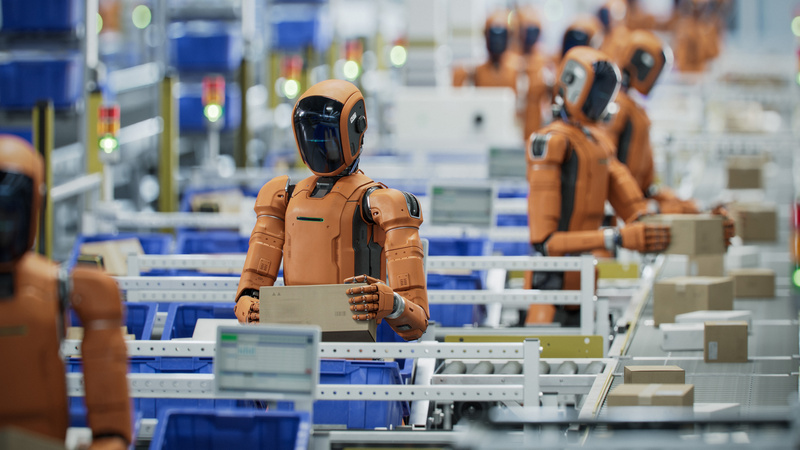
In automotive manufacturing, for example, cobots might position and hold interior components, while humans undertake fine alignment and fixing. In electronics, cobots handle precise, repetitive assembly tasks while humans focus on overall quality control. In logistics, they work alongside humans on packing lines or in warehouses, moving and sorting items with ease and efficiency. In healthcare, cobots are beginning to automate laboratory processes, preparing samples and pipetting, while humans focus on interpretation and diagnosis.
Each application represents a move away from rigid automation towards adaptive collaboration, where human judgment and robotic consistency reinforce each other. The result is not only greater efficiency but also safer and more satisfying workplaces.
A more collaborative future
In environments where human skill and judgement continue to add value, cobots represent the next stage of industrial automation. Humans and machines working in perfect harmony, each using their unique attributes.
The technologies underpinning cobots – sensing, edge computing, enhanced dexterity, and efficient power control – are shaping the future of smart industry. These systems reduce latency, improve energy efficiency, and allow machines to interpret and act within the physical environment safely, efficiently, and in real time.
As industries look for ways to remain competitive while preserving human well-being, cobots show what the next evolution of automation looks like. The “rise of the cobots” should be embraced, not feared; a redefinition of how humans and technology work together to build smarter and more human-centered production for the decades ahead.
















Leave a comment