
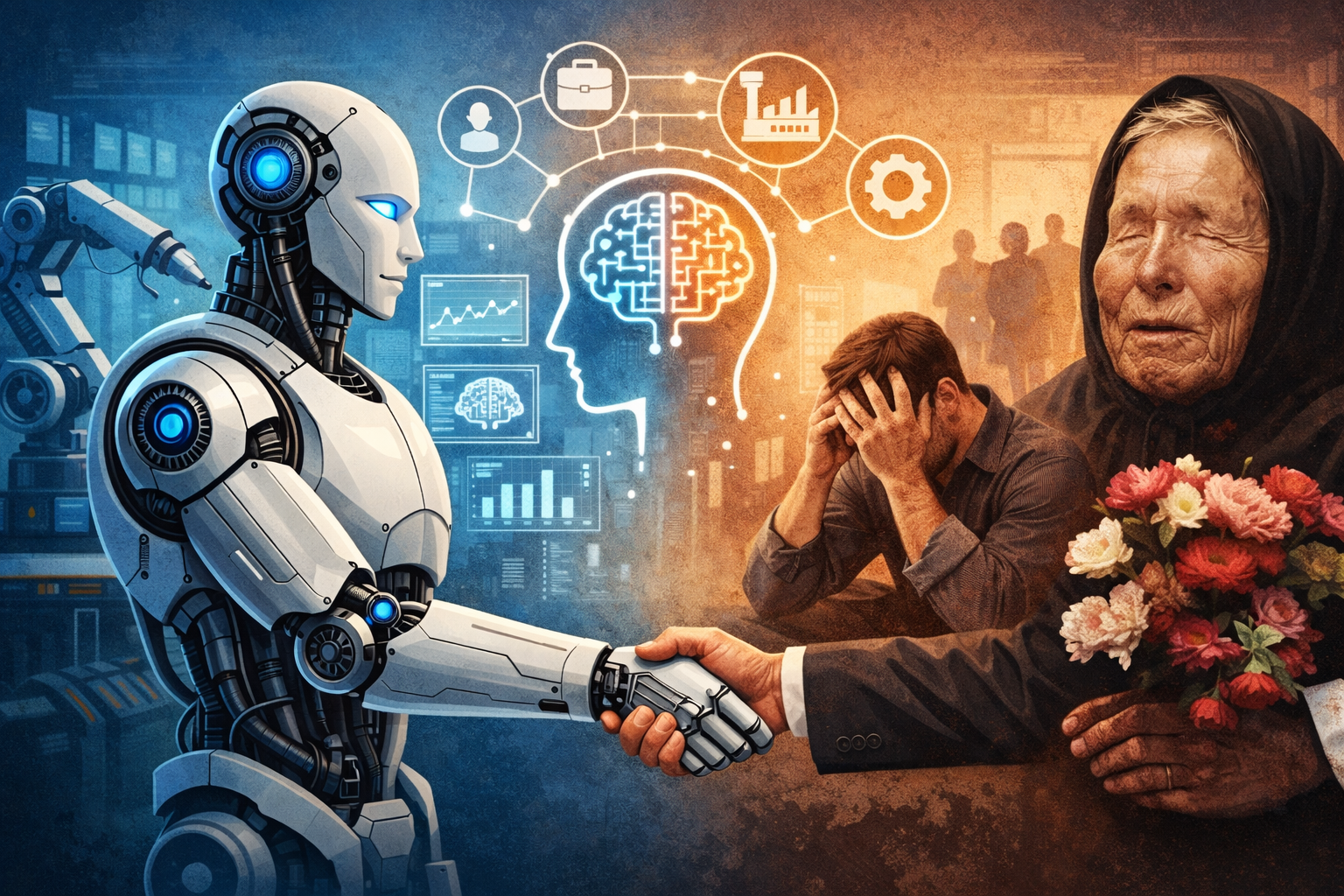
There is no verified record of Baba Vanga predicting that artificial intelligence would wipe out human jobs. Not one authenticated transcript, not a single recording, and no documented session from the blind Bulgarian clairvoyant — who died in August 1996 — mentions anything close to AI-driven unemployment.
That has not stopped millions from sharing it anyway.
Since early January 2026, posts tying Vanga’s name to fears about automation have surged on TikTok, X and Facebook. The spike came just as a brutal round of tech layoffs swept through Silicon Valley, and the two stories fused almost overnight.
Google confirmed voluntary exit packages across several divisions in late January. Microsoft shed hundreds of roles. Amazon trimmed headcount too, pointing to what it called ‘operational efficiency’. All three were pouring money into AI tools at the same time.
For staff clearing their desks, the optics were grim.
Big Tech Slashes Staff While Betting Billions on AI
Google’s restructuring programme, rolled out in the final week of January 2026, was tied directly to its AI-first pivot, sources familiar with the plans told industry outlets. Microsoft’s cuts ran deeper than initially reported, with an internal memo circulated in early February describing a ‘strategic realignment towards AI-first workflows.’
Within days, affected employees were posting about it on LinkedIn and Reddit. Several questioned openly whether their roles had been automated rather than simply eliminated.
Recruitment analysts said the pattern is now hard to ignore. Positions in data processing, entry-level coding and customer support are increasingly handled — partly or entirely — by software. New jobs have appeared in AI oversight and prompt engineering, but not at the same pace and rarely in the same places.
‘One week we were training the system,’ a former data analyst at a London-based fintech firm told colleagues in late January. ‘The next week, our team was told the system had made us redundant.’
She asked not to be named.
Why Baba Vanga Keeps Resurfacing
Vanga, who claimed to have lost her sight in a storm at age 12, was a cultural fixture across the Balkans throughout the Cold War. Over the decades, her supporters have credited her with foreseeing the September 11 attacks, the Chernobyl disaster and the emergence of ISIS.
Most of those claims fall apart on closer inspection. Historians and researchers at the Bulgarian Academy of Sciences have noted that the supposed prophecies rely on vague statements reinterpreted long after the events, rather than on specific predictions with a verifiable timestamp.
The AI jobs claim follows exactly the same path. No source document, no date, no direct quote.
When uncertainty spikes, people reach for familiar stories. Social media just makes that happen faster now.
What Workers Can Actually Do About AI Disruption
Employment experts said the most practical response to automation anxiety remains: upskill. A February 2026 report from the CIPD identified digital literacy and analytical thinking as the two capabilities most in demand among UK employers right now.
The UK’s Department for Education announced expanded funding for adult retraining on 4 February 2026, with programmes targeting regions most exposed to automation-driven redundancies. Details on eligibility and rollout are expected before the end of the month.
Businesses face pressure too, and not just to cut costs. Without meaningful investment in transition support and reskilling, the divide between workers who can adapt and those left behind is likely to widen — fast.
What Happens Next
A cross-party select committee hearing on AI and workforce displacement is scheduled for 19 March 2026. The next formal review of the UK government’s AI employment strategy is due before Parliament by the end of March.
The prophecy remains unverified. The redundancies do not.














Leave a comment