
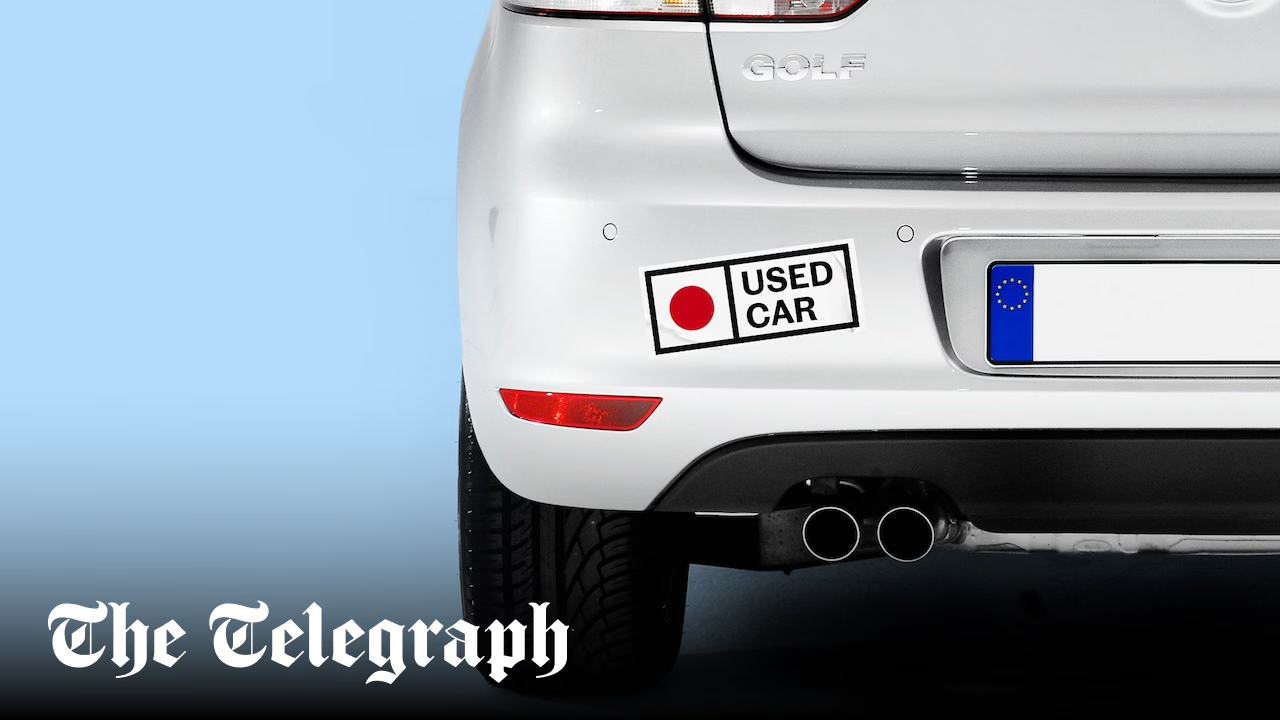
In addition to shorter service intervals than here in the UK, the Japanese tend to use main dealers for maintenance throughout a car’s life. The cost of this, as well as the stricter Japanese equivalent of our MOT roadworthiness test, means cars depreciate in value steeply once they are seven to 10 years old. Many owners will simply swap them for a newer car rather than pay for their upkeep.
Other countries have been happily taking these Japanese castoffs for years. Chay Anderson is the UK manager for the leading Japanese used-car exporter Nichibo. He is a native of New Zealand, where about 40 per cent of the used cars sold were first used in Japan. In the UK, the figure is about 0.4 per cent – but growing fast. “If you look at 25 years ago, most of the Japanese imports were high-performance cars like Nissan Skylines and fast Subarus. Fast-forward to now and it’s predominantly German brands, BMW, Audi and Volkswagen. The Golf and Polo are our top two sellers,” says Anderson.
High specifications – and drawbacks
Using an exporter such as Nichibo means the dealers in the UK don’t have to buy blind, since the cars are inspected and graded by scouts at the auction in Tokyo. As well as the condition, most of the Japanese-market cars will have higher specifications than the European equivalents, with features such as electrically folding mirrors standard on even older basic models.
But while these cars are full of Eastern promise, there are drawbacks. The dealers will be expected to go through the registration process and make sure the cars are legal to use in the UK, but it is also likely to involve a recalibration of the speedometer and odometer to read in miles rather than kilometres. This is usually possible simply by switching over the car’s main computer “brain” using a laptop, but the face of the instrument panel may also need to be changed. The radios may also need to be reprogrammed so they can receive UK stations, while navigation systems might need a new map download so they don’t think you are stuck in Tokyo.
You will also find that the service history is in Japanese, although Anderson says the stamps and numbers are the crucial parts and these need no translation. Some more sophisticated models have digital service histories stored in the car’s electronic memory.
Smoking area
One area where Japan lags behind the UK is with smoking. “It’s still fairly common to find smokers in Japan,” says Kemp, “but the numbers are coming down. It means that some cars will smell of smoke. I only buy stock which has the top grading for the interior, which means it doesn’t have any tobacco smell, but other buyers might find they reek of cigarettes.”
Insurance can also be a minor issue, with some brokers getting nervous as the cars might not be on a database. Baggott says: “They are a little harder to insure, but most companies are now happy to quote and it usually doesn’t cost much more. We send all our customers to Admiral as they don’t treat imports any differently to UK cars.”
What about prices? “The cars are cheaper to buy for dealers, but by the time conversions are carried out they will sell here in the UK for around the same price as equivalent UK cars, although some command a premium because they are in such good condition,” says Baggott.
Kemp agrees, pointing out that all his stock is classed as “Good” or “Great Price” on sales website Autotrader’s rankings. “I make a profit margin on the cars, of course, but it’s not as much as you think. The benefit for me is that I have to do very little refurbishment work before I sell them as they are in such good condition. I rarely get any warranty claims either,” he says.
“The rigorous Japanese maintenance regime and the lack of corrosion mean the cars are less expensive to run over the next few years, too. And that makes buyers very happy,” says Kemp.















Leave a comment