
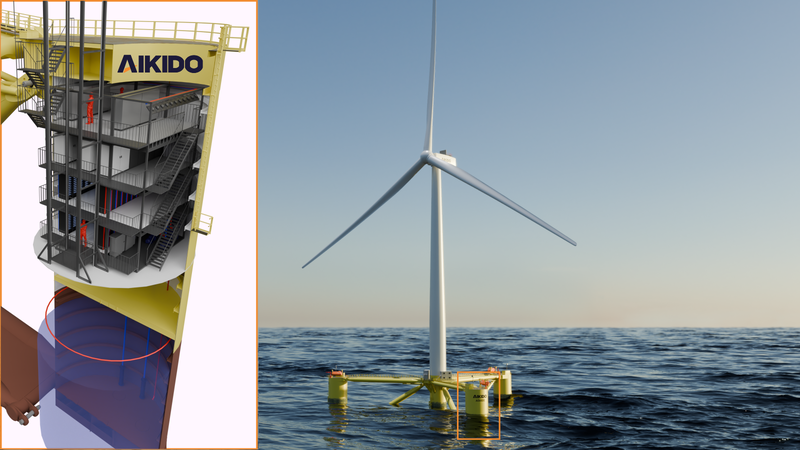
An AI data centre integrated into a floating offshore wind platform is being developed by US technology start-up Aikido Technologies for commercial deployment in 2028.
Founded in San Francisco in 2022, Aikido Technologies has been developing a floating offshore wind platform that can be manufactured and deployed in a streamlined way. The start-up has now announced that the platforms can be transformed into floating offshore data centres, with computing infrastructure housed directly within the platforms. The turbines supply power to the servers, while onboard battery storage and grid connection provide backup. The surrounding ocean acts as a heat sink, enabling natural cooling for the computing systems.
The rapid growth of AI data centres has become a contentious issue, with some firms even proposing space-based solutions. However, as Sam Kanner, CEO of Aikido Technologies, put it: “Before we go off-world, we should go offshore.”
Kanner added: “First movers in the O&G industry exploited deepwater resources over 40 years ago and reaped massive benefits. Aikido is well positioned to integrate proven, offshore components with typical data hall construction techniques to build GW-scale AI factories faster, cleaner, cheaper and more efficiently than conventional techniques.”
The company’s prototype, the AO60DC, will be able to host a 10–12MW onboard data centre, alongside a wind turbine with a generation capacity of 15–18 MW or more and integrated battery energy storage. If these platforms are scaled to form offshore wind farms, gigawatt-scale AI infrastructure could be built directly at a renewable energy source.
A proof-of-concept unit is currently under development in Norway, scheduled for deployment later this year. The first commercial project is targeted for the UK, with a planned operational date of 2028. According to Aikido, a site has already been identified and detailed engineering and commercial discussions are under way.
The design features a proprietary wind turbine substructure that is integrated with a modular flat-pack semi-submersible floating platform. This platform holds the turbine in the centre, with three legs extending outward. At the end of each leg is ballast reaching 20 metres deep, maintaining the platform’s buoyancy. The data centre enclosure is incorporated into a single steel unit in the upper part of each ballast tank, and the pre-fabricated data halls can be lifted into place during final integration.
The units are able to be deployed in sovereign waters that are already designated for offshore use, allowing for streamlined permitting and grid connection processes. They can also be installed and serviced using vessels that are already active in offshore wind and deepwater oil and gas industries.
Other advantages of the design include a passive primary cooling system: water is piped up to the data centre to provide liquid cooling to the servers, while warmed water is transferred through the steel hull into the surrounding seawater. Thermal impact is expected to be limited to a localised area extending only a few metres from the structure. As such, the environmental impact is deemed to be minimal.
“We have this power from the wind,” said Kanner. “We have free cooling. We think we can be quite cost competitive compared to conventional data centre solutions. This crunch in the next five years is an opportunity for us to prove this out and supply AI compute where it’s needed.”















Leave a comment