
The UK’s new car market has continued its strong sales form into February, recording the highest total sales volume seen in over two decades. Over 90,000 new models were registered last month – a high last reached in February 2004.
New car registration data published today by the Society of Motor Manufacturers and Traders (SMMT) showed that the overall new market grew by 7% over the same month last year, thanks to a large 17% uptick in private sales and a 2% increase in fleet registrations.
While private sales saw the largest increase, fleet buyers still account for nearly 60% of new car sales in the UK. Sales in the all-electric category grew by 3% – below the overall average – while plug-in hybrid demand surged by 44% when compared to February last year.
Underneath the headline numbers, there were a number of key stories. The main one is the continued growth of Chinese car manufacturer Jaecoo, with the Jaecoo 7 making the top five best-seller’s leaderboard in February, just below the Tesla Model 3 which still proves to be a popular all-electric choice in the UK.
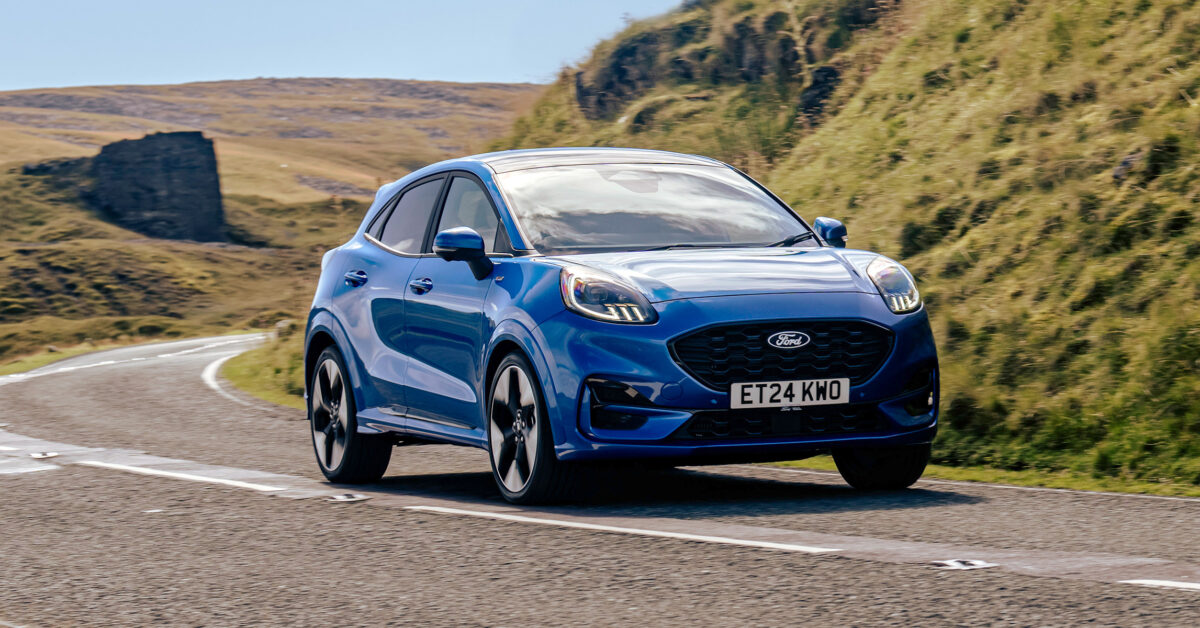
Finishing top of the pile was the ever-popular Ford Puma – the UK’s most popular new car choice in 2025. Sealing top spot in February means the compact Ford crossover has moved up to first once again in the annual charts, with the Kia Sportage not far behind.
All eyes on March after February sales surge

Over 90,000 new models arrived on UK roads last month – that’s around 6,000 more than February last year. February is traditionally a lower sales volume month, as buyers tend to wait for the new numberplates that arrive in March.
Given the new car market’s positive start to the year, the SMMT’s chief executive Mike Hawes says that all eyes are now on March’s registration results, “which typically set the tone for the year.”
Digging a bit deeper to look at the sales results by brand, Chery’s three brands (Chery, Omoda and Jaecoo) accounted for roughly 5% of all sales in the UK last month. That’s on par with the likes of Audi, Mercedes-Benz, Skoda and Vauxhall and a larger market share than household names like Renault and Toyota.
That said, the market leaders remain. Ford accounted for roughly 7% and Volkswagen 8% of the market last month. If you add Chery Group and fellow Chinese marque BYD together however, they outsold Volkswagen. The Chinese brands now pose a serious sales threat, and the impact of this on the rest of the industry is going to be profound, as a growing number of other car brands see customers disappearing to their new Chinese rivals.
EV demand flat once again

Electric car (EV) registrations saw an incremental increase of 3% in February when compared to the same month last year, which means that market share fell slightly since overall registrations were up 7%. Diesel registrations fell by 7% and petrol registrations crept up by close to 1%, so it was still a net gain against the vehicles that are now four years from extinction.
The all-electric share of the overall car market has now declined for the second consecutive month – a dip that partly reflects a strong start to 2025, when electric car buyers sought to avoid April’s introduction of new tax rates.
The ZEV mandate target for 2026 is 33%, so an EV market share of less than 22% (so far for the year) isn’t a great start. However, the real target is probably going to end up being somewhere between 25-28% so we’re not a long way off in reality.
Plug-in hybrids continued their surge, helped by the Jaecoo 7, Volkswagen Tiguan and Volvo XC40, which were all in the top ten cars for February. Over the last few months, plug-in hybrids have been closing in on regular hybrids in terms of sales, and just 1.5% market share separated them in February.
Good month, bad month
Should this be your first time reading one of our new car sales breakdowns, here’s a quick recap on how we judge whether a car brand has had a good or bad month.
Sales numbers can fluctuate depending on a number of factors, so we allow plenty of wiggle room. If a brand outperforms the overall market by at least 10%, that’s a good month. If a brand underperforms against the overall market by at least 10%, that’s a bad month. If it’s within 10% above or below, that’s within normal expectations.
This month, the overall market was up 7.2% over last February, so any brand that grew their sales by at least 17.2% has had a good month. Brands that saw registrations slide by at least 2.8% had a bad month.
January was a good month for Alfa Romeo, Alpine, BYD, Citroën, Dacia, Ford, GWM, Ineos, Jaecoo, KGM, Land Rover, Mazda, Mercedes-Benz, Omoda, Polestar, Skoda, Smart, Subaru and Suzuki.
Meanwhile, it was a bad month for DS Automobiles, Fiat, Genesis, Honda, Hyundai, Jeep, Kia, Lexus, Lotus, Maxus, MG, Mini, Nissan, Peugeot, Porsche, SEAT, Suzuki, Tesla, Volkswagen and Volvo.
That means the following brands were about where we’d expect to see them: Abarth, Audi, BMW, Cupra, Maserati, Renault, Skywell, Toyota, Volvo and Vauxhall.
Puma returns to the top

The Ford Puma was the UK’s most popular new car in February, outselling January’s best-seller the Kia Sportage by over 1,000 registrations. It’s beginning to look like business as usual, with the Puma and Sportage fighting it out to be crowned the UK’s best selling new car – the same table-topping rivalry as the two years prior.
The Mini Cooper finished third in February – enough to see the hatchback climb up to seventh in the annual chart after two months. The rest of February’s top ten was much closer, with 350 sales separating fourth and tenth place.
The Tesla Model 3 recorded its first monthly top ten appearance of the year finishing fourth, closely followed by the Jaecoo 7which is continuing its late 2025 success. Several of last year’s other consistent sales performers also appear, including the Volkswagen Tiguan and Vauxhall Corsa in seventh and eighth respectively, but there is one notable absence – the British-built Nissan Qashqai.














Leave a comment