
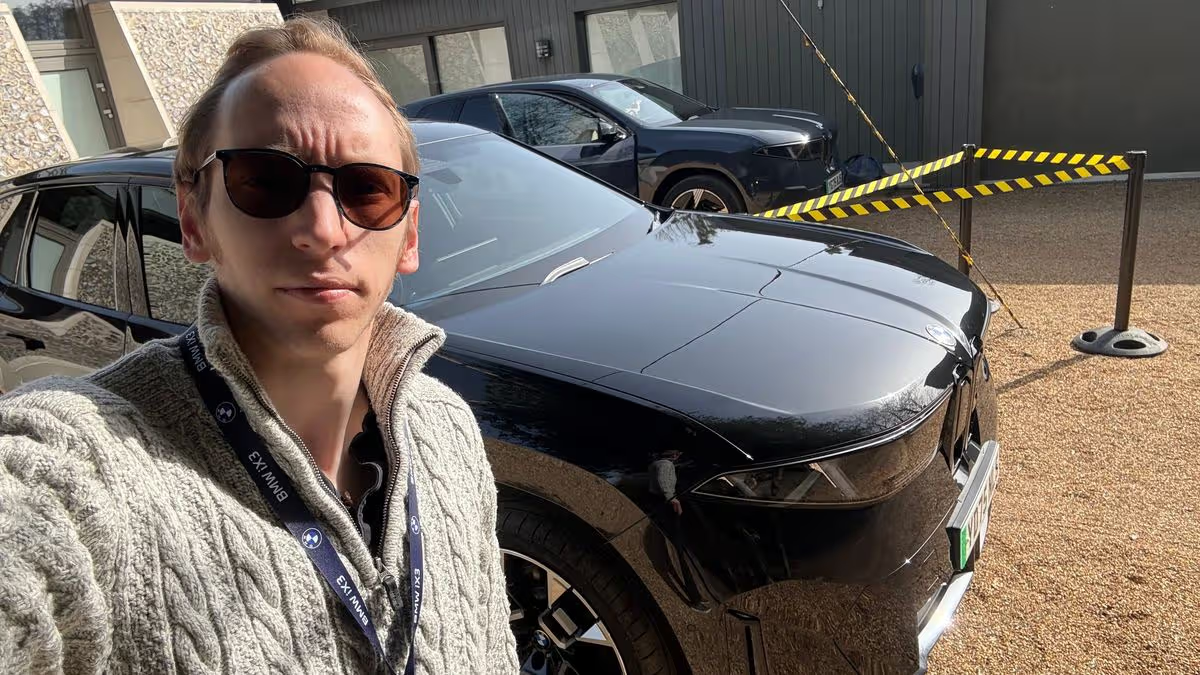
Christopher Sharp attended the UK launch of one of the most hotly anticipated new cars of 2026, the BMW iX3, which one Top Gear’s coveted Car of the Year award

Christopher Sharp test drove the BMW iX3(Image: Christopher Sharp)
The BMW iX3 is not just an important car for BMW, marking the start of its new range of Neue Klasse cars, but potentially one of the most important cars launched this year.
Along with multiple members of the motoring and national press, I had an opportunity to attend the UK launch of the BMW iX3 just a few weeks after Top Gear magazine had named it their car of the year.
Having spent a day with the car I can see exactly why it won the award. I found it truly innovative and helpful, and its driver aids are present without being overly intrusive.
The car I drove was officially the BMW Ix3 xDrive M Sport Pro version of the car. What this means in simple terms is it was a four wheel drive top specification model. All in, the total cost of the car I drove was just over £72,000. Going deeper into those specifications, the iX3 had 463hp, had an unladen weight of 2.3 tonnes, and WLTP range of 451.2miles (722km).
Beyond the range, the price, and the figures in general, the iX3 surprised me in three different ways and led to one, at least I think, intriguing observation.
Surprise Number 1: How it looked
BMW received a lot of stick a few years ago when it increased the size of the kidney grills on the size of its cars. While we eventually got used to this prominent design change, there was sense that we wouldn’t mind if BMW had a change of heart.
And that they have done, with the the new iX3 and upcoming 3 series replacement coming with much smaller kidneys on the front, a design change that feels like a nod to the original Neue Klasse cars of the 60s.
Despite the smaller grill, I wasn’t sure what to think of the iX3 when I first saw photos. It looked a bit stocky and squashed. Seeing it in the flesh, however, and it all made sense. The car was longer than it looked and the front bodywork a tad lower, so that it all looked rather more elegant.
Surprise Number 2: The handling
The laws of physics should dictate that a 2.3-tonne electric SUV shouldn’t handle well, but the BMW does. A bit like rivals Audi, it manages to communicate effectively and with nuance through the seat, steering and pedals. You can genuinely thread your way along a road with confidence that you know what each corner is doing, and that’s before you get to the regenerative braking.
Regenerative braking is when the car’s braking systems are used to put more energy back into the battery to give you more range. Strong regenerative braking systems can enable you to use just one pedal motor. However, the BMW’s is a little bit different in that it works with the satnav.
Put simply, if you put in your destination, the system looks at the corners coming up and is able to predict how much regenerative braking is needed to slow the car down. For example, if you’re coming up to a roundabout at 18mph it will brake less than if you’re coming up to corner on a country road at 50mph for example.
This doesn’t mean you shouldn’t touch the actual brake pedal, the system won’t bring the car to a halt for you, but is very intuitive. It is possible to turn off this system, but it is remarkable so why would you want to?
Also remarkable is the interior. There is no instrument binnacle in front of you, but there is the expected massive touch screen. However, BMW has also installed a small screen that runs just beneath the windscreen. This sounds weird, but what it means is you don’t need to take your eyes off the road to see your speed, the next turn you need to make, or what song you’re listening to.
Surprise Number 3: I preferred driving my car
The following may sound like a slight, but in one sense it isn’t. I drive a BMW MINI Clubman Cooper S; it’s a 189bhp four wheel drive MINI estate that weighs around 1.5 tonnes. I’m always intrigued when I get back into it after testing a car because I like comparing a car launched in the 2010s to one launched now because so much has changed.
As I drove home I realised that I preferred driving my car not just because it felt lighter and more fun, but because I didn’t have to turn anything off when I got in. I didn’t have to set driving modes, I didn’t have to turn of driving assists, I could just crack on. I would argue that this demonstrates how well BMW’s Clubman has aged from a handling and dynamic perspective.
Comparing the iX3 to a nearly decade old MINI – a car built by BMW – is I concede a bit of an unfair fight. There’s always going to be a little bit of own car bias combined with the laws of physics, and I accept how fortunate one is to be invited to the UK launch of a new car. But it demonstrates that just a few years ago cars let us crack on, didn’t disturb us as much; left it up to stay in between two white lines on the motorway.
Cars today are safer than they’ve ever been, and that’s good. But they are also built for a world where critical thinking is on the way out and humans want to worry less.
In some cases, this has seen amazing advances in the car, particularly with regards to safety and giving you a heads up. Take parking sensors, and blind spot checkers and the iX3’s satnav telling you what type of bend is coming up next, like having a friend doing the navigation who knows the road better telling. These are great changes, and ones that help you prepare better as a driver.
Which is why I conclude that the iX3 is completely worthy of its car of the year title. If the rest of BMW’s Neue Klasse cars are in anyway like it then there is hope for motoring joy in an increasingly electrified world.
Christopher’s Verdict: 9/10
















Leave a comment