
‘Government should not surrender the insight layer gently’

Image:
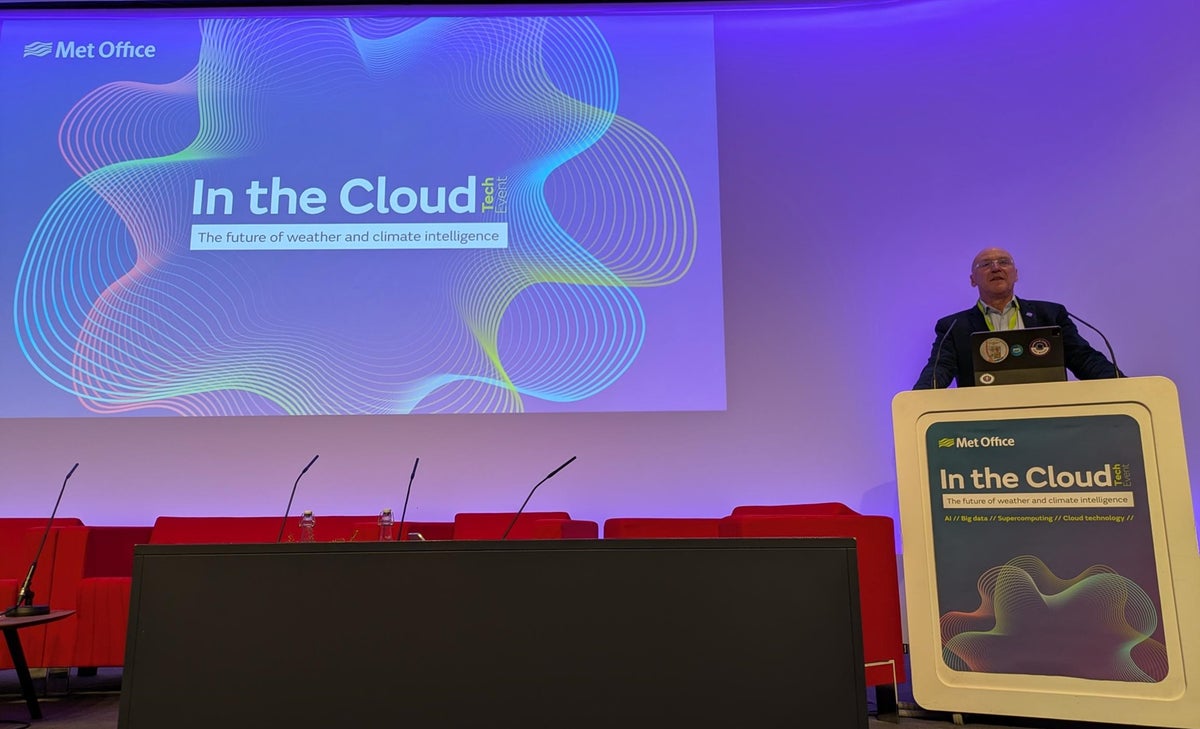
Charles Ewen, Met Office CDIO. Image: Tom Allen / The Channel Company
Artificial intelligence is all anyone wants to talk about in 2026. But, says Met Office CDIO Charles Ewen, it is not the means to an end by itself.
“Innovation rarely, if ever, comes from one big breakthrough,” said Ewen at last week’s Met Office in the Cloud event, which Computing was invited to as an exclusive press partner. “It actually happens when multiple maturing technologies come together and converge, enabling one another and unlocking previously inaccessible new value.”
This “compound innovation” turns AI from transformative technology to a catalyst for change that relies on maturity in many other areas.
Supercomputing is another example of compound innovation, and last year the Met Office celebrated turning off its last on-premises machine in favour of a cloud-based approach with Microsoft. Needless to say, AI is a significant part of the new machine’s runtime, enabling new insights at superior resolutions.
Although he discussed several applications of Met Office data with AI, Ewen particularly highlighted defence, where there is a long history of collaboration. The Allies’ superior weather data famously ensured the D-Day landings were as successful as they were, for example.
“For defence and security applications, the ability to co-locate weather and climate data with operation data has significant promise, and the potential to deliver new advantage.”
‘We can’t afford stale products and data’
Image

Description
The Allies’ superior weather charts were instrumental in the success of the D-Day landings. Image: Tom Allen / The Channel Company
The defence sector was well represented on the day, especially in a panel on using technology for strategic decision-making.
Captain Bryan McCavour MBE (deputy assistant chief of staff in information warfare at the Royal Navy) and Laurie Thraves (deputy director and head of the National Situation Centre at the Cabinet Office Briefing Rooms, aka COBRA) both spoke about the importance data and AI to the UK’s defence posture in the 21st century.
“The defence cycle is moving at such a pace we can’t afford stale products and data that cannot be manipulated,” said McCavour. “Right now, in Ukraine, there are people being targeted and killed using AI, often without humans in the loop… We need to exploit AI not just at the core, but at the edge.”
The issue is not, however, limited to “wherever the military is fighting.” As we’ve written before, your home front is as viable a target as the front lines when it comes to modern warfare.
“We need to be really aligned to the fact that, as a society, the UK could come under attack,” said McCavour. “Our infrastructure – our ability to process, disseminate, analyse and exploit the data that the Met Office is producing in the UK – could also be challenged.
“It’s not just a military core-edge problem. There’s going to be elements of UK domestic infrastructure that needs to be able to exploit small packets of data in locations to support decision-making.”
Thraves agreed that “the things we are interested in protecting are the things an adversary is interested in destroying” – like critical national infrastructure or public services.
“Some of that is in really good shape and well defended,” he said. “Some of it…could be improved.” He specifically noted the prison service as one that is “incredibly vulnerable to even the slightest disturbance.”
Thraves described a scenario where Met Office data could be absolutely critical: a nuclear incident. “[Our tracking] is combined with the weather data showing you where the plume is moving. Then we’re thinking about what’s in the path of the plume: is there critical national infrastructure? Are there schools? Are there hospitals? Where are the people?”
Reacting in this scenario “really depends” on having data you can not only integrate, but integrate quickly. That’s where agencies like the Met Office come in.
“Government departments [are] generally not good at technology, but government agencies are really good.”
But no matter the quality of the data, both Thraves and McCavour were keen to stress the importance of keeping the human in the loop – something that came up again during the audience questions.
When red lines meet reality
With both a Cabinet Office spokesperson and military officer on-stage, I had to ask about the ongoing Anthropic-Pentagon dispute.
On the one hand, a tech company is finally showing some backbone in standing up for its ethical red lines. From another point of view, a private company is trying to dictate how the military can operate.
“Government should not surrender the insight layer gently,” said Thraves. “The challenge for the UK government and military is not AI, it’s structured data.”
He named a range of data that would be necessary to inform decision-making in the event of a biological weapon attack, from weather to health to mobility and geospatial. An AI, in that situation, would have to make “quite difficult tradeoffs” and “we need to be really careful and cautious before we surrender that.”
“It’s not about AI, it’s about ethics and who we want to be,” said McCavour.
“Our enemies and our allies are using AI in Ukraine right now… and in the Middle East, the edges are starting to fray – not just in terms of the geopolitical order, but the rules of armed conflict.”
He continued, “When you introduce that AI piece, what I worry about is a race to the bottom in terms of how we adapt ethics: in terms of the rules of war, in terms of how we fight.”
The UK as a country and society has not yet had “a mature debate” about the use of AI in war. At the same time, we must recognise there are countries who “will probably not apply the same level ethical levels of armed conflict standards as we do.”
On the topic of ethics, how about the Met Office’s own red lines? Richard Bevan, services director at the Met Office, said meteorological data is open by its nature – confidentiality is less important than integrity.
However, “We would hope it will be used for purposes of good – but if the world changes it may be something we have to consider.”
A line that certainly caused consternation for the military officers in the room.
















Leave a comment