
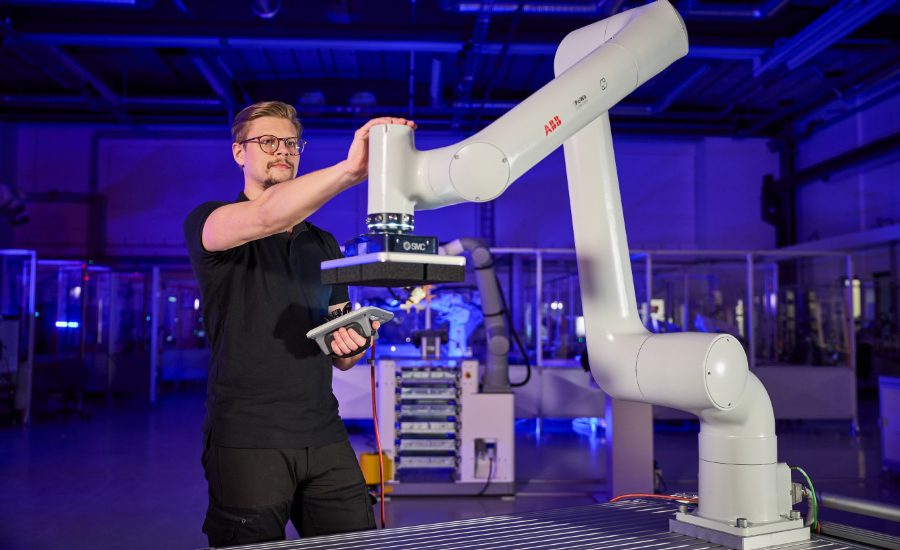
ZURICH, SWITZERLAND—ABB Robotics has introduced a new family of collaborative robots designed to combine the flexibility of cobots with the speed and payload capabilities typically associated with industrial robots.
The new PoWa cobot lineup offers payload capacities ranging from 7 to 30 kilograms and top speeds of up to 5.8 meters per second, targeting applications that require higher throughput than traditional collaborative systems can deliver.
The robots are designed for use in assembly, machine tending, palletizing, screwdriving and welding, particularly in environments where manufacturers need to automate heavier or faster processes without deploying large, fixed automation systems.
“Cobots are growing significantly faster than traditional industrial robots, driven by demands from both small and midsized companies starting their automation journey as well as large enterprises,” said Andrea Cassoni, head of collaborative robots at ABB Robotics. “Established manufacturers want to automate heavier, fast cycle applications, without the complexity and operational rigidity of traditional industrial robots.”
ABB said the new platform is intended to address a longstanding gap between conventional cobots, which are often limited in speed and payload, and industrial robots, which are typically designed for high-volume, dedicated production lines.
The PoWa systems are built on ABB’s OmniCore controller platform and support integration with the company’s software tools for programming and simulation. The robots feature no-code programming and can be deployed quickly, allowing operators to set up and redeploy systems across different tasks with minimal training.
The launch reflects growing demand for more versatile automation, as manufacturers look to apply robotics to a wider range of applications, including high-mix production environments where flexibility and speed are both critical.
ABB expects the collaborative robot market to continue expanding, driven by adoption among both small manufacturers and large enterprises seeking to extend automation beyond traditional use cases.















Leave a comment