
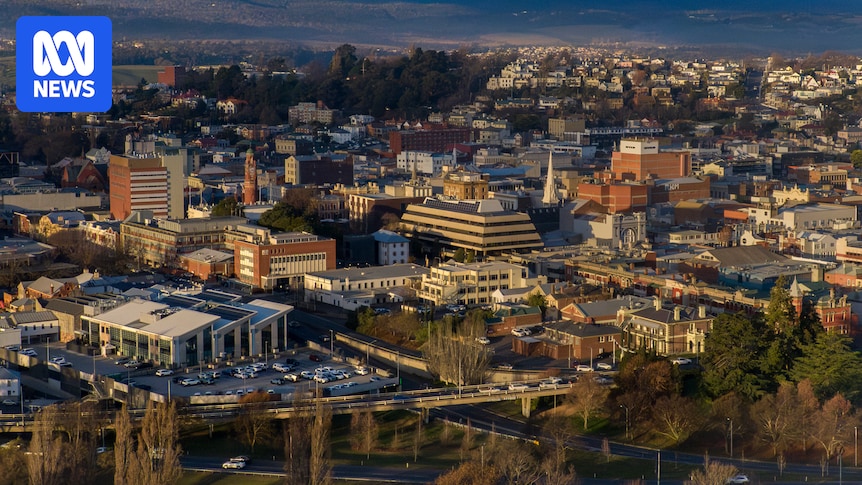
Tasmania’s West Tamar region is known for its vineyards, gastronomy, national parks and agricultural scene. It is also one of the state’s fastest-growing areas.
Last week, its council released a draft of a 10-year strategic plan in a community consultation paper where the data was “synthesised” by artificial intelligence (AI).
West Tamar Council chief executive Kristen Desmond said the use of AI “allowed us to have a document that’s got more depth to it at about a fifth of the price”.

West Tamar Council chief executive Kristen Desmond (left) and mayor Christina Holmdahl. (ABC News: Mackenzie Archer)
Ms Desmond said the process was very similar to employing a consultant, but took less time.
“If we asked a consultant to review 50 strategic documents and come up with themes out of those, before they even started talking to people, that would be 12 months of work,” she said.
“AI synthesised [multiple] documents. Then we had seven targeted community workshops from which the AI was able to bring out a set of themes.
“The reports from both of those processes were synthesised and that gave us the basis of the plan.”
West Tamar Council stretches from Launceston in the south to Greens Beach at the mouth of the River Tamar. (Facebook: West Tamar Council)
To allay residents’ fears about the use of the tool, Ms Desmond said “humans were involved all the way along” and it was “people who turned it into the document”.
“We’ve talked about it as a second brain. It’s done the grunt work but it hasn’t done the polishing,”
she said.
“From the strategies that we supplied, to being at every one of the targeted community workshops to checking the reports … council was kept updated through the whole process.”
She said the final version was also “very different to the base document produced by AI”.
The regional council takes in populated areas as well as more rural locales in the Tamar Valley.
‘No action in any of the words’
Former Greens candidate and local resident Jack Davenport said the document lacked local relevance.
“You could easily substitute the place names, the West Tamar references, with a completely different place anywhere in the country and it would probably be just as applicable,” he said.
“I think it oversimplifies the relationship between the different parts of West Tamar.”
Jack Davenport says the document lacked local relevance. (ABC News: Loretta Lohberger)
Beaconsfield business owner Susan Wutke also took exception to the way the report was compiled saying, “there’s no action in any of the words”.
“We pay these people to come up and consult with community, bring creativity, inspiration, ideas and it’s all completely lost with AI,”
she said.
The document states “the plan is informed by a review of Council and regional strategies, engagement with elected members, staff, youth, business and community stakeholders, and the strongest recurring themes across that work.
“The plan is built around three civic themes. These reflect how people experience West Tamar as one connected place, rather than as separate services or departments.”
Ms Desmond encouraged residents to engage in the consultation process if they have concerns.
“We’ve put a lot of work into this to make it truly West Tamar unique,” she said.
“If they think we’ve missed something, it’s open for community consultation … This part is about people fixing it.”
Lack of resources impact councils
West Tamar Council mayor Christina Holmdahl said AI would continue to play a role at small councils.
“We’re very enthusiastic about the way we’re going to be able to use AI in the future,” Councillor Holmdahl said.
“We’re going to be able to use our people more efficiently and get more out of them, which is good for the ratepayers because we’re doing more work than we normally would.”
Local Government Association Tasmania president Mick Tucker agreed that employing AI could help to free up limited council resources.
Mick Tucker says if done correctly, AI could free up resources for councils. (ABC News: Emily Smith)
“We know in local government [that] planning is one of the big issues [where] we all struggle with lack of resources,” Councillor Tucker said.
“If we can make sure that there is really intense scrutiny going in and going out … then we can actually really free up resources for the more important issues at hand.
“We don’t need to have a highly paid manager there doing that initial input … If it needs to have follow-up, that’s where you want to put the best of your resources.”
Tasmanian-based technology adviser Simon Tyrrell said an advantage of AI was that it offered a powerful tool to smaller organisations.
“For really the first time — since the internet and then the smartphone — they’ve actually got access to the same technology capabilities that the biggest companies in the world are using,”
Mr Tyrrell said.
“We’ve been very limited in how much information we as humans can synthesise and the time it takes.
Technology adviser Simon Tyrel says AI offers small organisations a powerful tool. (Supplied)
“It is possible with these [AI] tools to load them up with secure, sensitive, historical information and run all sorts of processes across the top of them.”
Although, Mr Tyrrell warned that AI users should be educated in how to use the technology.
“We’re not seeing investment in those skills that are going to be required for these tools to be used safely and well,” he said.
“If I go and ask an AI tool, ‘give me something that matches these exact facts and supports my argument’, the models work in a way that they will try to answer your question.
The 10-year plan focuses on three core themes: Our Shape, Our Heart, and Our Economy. (Facebook: West Tamar Council)
“If I then change that to say, ‘you must only use cited sources of real cases’ then I simply said to the AI, ‘is that a real case?’ If it’s made it up, it will actually say so.”
Public consultation on the West Tamar Draft Community Strategic Plan closes on June 28.















Leave a comment