
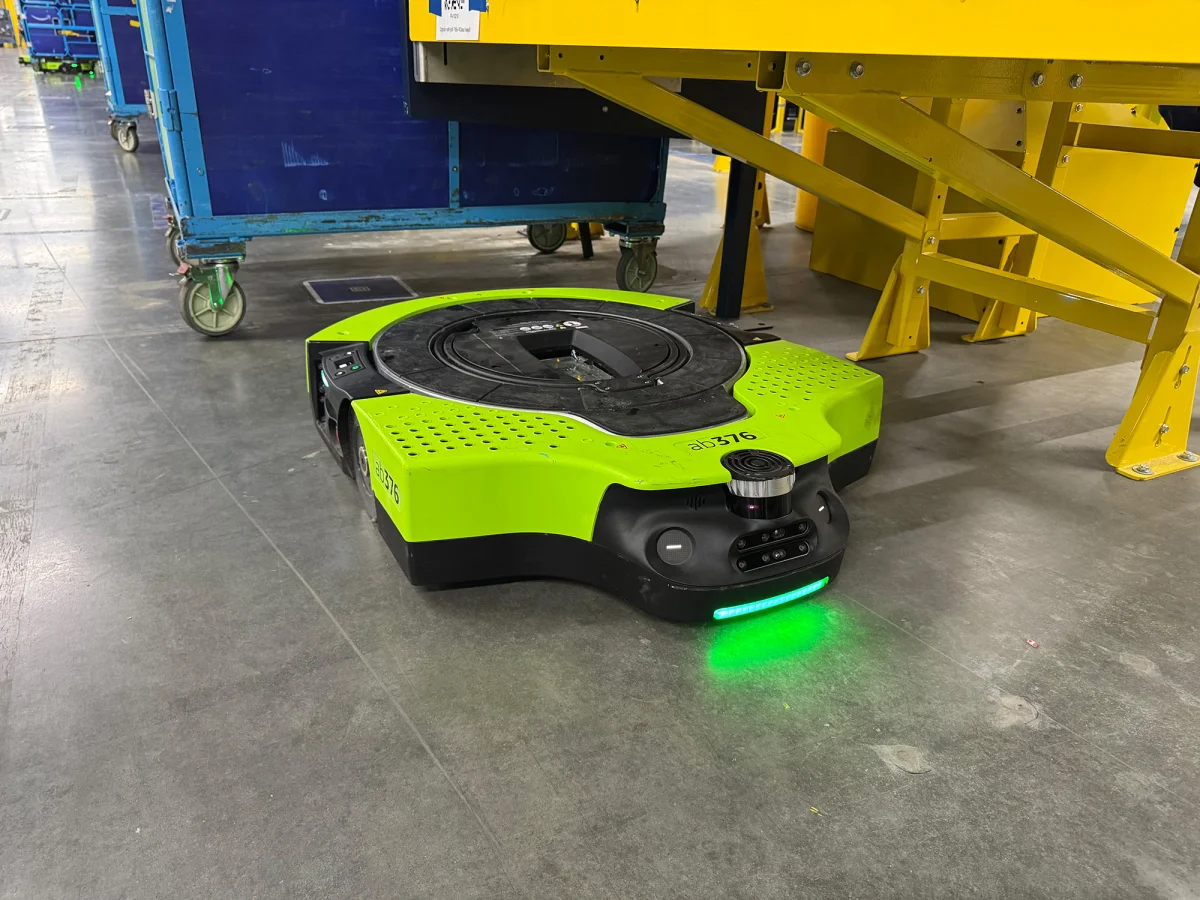
Amazon has unveiled the next generation of its warehouse robot, “Proteus.” Externally, the new version does not differ from the previous model, as it builds on the design of the well-known robot that autonomously transports trolleys weighing just under 400 kilograms over long distances through Amazon’s logistics centers. However, there are two innovations.
One concerns the area of application. According to Amazon, the second generation of Proteus is no longer just designed for use in the loading ramp area but is intended to be used wherever goods need to be transported. This includes the transport of containers upon their arrival at a location, transfer between workstations, and support for employees in fulfillment centers and at delivery locations.
Above all, however, according to Amazon, the way employees can interact with Proteus has been fundamentally changed. Thanks to AI, the robot is now capable of understanding natural language. In practice, employees should be able to assign tasks to Proteus as they would communicate with a colleague. “You tell it what needs to be done; it determines the priority, the route, and the schedule,” said Scott Dresser, Vice President of Amazon Robotics, at Amazon’s “Delivering the Future” event in London on Thursday.
Proteus is currently in use in 25 fulfillment centers in the United States. The system is currently being tested in Amazon’s labs, and its introduction in Europe is planned for the first half of 2027.
Amazon continues to rely heavily on robotics
According to Amazon, the expansion of Proteus is part of a broader robotics strategy. In addition to advances in mobile robots, the company is also developing new technologies for collaborative robotics and robot-assisted handling – the ability to precisely handle individual objects.
This also includes “STARK,” a new collaborative robot system for transporting containers, which works alongside employees, taking full containers from conveyor belts and placing them on trolleys – a task that would otherwise require repeated heavy lifting. After an initial pilot project in Barcelona, STARK is to be rolled out to 15 locations across Europe by 2027.
However, not everything always goes as planned at Amazon. At the beginning of the year, the online retailer took the robot “Blue Jay” out of operation again after less than six months. This robot was supposed to pack packages with multiple arms for swift delivery. However, it was already stated at the time that the technologies developed for Blue Jay were to be incorporated into other products.
According to Amazon, these new technologies are also part of the plan to invest over 10 billion euros in the coming years to expand and modernize its fulfillment operations in Europe. This also includes the expansion of Vulcan, Amazon’s first robot with a sense of touch.
(nij)














Leave a comment