
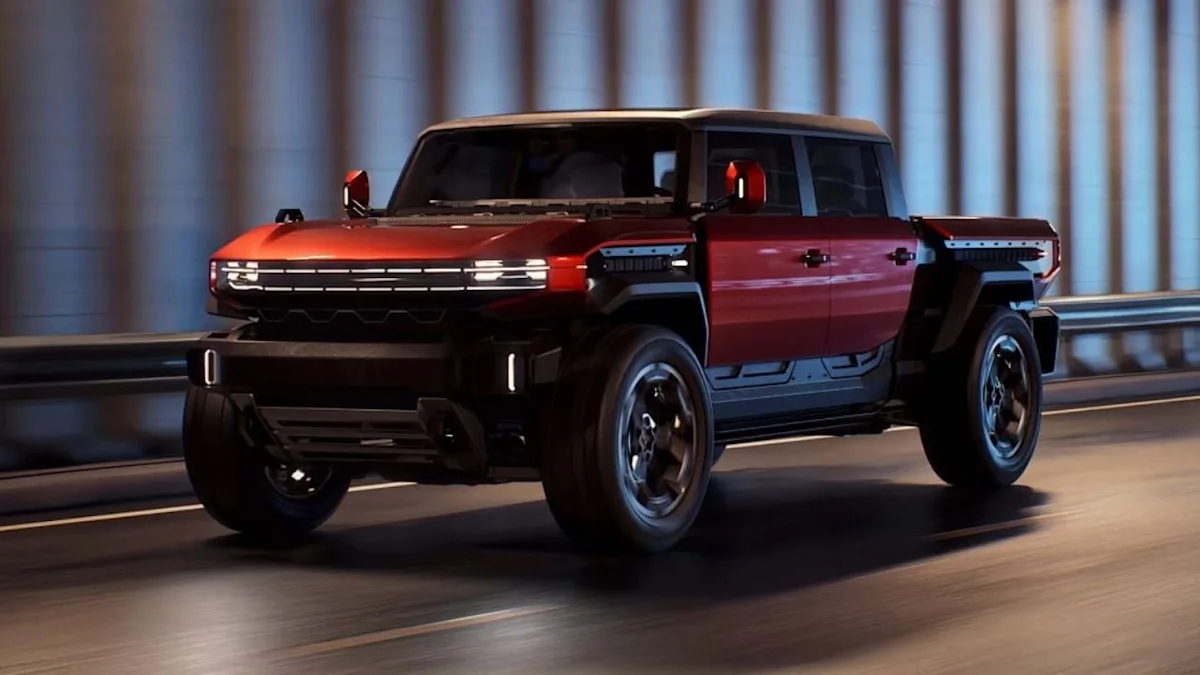
General Motors believes the traditional automotive development cycle may soon become a thing of the past. The automaker says advances in artificial intelligence, simulation software, and virtual engineering could allow it to develop entirely new vehicles in roughly two years instead of the industry-standard four to six.
That timeline might sound wildly ambitious, but GM insists it has already proven it can work. The company points to the GMC Hummer EV, which reportedly moved from concept to production in just 20 months. Now GM wants that accelerated process to become standard practice rather than a one-time engineering sprint.
The push comes at a critical moment for the automotive industry. Automakers are facing mounting pressure from rapidly advancing Chinese manufacturers, changes in EV demand, evolving government regulations, and increasingly expensive product development costs. Companies can no longer afford to spend half a decade developing vehicles that may enter a completely different market by the time they finally launch.
GM believes AI can help solve that problem. Instead of relying heavily on costly physical prototypes, the company is increasingly moving its development work into virtual environments where engineers can simulate everything from crash performance to cabin comfort long before the first test mule ever hits the road.
GM Wants Virtual Testing To Replace Early Physical Prototypes

Photo Courtesy: Autorepublika.
For decades, automakers depended on physical prototypes to uncover problems during development. Engineers would build expensive test vehicles to evaluate handling, cooling systems, aerodynamics, crash structures, suspension tuning, and countless other variables.
GM says that process is changing rapidly. According to Jason Fischer, the company’s executive director of virtual integration engineering, physical prototypes are increasingly becoming “confirmation builds” rather than the first time engineers discover major issues.
Using AI-powered simulation tools and decades of engineering data, GM can now test vehicle systems digitally under a huge variety of conditions. In demonstrations shown to Business Insider, the company virtually ran a Cadillac Lyriq through Consumer Reports-style avoidance maneuvers while engineers simultaneously analyzed hardware and software behavior inside a shared digital environment.
The simulations can also recreate different weather conditions like rain, snow, and ice without ever leaving a computer lab. Engineers can evaluate airflow, cabin cooling, energy efficiency, range, and fuel economy together in a process that reportedly takes days instead of months.
GM says the system allows engineers to identify potential “uh oh” moments much earlier in development before expensive redesigns become necessary.
AI Is Already Influencing Real GM Components
The technology is not limited to software simulations or theoretical testing. GM says AI-assisted engineering is already helping shape physical components used in production vehicles.
One example involves a redesigned rear hood bracket for the Chevrolet Corvette. Using topology optimization software and AI-assisted modeling, GM developed a new design that the company claims is 30 percent stiffer, 20 percent lighter, and roughly 95 percent more durable than the original component.
The automaker also says it customizes many of its AI and simulation tools internally instead of relying entirely on off-the-shelf software. According to Fischer, GM works closely with suppliers while also developing proprietary techniques specific to its own vehicle programs.
That combination of virtual engineering, AI optimization, and simulation allows development teams to test how vehicle hardware and software interact far earlier than traditional methods allowed.
GM’s chief product officer Sterling Anderson, formerly of Tesla and Aurora Innovation, believes that speed will increasingly define the winners in the automotive industry. He compared the future of vehicle development to modern software companies capable of rapid iteration and constant improvement.
Faster Development Could Become Essential For Survival
Image Credit: Chevrolet.
The pressure to accelerate development is not unique to GM. Automakers across the industry are trying to respond more quickly to changing market conditions and consumer demand.
Chinese manufacturers, in particular, have dramatically shortened development cycles while rapidly introducing new EVs and hybrids. At the same time, many Western automakers have been forced to rethink expensive EV strategies after consumer demand grew slower than expected.
A shorter development timeline gives companies more flexibility. If fuel prices shift, government incentives disappear, or buyers suddenly swing back toward hybrids or affordable sedans, automakers can theoretically respond much faster.
GM’s own recent history illustrates why that’s important. The company invested heavily in EV expansion just as market enthusiasm began cooling and affordability concerns started reshaping buyer priorities.
By compressing development time to two years, GM hopes future vehicles can better match the realities of the market they actually launch into rather than the one automakers predicted half a decade earlier.
Whether the entire industry can realistically move that quickly remains to be seen. Still, if GM successfully makes 20-month development cycles routine, it could fundamentally reshape how modern cars are engineered, tested, and brought to market.















Leave a comment