
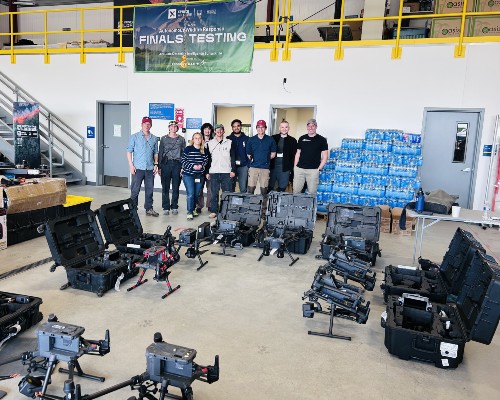
University of Bristol robotics experts are competing in the finals of the prestigious XPRIZE Wildfire Autonomous Wildfire Response $5M competition in Alaska this weekend (Sunday 21 June) as part of an international team called AURA Foresight.
The AURA Foresight team is one of just four finalists selected from more than 130 teams worldwide. During the final challenge, the team will deploy its autonomous system to detect, verify and coordinate rapid responses to wildfire ignitions across a 700 km² area within just ten minutes.
The competition aims to transform how the world detects and responds to destructive wildfires by encouraging breakthrough technologies capable of identifying and suppressing fires before they escalate into major disasters.
AURA Foresight is an international collaboration between the AURA UK team led by the University of Bristol, and Fire Foresight in Australia.
As wildfires become more frequent and severe worldwide, AURA Foresight’s technology provides continuous monitoring of landscapes using optical and thermal sensors. Artificial intelligence automatically identifies potential ignitions, while swarms of autonomous flying robots are deployed to verify threats and coordinate rapid intervention within minutes, helping prevent small fires from developing into destructive wildfires.
Designed to act at the earliest possible stage, the system aims to contain fires when they are still small and manageable, reducing the risk of widespread environmental damage, economic loss and threats to human life.
Central to the team’s approach is close collaboration with firefighters and emergency response professionals. The consortium works directly with Lancashire Fire and Rescue Service in the UK and with wildfire response experts in Canada and Australia to ensure the technology addresses real world operational challenges and integrates seamlessly into existing emergency response workflows. By combining frontline expertise with advanced robotics, the team is developing technology that supports firefighters and enhances operational effectiveness during wildfire incidents.
The Autonomous Wildfire Response Track is one of two tracks within the US$11 million XPRIZE Wildfire competition. Being selected as a finalist places AURA Foresight among a small group of innovators developing the next generation of tools to help communities, land managers and emergency services respond to wildfires faster and more effectively.
Unlike many wildfire technologies that rely on specialised infrastructure or proprietary hardware, AURA Foresight has been designed from the outset to be practical, affordable and easy to deploy.
Key advantages include:
- Out-of-the-box deployment with minimal setup requirements.
- Adaptability to any environment, from forests and remote wilderness to critical infrastructure corridors.
- Scalability from a handful to dozens of flying robots, depending on operational needs.
- Compatibility with different aircraft and robot platforms, avoiding vendor lock-in.
- Built on commercially available technologies, making advanced wildfire protection accessible and achievable for organisations of all sizes.
The result is a system that can help agencies move from passive monitoring and delayed response to proactive, automated intervention.
Dr Georgios Tzoumas, Team Co-Lead of AURA Foresight and Senior Research Associate at the University of Bristol, said: “It’s amazing what can be achieved when great people come together around a shared purpose.
“Our team has been working on autonomous wildfire detection and intervention technologies for more than six years. Reaching the XPRIZE finals is an exciting milestone because it feels like the solution is finally within reach. By combining AI, swarm robotics and close collaboration with firefighters, we’re showing that it’s possible to tackle wildfires while they are still small, before they grow out of control. We can’t wait to demonstrate our technology in the field in Alaska.”
Fire Foresight CEO Rob Vernon added: “Our approach with the XPRIZE competition has been to bring all the pieces of the wildfire jigsaw puzzle together, and that capability only truly scales when it’s done with partners from around the world and on the ground. In Australia, we have been building the largest network of bushfire detection capabilities and the partnerships that we’ve formed, and continue to form, through this competition allow us to focus our attention on the autonomous mitigation and suppression capabilities, so desperately need to address the challenges faced by wildfire and climate change.”
The consortium includes the University of Bristol, Bristol Robotics Laboratory, the University of Sheffield, Lancashire Fire and Rescue Service, Fire Foresight, Indicium Dynamics, Robotic Cats, Taz Drone Solutions, SkyFly Drones, Southern Denmark University, the University of Manchester, and Little Place Labs.
Together, these partners combine world-leading expertise in swarm robotics, autonomous systems, artificial intelligence, computer vision, aerial robotics, wildfire operations and field deployment.
By bringing together researchers, engineers, firefighters and technology innovators from across three continents, AURA Foresight is demonstrating how international collaboration can accelerate solutions to one of the world’s most pressing climate challenges.














Leave a comment