
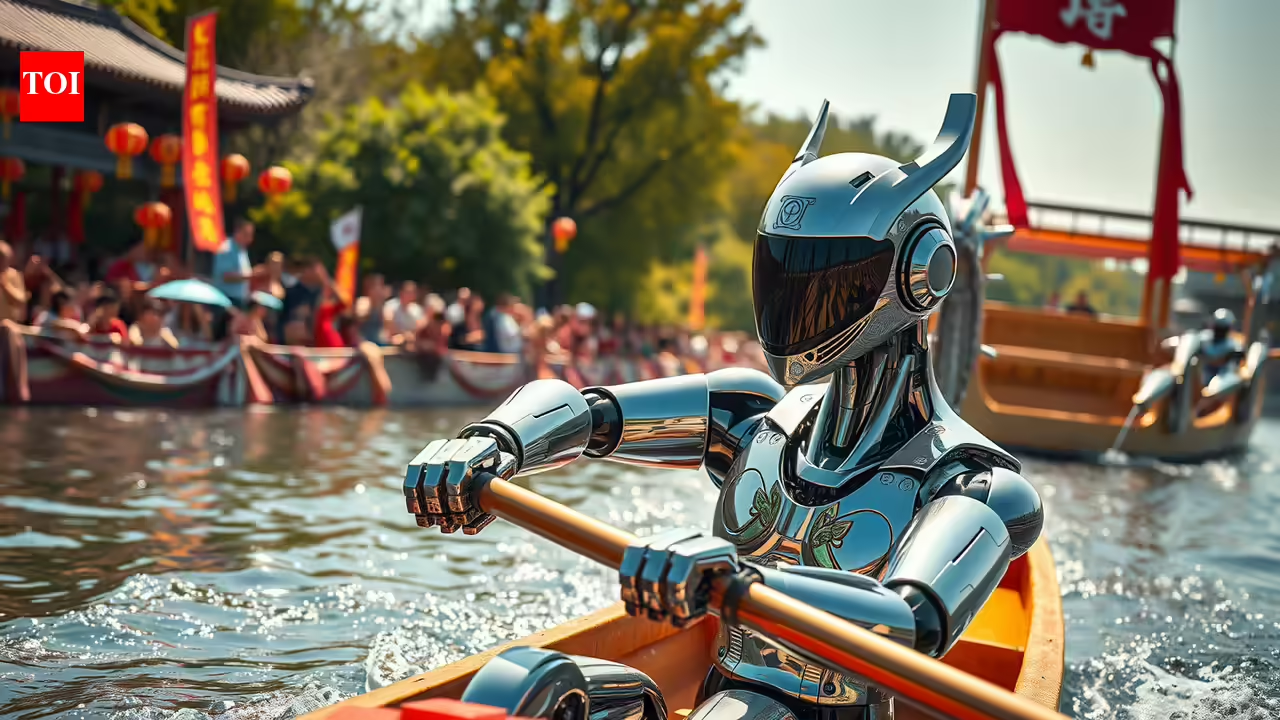
The Dragon Boat Festival has celebrated teamwork, rhythm, and endurance for more than 2,000 years. This year, one of China’s oldest traditions gained an unexpected crew: humanoid robots. As dragon boats cut through the water during festival celebrations, advanced AI-powered machines joined demonstrations that blended cultural heritage with cutting-edge robotics. The spectacle drew attention not simply because robots were present, but because rowing a dragon boat requires a level of synchronisation, balance, and coordinated movement that remains challenging even for humans. The event highlights how rapidly humanoid robotics is advancing in China, where researchers and companies are increasingly testing machines in dynamic real-world environments. From martial arts performances to dragon boat rowing, these demonstrations offer a glimpse into how embodied artificial intelligence is moving beyond laboratories and into public life.
How humanoid robots joined one of China’s oldest cultural traditions
The Dragon Boat Festival, known as the Duanwu Festival, is one of China’s most important traditional celebrations and was inscribed on UNESCO’s Representative List of the Intangible Cultural Heritage of Humanity in 2009. Dragon boat racing remains its most recognisable feature, with teams paddling in unison to the beat of a drum. What makes dragon boat racing remarkable is the precision involved. Success depends on dozens of rowers matching their movements perfectly while maintaining balance and timing.That same challenge has attracted robotics engineers. Recent demonstrations involving humanoid robots showcased machines capable of performing coordinated rowing movements, requiring continuous adjustment of posture, force, and rhythm. While the robots were not competing against professional crews, the exercise demonstrated how far motion control systems have progressed in recent years.Researchers view such activities as valuable tests for embodied AI because they require robots to perform complex physical tasks rather than simply execute pre-programmed movements.
Why dragon boat rowing is a difficult challenge for AI-powered robots
Walking is difficult for a robot. Moving in perfect synchrony with multiple partners while maintaining balance on an unstable platform is significantly harder.Modern humanoid robots rely on a combination of sensors, computer vision, motion-planning algorithms, and real-time feedback systems to perform coordinated actions. Small errors can quickly compound, causing instability or loss of synchronisation.China’s robotics sector has spent the past few years pushing these capabilities forward. As reported by CGTN, earlier in 2026, humanoid robots developed by companies including Unitree Robotics demonstrated advanced martial arts routines during the Spring Festival Gala, executing complex sequences involving balance recovery, rapid directional changes, and coordinated group movements. According to Applied and Computational Engineering analyses of embodied intelligence, one of the major goals of humanoid robotics research is creating machines capable of adapting to unpredictable environments rather than operating only in controlled settings.Dragon boat rowing provides exactly that type of challenge. Water movement, changing weight distribution, and the need for precise timing make it an effective test of robotic coordination and control.
China’s robotics industry is using public events to showcase embodied AI
The appearance of humanoid robots at cultural events reflects a broader trend within China’s technology sector.According to industry data cited during the 2026 Spring Festival Gala, China accounted for roughly 90 per cent of global humanoid robot shipments in 2025, with production expected to continue growing rapidly. The country’s robotics companies are increasingly using high-profile public demonstrations to showcase advances in mobility, balance, coordination, and artificial intelligence. For robotics researchers, the significance extends beyond entertainment.Tasks such as rowing, dancing, martial arts, and sports require machines to operate in environments that cannot be perfectly predicted. Success in these scenarios often reflects improvements in real-world adaptability, a crucial step towards future applications in manufacturing, logistics, disaster response, and healthcare.The Dragon Boat Festival demonstration therefore served two purposes simultaneously. It celebrated a tradition that has endured for centuries while highlighting technologies that could shape the decades ahead.
What humanoid robots at the Dragon Boat Festival tell us about the future
Dragon boats have long symbolised collective effort. Every paddler must move together for the vessel to gain speed.In many ways, that principle mirrors the challenge facing robotics engineers today. Building useful humanoid robots requires the integration of mechanics, artificial intelligence, sensor technology, and human-centred design into a single coordinated system.The sight of robots rowing alongside a tradition rooted in ancient China may have seemed unusual, yet it offered a powerful reminder that technological progress does not always replace cultural heritage. Sometimes it finds a way to participate in it.













Leave a comment