

AI data centres must deliver continuous, reliable power while transitioning toward low-carbon energy. Yet many still depend on fossil-fuel-based backup systems such as diesel generators to ensure uptime. Balancing resilience with sustainability is becoming a defining challenge for the industry.
Reducing dependence on fossil backup through energy storage
To move toward truly sustainable operations, data centres are increasingly integrating advanced energy storage into their power architecture. Battery systems are no longer limited to emergency backup; they are becoming a core layer that helps stabilise how power is generated, stored, and used across AI-driven facilities.
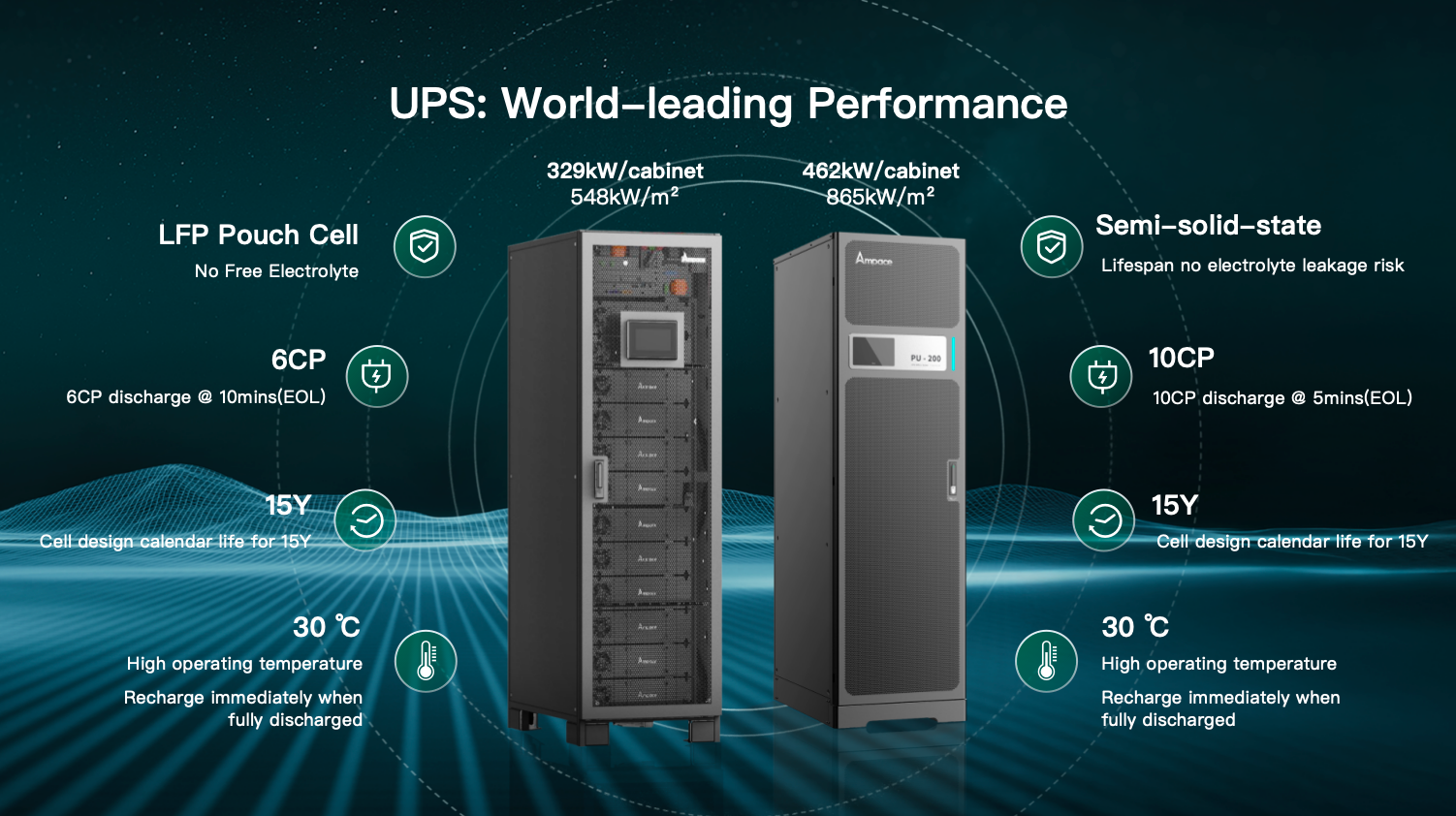
Within AI data centre power architecture, Ampace’s UPS and BESS are playing a critical role in smoothing highly dynamic electricity demand. By absorbing rapid load fluctuations caused by AI workloads, they help reduce the need for oversized infrastructure while also easing pressure on the grid. This stabilisation effect allows data centres to operate more efficiently under variable loads, rather than constantly preparing for extreme peak demand.
At the same time, this capability supports a more flexible use of energy sources. As renewable energy becomes a larger part of the power mix, energy storage helps manage intermittency and improves the alignment between energy supply and real-time demand. This reduces reliance on traditional fossil-fuel-based backup systems, such as diesel generators, which have historically been required to guarantee uninterrupted operation.
By enabling both power stability and greater compatibility with low-carbon energy, Ampace’s battery solutions support data centres move closer to achieving both high performance and sustainable operation in AI-driven environments.
Optimising energy efficiency for AI workloads
AI workloads introduce rapid, unpredictable changes in power demand, making efficient energy management more complex. Without precise control, these fluctuations can lead to unnecessary energy loss and reduced system efficiency.
Ampace addresses this by improving how energy is monitored, distributed, and utilised across the battery system. More accurate tracking of battery condition and energy levels enables power to be delivered precisely when needed, avoiding inefficiencies caused by overcompensation or imbalance.
The system is also designed to maintain consistency across battery cells and reduce uneven aging, helping sustain performance over time while minimising wasted energy. In addition, optimised control of thermal and operating conditions reduces internal energy consumption, further improving overall system efficiency.
By aligning energy supply more closely with real-time AI demand, Ampace enables data centres to operate more efficiently under high-density workloads – supporting both performance and sustainability goals.
Enhancing safety and lifecycle sustainability
For AI data centres, sustainability is closely tied to system reliability and longevity. Frequent replacement or safety risks not only disrupt operations but also increase environmental impact.
Ampace adopts a full-lifecycle design approach to address these challenges. Its battery architecture reduces risks associated with leakage while improving intrinsic system safety. At the same time, over 15 years long lifecycle performance under AI workloads helps extend system lifespan and reduce the need for replacement.
This combination of safety, durability, and stability supports more resource-efficient operations and contributes to a lower overall environmental footprint across the lifecycle of data centre infrastructure.
Scaling low-carbon impact across operations
Ampace’s commitment to sustainability extends beyond its products into its manufacturing and energy practices.
In February 2026, its XM campus achieved 100% zero-carbon electricity usage and passed ISO14064 organisational greenhouse gas verification for the third consecutive year. Compared with its 2024 baseline, carbon emissions per unit product have decreased by 82.9%.
This progress is driven by a comprehensive low-carbon strategy, including low-emission design, energy-efficient manufacturing supported by distributed solar and energy storage, reduced supply chain emissions, and the development of circular battery ecosystems.
The company has also achieved operational carbon neutrality under ISO14068-1:2023 certification. Its deployment of a 28 MWp photovoltaic system with 8.5 MWh of energy storage enables intelligent energy management, improving renewable energy utilisation and reducing overall carbon impact.
Advancing sustainable AI infrastructure
As AI continues to scale, the path toward sustainable data centres depends on integrating energy efficiency, renewable power, and resilient infrastructure.
Ampace’s AIDC Battery Solution is designed to support this transition – enabling data centres to meet high-density computing demands while advancing toward more reliable, efficient, and low-carbon energy systems.














Leave a comment