
Key takeaways:
- One model used approximately 106 features to predict OSA, whereas the other only used four.
- Receiver operating characteristic areas under the curves were above 0.7 for predicting any OSA and moderate-severe OSA.
Machine learning models that use electronic health record data to predict obstructive sleep apnea had greater performance than two screening questionnaires, according to a poster presented at SLEEP 2026 Annual Meeting.

Nathanael H. Hwang
“Because these models rely solely on pre-existing EHR data, the prediction output can run passively in the background for any given patient,” Nathanael H. Hwang, research intern at Beth Israel Deaconess Medical Center, told Healio. “An OSA risk profile can therefore be generated for each patient and made available for clinicians to review in the course of their care.

Data derived from Hwang NH, et al. Applying machine learning to predict obstructive sleep apnea using electronic health records. Presented at: SLEEP Annual Meeting; June 14-17, 2026; Baltimore.
“This supports both encounter-based use cases, in which a clinician reviews the risk profile during an office visit, and population screening strategies, in which proactive batch outreach to patient groups can be operationalized,” Hwang said.
In this study, Hwang and colleagues developed and validated four machine learning models using EHR data from 265,236 adults (mean age, 51.7 years; 56.7% men; 37.2% white; 39.3% Hispanic) with a diagnostic sleep study at Kaiser Permanente. Models were developed to predict any OSA (apnea-hypopnea index [AHI] ≥ 5) and moderate to severe OSA (AHI ≥ 15), with both full-feature and minimal-feature versions for each outcome.
“We recognized the need for better identification of people at risk for OSA,” Hwang told Healio. “Clinicians consistently report the tediousness and limited performance of current tools such as the STOP-BANG questionnaire. Leveraging more sophisticated approaches like machine learning, we felt compelled to develop a higher-performing tool to support clinical decision-making.”
One model used approximately 106 features including demographics, comorbidities, labs and vitals to predict OSA (full model), whereas the other model only used age, sex, BMI and race/ethnicity to predict OSA (minimal model).
“We aimed to design the tool as a low-effort solution built on commonly available EHR data, requiring no additional data collection,” Hwang said. “Our broader motivation is to promote public health by making our models available in a form that can be feasibly implemented across most health systems.”
In an internal held-out test (n = 57,861), researchers found a receiver operating characteristic area under the curve (ROC AUC) above 0.7 with the full model for predicting both any OSA (0.777; 95% CI, 0.772-0.781) and moderate-severe OSA (0.758; 95% CI, 0.754-0.762).
The ROC AUC also stayed above 0.7 with the minimal model for both any OSA (0.752; 95% CI, 0.748-0.757) and moderate-severe OSA (0.73; 95% CI, 0.726-0.734), according to the poster.
Using a prospective temporal cohort (n = 36,517), researchers continued to find ROC AUC values above 0.7 for predicting both types of OSA with the full model (any OSA, 0.788; moderate-severe OSA, 0.768) and the minimal model (any OSA, 0.77; moderate-severe OSA, 0.742).
“The minimal models performed nearly as well as the full models,” Hwang told Healio. “We consider this an encouraging finding, as the minimal model should be substantially easier to implement in practice, while the full models are options for health systems that want to maximize performance.”
The external validation cohort included 20,194 individuals (mean age, 53.7 years; 49.3% men; 61.8% white; 6.9% Hispanic) from Kansas University Medical Center (KUMC).
After applying the Kaiser Permanente models to KUMC, researchers continued to find ROC AUCs above 0.7 from both models for predicting any OSA (full, 0.735; minimal, 0.733) and moderate-severe OSA (full, 0.71; minimal, 0.715). ROC AUC values after warm-start fine-tuning transfer learning were similar to those noted above for any OSA (full, 0.742; minimal, 0.73) and moderate-severe OSA (both 0.719).
“Although the overall AUC values were lower at the KUMC site, the performance was comparable to the KUMC natively trained models, demonstrating the transportability of the models to other health systems,” Hwang said.
This study also included a head-to-head cohort of 1,981 individuals to see how the two machine learning models stack up against the STOP-BANG and Supersparse Linear Integer Model (SLIM) screening questionnaire tools.
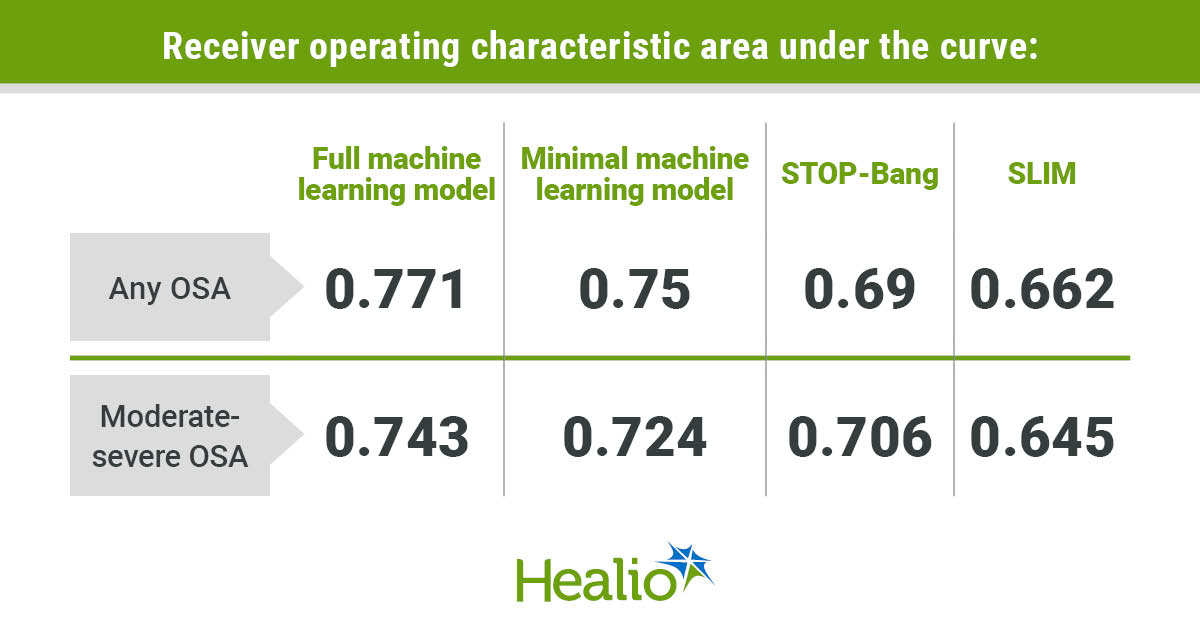
For predicting any OSA, the full model had the highest ROC AUC (0.771), followed by the minimal model (0.75), STOP-BANG (0.69) and SLIM (0.662). This pattern was also observed for predicting moderate-severe OSA, as the full model had the highest ROC AUC (0.743), followed by the minimal model (0.724), STOP-BANG (0.706) and SLIM (0.645).
When evaluating net benefit across decision thresholds, the greatest net benefit was reported with the machine learning models vs. STOP-BANG and SLIM and remained above the “treat all” strategy across the entire threshold range, which Hwang said supports their excellent clinical utility.
“Real-world validation of performance and clinical utility is essential,” Hwang told Healio. “This work is already underway, with our models being integrated into primary care and perioperative workflows as quality improvement clinical pilots.”
For more information:
Nathanael H. Hwang can be reached at nhwang3@bilh.org.
Sources/Disclosures
Source:
Hwang NH, et al. Applying machine learning to predict obstructive sleep apnea using electronic health records. Presented at: SLEEP Annual Meeting; June 14-17, 2026; Baltimore.
Disclosures:
Hwang reports currently working at Resmed Corp. as a research intern.

Ask a clinical question and tap into Healio AI’s knowledge base.
- PubMed, enrolling/recruiting trials, guidelines
- Clinical Guidance, Healio CME, FDA news
- Healio’s exclusive daily news coverage of clinical data
















Leave a comment