
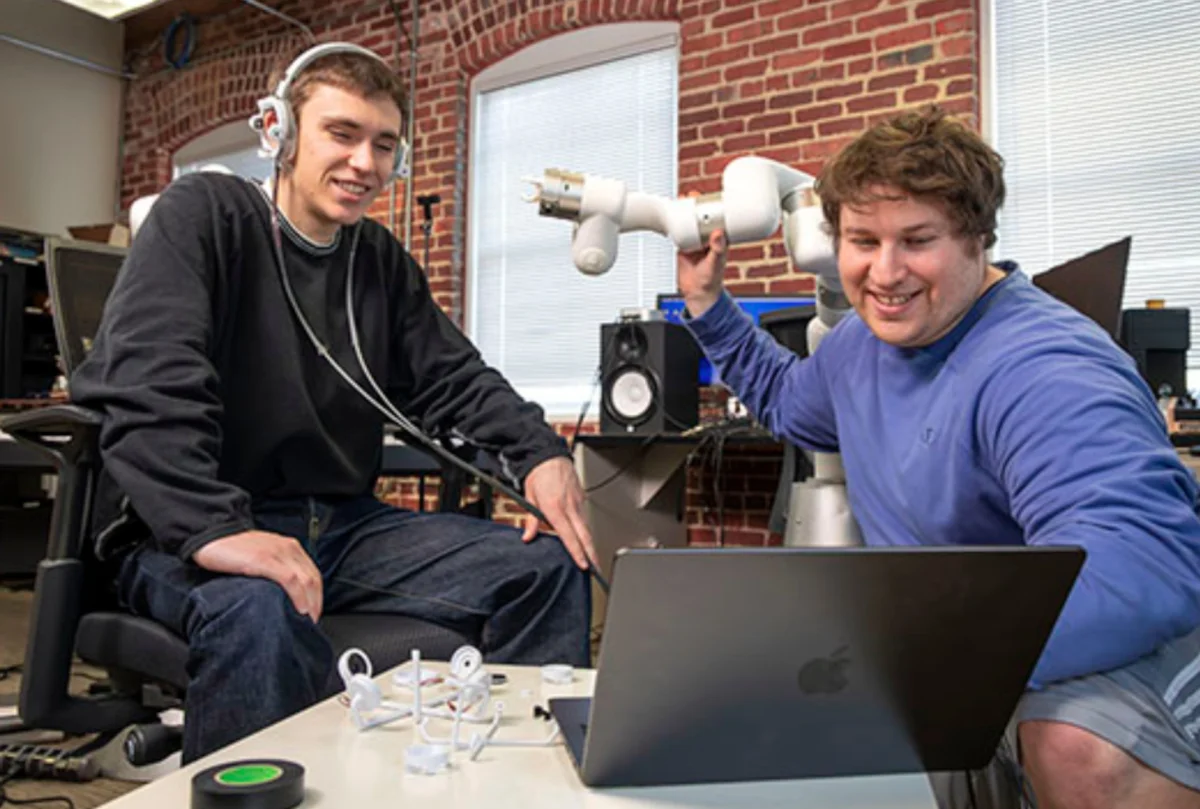
Scientists at the Georgia Tech Center for Music Technology have developed Spherephones, a wearable system that signals the approach of a robot to a human in collaborative work scenarios using a melody in three dimensions. The researchers aim to prevent accidents during human-robot collaboration and increase workplace safety.
In horror films, music signals that a jump scare is imminent. The Georgia Tech researchers are leveraging this to signal the approach of a robot in collaborative work scenarios, such as in factory halls, through an escalating melody. Previous approaches, such as simply emitting a warning tone, are often insufficient, according to the scientists. These signals provide no information about what problem is occurring, where it is occurring, and how quickly it needs to be addressed. Furthermore, it has been observed that people tend to tune out such simple warning signals over time.
“Alerts always demand your attention, even when they don’t need to,” explains Amit Rogel, one of the researchers involved. “Music doesn’t have to do that.”
Background music replaces simple warning signals
Accordingly, the scientists developed Spherephones, a wearable system that converts robot movements in a work environment into music, allowing a worker to anticipate the course of the movements. The output is via open headphones, so the person can perceive both the melody and the normal ambient sounds.
Empfohlener redaktioneller Inhalt
Mit Ihrer Zustimmung wird hier ein externes YouTube-Video (Google Ireland Limited) geladen.
The video explains the principle of Spherephones and demonstrates their function.
As soon as a robot approaches, a melody plays, allowing the person to predict when it will end. This is the point at which the robot arrives. The advantage of this method: The music remains in the background; it can swell and fade and warn without interrupting concentration. The Spherephones are equipped with four speakers per ear that surround the ear, enabling simultaneous signaling in three-dimensional space and allowing the human worker to identify where a potential danger might be expected.
The music genre used is computer-generated lo-fi, a calm background music, such as that used for studying. It allows one to recognize if something is moving towards them and from which direction it is coming. At the same time, the melody signals whether it is dangerous or not.
To ensure that multiple different people in a room receive the appropriate warnings for them, the melodies are personalized. Each worker receives their tailored Spherephone, which signals the approach of a robot in the room.
Other applications possible
In experiments, the scientists found that spherephones are not only suitable for improving safety in collaboration with robots. The researchers are investigating how they can be used with appropriate adaptations for visually impaired people, veterans with post-traumatic stress disorder, and gamers. They state that further applications are possible.
(olb)















Leave a comment