
As AI becomes more deeply embedded in research and publishing workflows, the question is no longer whether scholars will use AI, but what kind of AI they can trust. Paperpal, the academic writing and research assistant developed by Mumbai-based Cactus Communications, is approaching five million registered users globally, including around 1.3 to 1.4 million in India, and has expanded well beyond its original researcher base to attract students, professionals, and journalists, it said.
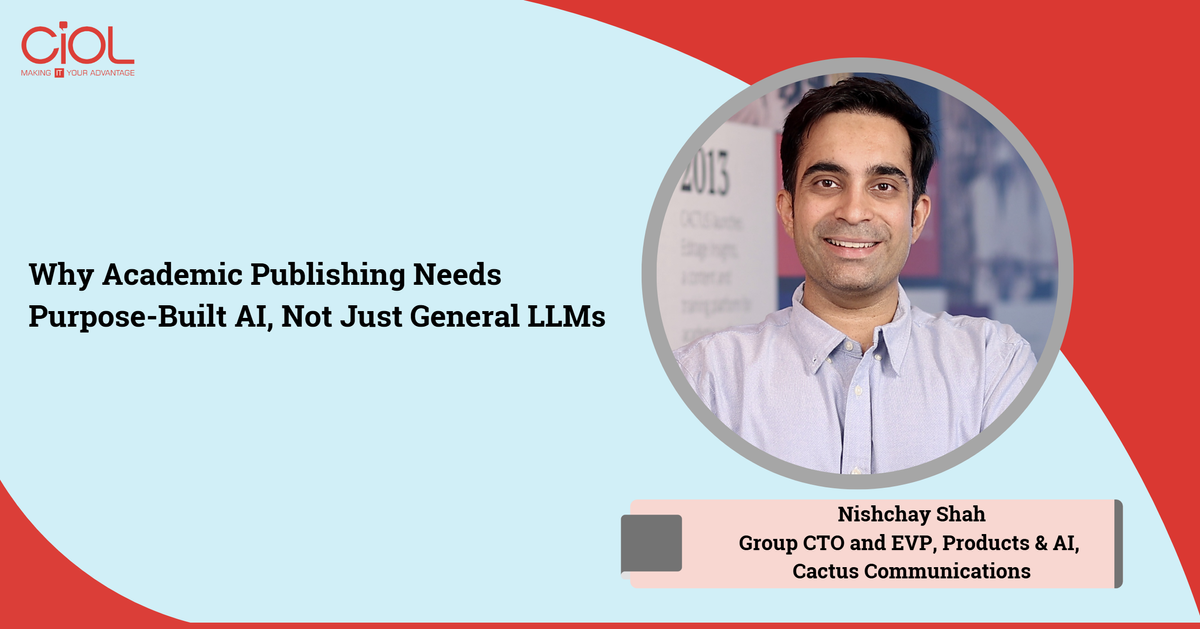
Founded in 2002, Cactus Communications has evolved from a research services firm into an AI-led research technology company. In an interview with CIOL, Nishchay Shah, Group CTO and EVP, Products & AI at Cactus Communications, discusses the company’s transition from research services to AI-led products, why academic publishing demands purpose-built models rather than generic large language models (LLMs), how Paperpal is building trust and verification into research workflows, and where he sees India’s biggest opportunity in domain-specific AI.
Interview Excerpts:
Cactus began as a research services company and has since evolved into an AI-led organization. What drove that transformation, and what was the hardest part of building AI products in a research ecosystem?
Around 2015–16, the business was growing well, but there was a lot of chatter in AI circles that text-based AI was going to become a real thing. We decided that if AI was going to disrupt our business anyway, we’d rather disrupt ourselves and use it to build better offerings for customers. The idea wasn’t to build Paperpal specifically but was to use AI to inject efficiency, accuracy, and quality into what we gave customers.
Two challenges stood out. First, the tech itself. Building an AI product is far easier today than it was in 2016, when server costs and infrastructure were prohibitively expensive where it took us almost a year just to figure out where to start. Second, getting people to adopt AI. It wasn’t reliable enough to let go of, so you needed humans in the loop, which actually created more work early on or at least until the value it delivered outweighed the effort of managing it.
Researchers already have access to general-purpose AI tools like GPT-5, Claude, and Gemini. Why does scholarly communication need a purpose-built platform like Paperpal?
We get this question from investors and outsiders all the time. Our view: foundation models are the engine, not the car. Paperpal runs on almost 30 different models, and about half are homegrown, super-micro models built for specific research use cases.
Academic writing has its own language like the tone journals and publishers expect is different from what a generic LLM is trained to produce. We still hear, almost daily, that Claude or GPT couldn’t do justice to language editing the way Paperpal does. On top of that, we’ve built in plagiarism checks, statistical reporting, ethical compliance, and citation checks —a narrower but expert-level tool built to take a researcher’s manuscript all the way to publication-ready, versus a broad general-purpose tool.
Hallucination, plagiarism, and overdependence on AI are big concerns in academia. How do you protect research integrity?
Every output from our research tools is grounded in evidence like if the system makes a claim, it cites the specific published papers behind it, with valid links. That’s how we avoid hallucination, though it does mean we stay focused on actual research rather than pulling from blogs or random articles. The second piece is that Paperpal is built to help researchers write, not to generate for them. You put in your own notes and inputs, and it synthesizes rather than generating from scratch. We also have a feature that tracks how much of a document came from AI generation, the user’s own writing, or copy-pasted input, so authors know exactly how much of the final piece is truly their own.
How do you see AI reshaping peer review, and which parts should stay human?
AI is accelerating research broadly were researchers used to lose huge amounts of time to grunt work like statistical analysis, image generation, and abstract writing. That’s freeing them up to spend more time actually thinking and exploring hypotheses. But peer review itself should remain human as it’s the final verdict on whether research is valid. We have an AI-assisted tool, Paperpal Preflight, but some journals that experimented with fully automating peer review found the tools showed bias in what they approved. AI should handle structural and integrity checks; humans should own scientific judgment.
What are the biggest inefficiencies in today’s review process, and how does Preflight help before a paper even reaches peer review?
Peer review is essentially unpaid community service, so there simply aren’t enough reviewers, and AI is only increasing the volume of papers being produced. But before a paper even gets to a human reviewer, there’s a whole layer of technical and compliance checks: correct abstract, references, formatting, plagiarism, paper-mill red flags, image integrity. Preflight automates most of that first layer, and on the reviewer side, it surfaces key statements and related published work so reviewers spend less time on mechanics.
For journals and publishers specifically, Preflight’s Integrity Suite tracks close to 30 different markers like content manipulation, disclosure gaps, image manipulation, and more. So yes, this is as much a trust and verification layer as it is a productivity tool.
India’s AI narrative centers on foundation models and infrastructure. Where’s the real opportunity, and what’s holding it back?
For India, the foundation-model ship has largely sailed, there are already enough good ones out there. What India has is a huge, self-sustaining ecosystem with lots of industries, lots of data, a large young population. The opportunity is in micro-models trained on Indian data for Indian problems, agriculture is a good example, where the capability exists but large-scale data collection doesn’t. The biggest bottleneck is penetration into rural areas, where most of the real industrial and agricultural work happens but AI education hasn’t reached. If we can get education and data collection going there, that’s where the real leap happens.
What have you learned about scaling AI products from India into competitive global markets?
People outside India tend to have more patience. Indians want immediate ROI and tend to skip steps, which can hurt in AI, where things often fail repeatedly before showing value. The flip side is we’re good at cutting losses fast and not getting trapped by sunk cost. The other gap is education. In the U.S. and China there’s a much stronger cultural focus on skilling and exploration. In India, an engineering student’s first question is usually “where will I get placed?” rather than “what can I build?” If that shifts, India can really move ahead.
What do you see as the next breakthrough applications of AI in research?
Collaboration and communication will change the most. Look at COVID, the vaccine came together fast partly because governments opened up and shared data. AI-driven data synthesis will let someone in a remote part of Uganda learn what’s happening at Johns Hopkins almost in real time. On the consumption side, synthesis is the biggest shift. Finding and synthesizing 30 relevant papers used to take weeks but with Paperpal, that happens in seconds, and you can go deeper into individual papers from there.
Where do the numbers stand today, users, growth, business model?
The registered user base has grown 71% year-on-year globally, and we’ve increasingly seen non-researchers like students, professionals, journalists, adopt the product organically. It’s a dual B2B/B2C model: about 80% B2C, with social media (LinkedIn, Instagram, YouTube) as our biggest acquisition channel, plus geographic pricing. The rest is institutional licensing for universities.
Our edge is threefold: we’re built specifically for research-backed writing; we’ve spent 24 years understanding how journals, publishers, and researchers actually work; and we run over 100 customer conversations a month to drive the roadmap, rather than building off an internal wishlist. We have a 200+ person AI, engineering, and technology team, with 10% –15% of overall R&D spend dedicated to AI. In the last 30 days alone, researchers completed more than 2.2 million AI-assisted writing interactions, and 87% of users say Paperpal helps them write and revise faster. North America is our largest market, followed by India, with growing traction in Japan, the U.K., the Middle East, and Southeast Asia, Paperpal now has users across 125 countries.
(Note: The figures are as of June 2026)















Leave a comment