

An explanation of what Artificial General Intelligence is, aimed at beginners. We introduce the differences from generative AI, its characteristics, the current state of its realization, and the future that creators who use AI need to know.
“If ChatGPT can do this much, hasn’t Artificial General Intelligence already been realized?”
When using AI, one might have such a question.
Writing text, creating images, generating ideas, writing programs. Current generative AI has become capable of supporting our work in a fairly wide range of ways.
So, what exactly is Artificial General Intelligence?
In this article, we will organize the meaning of Artificial General Intelligence, its differences from generative AI, the current state of its realization, and its relationship with our work as simply as possible.
What is Artificial General Intelligence?
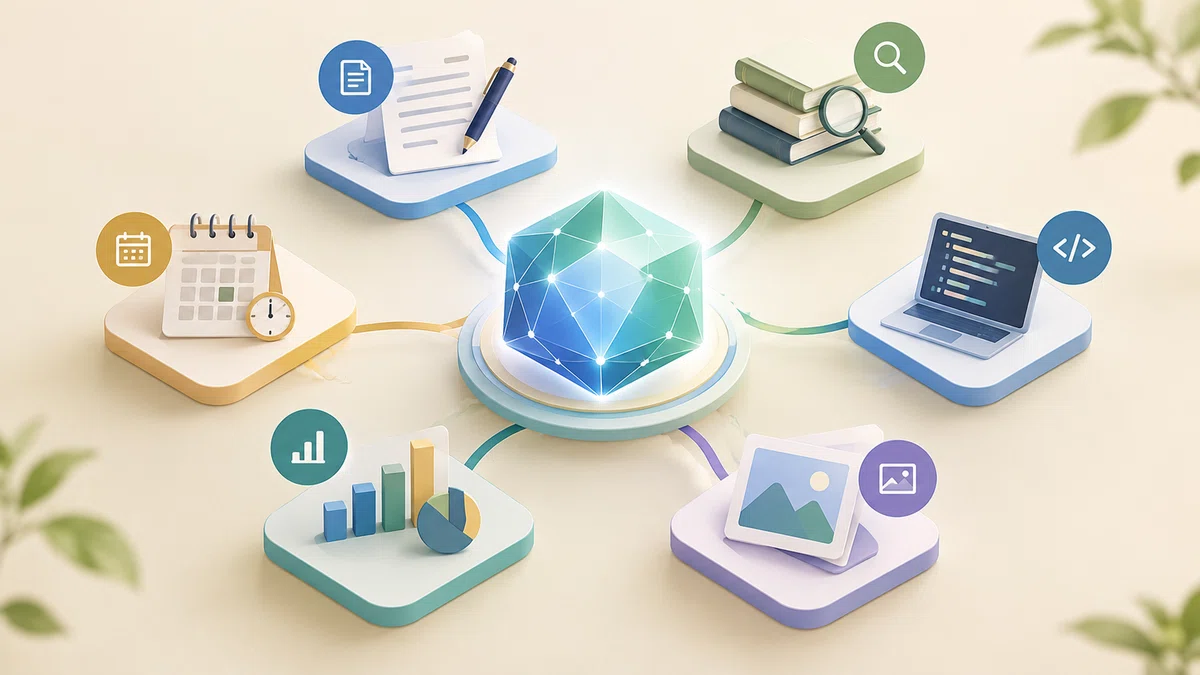
Artificial General Intelligence refers to artificial intelligence that can flexibly respond to various intellectual tasks.
In English, it is called Artificial General Intelligence and is abbreviated as AGI.
There are many current AIs that are strong in specific applications. On the other hand, AGI is considered to have high versatility, capable of handling a wide range of tasks with a single AI, rather than just a specific field.
In an article published on September 2, 2026, the National Institute of Advanced Industrial Science and Technology (AIST) describes AGI as “AI that demonstrates capabilities equal to or greater than those of humans.” However, it should be noted that there is no clear definition among researchers, and it is perceived as an abstract concept.
AGI is an abbreviation for “Artificial General Intelligence.” While many conventional artificial intelligences (AI) are specialized for specific uses, it can be said that it is “AI that demonstrates capabilities equal to or greater than those of humans,” equipped with high versatility that allows it to execute various tasks with a single AI.
In other words, the point when understanding AGI is not “AI that is good at one thing,” but AI that can apply knowledge and abilities to various tasks.
What is the difference between Artificial General Intelligence and generative AI?
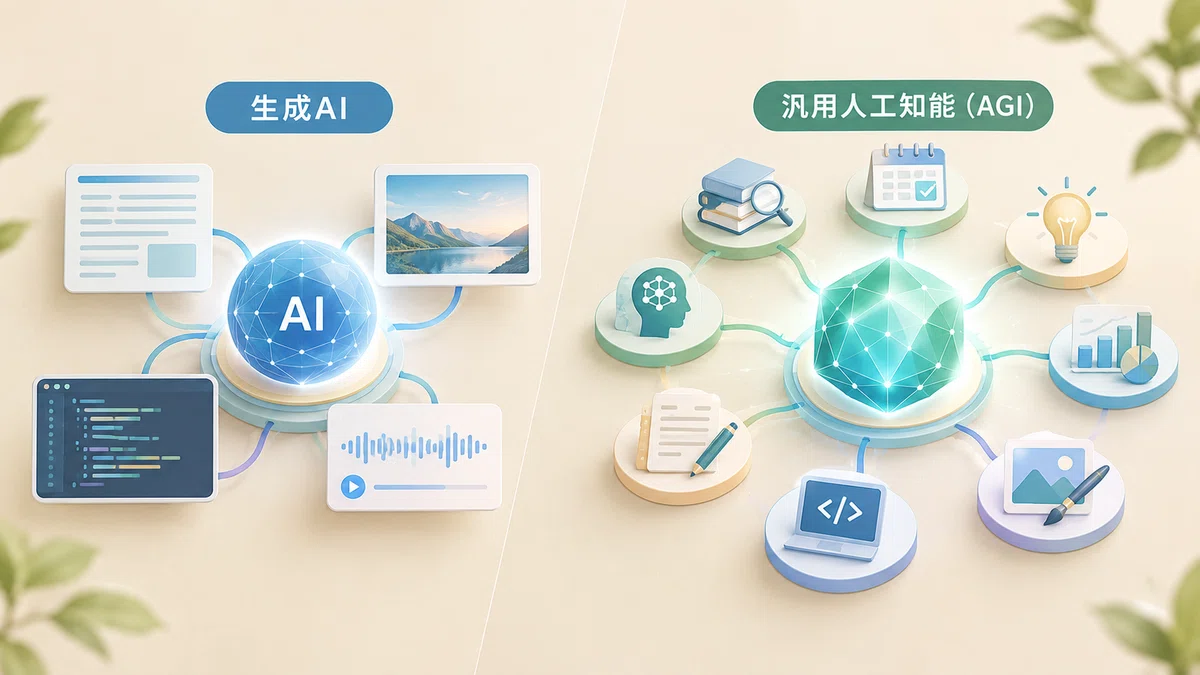
Artificial General Intelligence and generative AI are not the same thing.
Generative AI is AI that generates text, images, audio, code, etc. Many of the generative AIs we use today can handle a very wide range of applications, but that alone does not define them as AGI.
In “Basic Knowledge You Should Know About AI,” NEDO organizes many of the AIs currently in practical use as specialized artificial intelligence, and explains that AGI is still in the research stage.
The second is “Artificial General Intelligence (AGI).” This is AI that can flexibly handle various tasks like a human, and it is also called “strong AI.”
What is important here is that the high performance of generative AI and the realization of AGI are separate issues.
For example, even if a text-writing AI can write an article, that alone does not mean it has become an AGI that can understand unknown tasks, acquire necessary knowledge, and apply it to other fields like a human.
Has artificial general intelligence already been realized?
At this point, it is not a situation where we can uniformly judge that it has been realized regarding AGI.
One reason for this is that there is no clear definition of AGI in the first place.
AIST also explains that the time judged as realized changes significantly depending on what is considered AGI. Furthermore, NEDO has organized that AGI has not yet been realized as of 2025.
This point is also important when writing articles about AI.
The fact that “AI is evolving rapidly” and the judgment that “AGI has been realized” must be considered separately.
In the world of AI, every time a new model appears, there is a debate about whether it has “approached AGI.” However, at this stage, the term AGI itself has a range of definitions.
What will change if artificial general intelligence is realized?
If AGI is realized, the way we work could change significantly.
For example, it is a future where a single creator is supported by AI in a series of tasks: thinking of plans, researching information, writing articles, creating images, editing videos, and analyzing data after publication.
Even now, I do not use AI merely as a text generation tool, but utilize it as part of a workflow that connects planning, information organization, article creation, image production, and more.
From this experience, I feel that in AI utilization, it is important not only “what to ask AI,” but “how to design the entire job”.
Without waiting for whether AGI will be realized in the future, the production environment for people working alone is already starting to change significantly with current generative AI.
Rather than AI replacing a single task, humans design new work flows that incorporate AI.
I believe this perspective is particularly important for creators today.
Understanding Artificial General Intelligence reveals the current state of AI
Artificial General Intelligence is a concept that aims for AI capable of flexibly responding to various intellectual tasks.
On the other hand, while current generative AI is already used for a wide range of purposes such as text, images, audio, and code, AGI and generative AI are not synonymous.
The Japanese Society for Artificial Intelligence also explains AGI from the perspective of being “designed to be able to acquire various skills.”
“Artificial General Intelligence” is the translation of “Artificial General Intelligence (AGI),” and it refers to “general-purpose” artificial intelligence in the sense that it is designed to be able to acquire various skills, rather than being designed for individual tasks.
When following the evolution of AI, eyes turn to topics like “Is AGI next?” or “Is it already AGI?”
However, for a creator, what is important is not just guessing the name of the future.
How far can I streamline my work with the AI available now?
And, how can I combine it with judgments and ideas that only humans can make?
Just by holding that question, the way you interact with AI will change significantly.
Looking back at the history of AI, research began in the 1950s, and with the advent of ChatGPT in 2022, generative AI suddenly became familiar.
What kind of AI will appear next is not yet determined.
That is why, instead of fearing AI and standing still, try using the AI available today as a work partner.
I believe that such a accumulation of small experiments is important when thinking about how we will work in the future.
In this note, I will continue to share information on AI utilization for solo creators and ways to streamline remote work.
If you found this helpful, please like and follow.













Leave a comment