
‘I’m not sure whether to solve this with generative AI or traditional machine learning.’ I receive this inquiry very often these days.
I believe the background to this is that ‘AI’ has come to almost exclusively refer to generative AI. The premise that there are different types of AI has become obscured, leading to cases where goals and tools are mismatched—such as leaving demand forecasting for next month to generative AI, or searching for a numerical prediction model when one wants to search through internal documents.
Even with the same topic of ‘sales,’ an AI that writes explanatory text for a management meeting and an AI that predicts next month’s sales are performing different tasks and learning in different ways. What happens if you choose without knowing this difference? I have summarized the content I spoke about at a recent webinar into an article, following the order of the day.
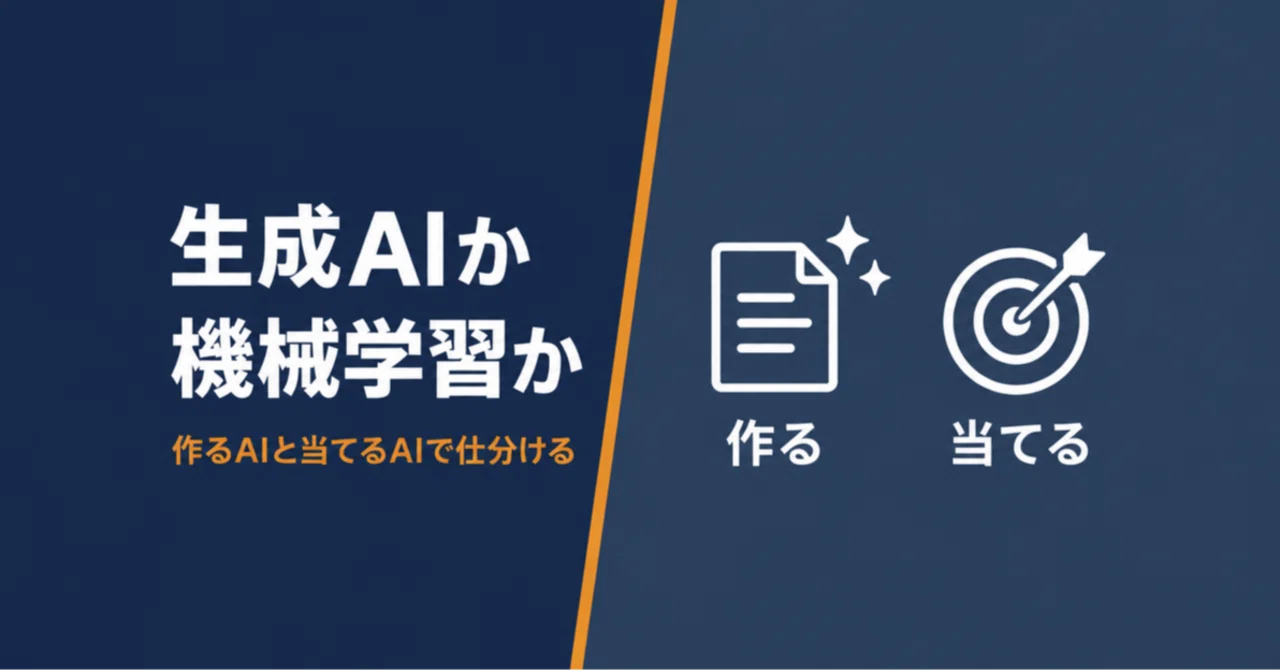
Broadly speaking, AI can be divided into two categories: ‘AI that creates’ and ‘AI that predicts’
At the beginning of the webinar, these were the only words I put forward: ‘AI that creates’ and ‘AI that predicts’.
-
AI that creates (Generative AI): Creating new content such as document generation, summarization, translation, coding, image generation, and dialogue.
-
AI that predicts (Machine Learning): Predicting numbers or labels (classifications like ‘likely to churn or not’), such as sales or demand forecasting, customer segmentation, inventory and vehicle dispatch optimization, anomaly detection, and product recommendations.
Generative AI is a partner that creates new value with you, while machine learning is like an engine that predicts the future to support decision-making. I believe they are not about which is superior, but rather two different tools with different purposes that complement each other.
Even for the same ‘sales’ topic, the task you assign changes. You have generative AI create explanatory text for a management meeting based on last month’s sales results. You have machine learning predict next month’s sales from past data.
Because they learn differently, they are good at different jobs. Generative AI learns by reading vast amounts of text and probabilistically predicting the next word, so its focus is on tasks involving creating and understanding language. Machine learning learns the relationship between input features (such as age and income) and correct values (such as whether a purchase was made), so it excels at predicting, judging, and classifying numbers and labels.

Generative AI has spread. However, its usage is skewed toward text
The adoption of generative AI has progressed significantly over the past few years. However, since the meaning of ‘adoption’ differs in every survey, the numbers must be viewed in conjunction with their definitions.
-
Teikoku Databank survey from March 2026 (approx. 10,000 valid responses): 34.5% of companies use generative AI in their operations, and 14.2% are considering its use.
-
Yano Research Institute survey: The adoption rate went from 9.9% in 2023 to 25.8% in 2024. This is the total of 4.0% that have introduced it company-wide and 21.8% that have introduced it in some departments.
-
PwC survey from spring 2025: 56% of companies are using it internally or providing it externally, an increase of 13 points from the previous survey.
Because the subjects and the way the questions are asked differ, they cannot be lined up as a single adoption rate. However, adoption is progressing in every survey.
Looking at how it is used, the most common use in the Teikoku Databank survey is ‘document creation, summarization, and proofreading’ at 45.1%, while uses that handle numerical data, such as data analysis, were in the minority.
Perhaps because the usage is biased, expectations that ‘generative AI can do anything’ have taken precedence, and I feel that cases where it falls short of expectations are increasing. In the PwC survey, there was a certain number of responses stating that the results fell short of expectations, and this has increased over time. A survey by the Research Institute of Economy, Trade and Industry (RIETI) also points out that there are many PoCs (initiatives to test effectiveness before full-scale introduction) that do not proceed to full-scale implementation.
I believe the background to this is a lack of clear problem definition and a mismatch in technology selection where tools are chosen that do not fit the purpose or the nature of the data, which leads to projects stalling at the PoC stage. Therefore, it is necessary to determine what to solve with generative AI, what to solve with machine learning, and what to combine.
‘AI that predicts’ excels at numerical prediction of structured data
From here on, I will create a map with machine learning on the left and generative AI on the right. Let’s start with the left side.
Machine learning basically handles structured data. This refers to data composed of rows and columns, such as that found in CSV files or databases, including sales history, inventory masters, transaction history, equipment sensor values, and customer masters.
Typical tasks include demand forecasting, credit scoring (judging whether to lend money based on a score), and fraud detection. For the manufacturing industry, predictive maintenance, anomaly detection, production planning, and shift optimization are also tasks that are well-suited for it. ‘Recommended for you’ features on Netflix, Amazon, and Rakuten are also areas where machine learning excels.
There are two major benefits: the accuracy of predictions can be measured numerically, and the results can be explained. You can calculate hit rates and error margins, and provide evidence such as which variables are affecting sales or that there is a tendency for risk to decrease as annual income increases. Generative AI is not good at making arguments based on numerical evidence, and hallucinations (outputting plausible but incorrect information) occur easily.
For example, predictive maintenance is a way of using equipment sensors and historical data to detect signs of failure and perform maintenance before the equipment stops. This prevents sudden shutdowns, production losses, and increased maintenance costs. Anomaly detection in structured time-series data is an area that cannot be solved by generative AI.
‘AI that creates’ excels at tasks involving language. However, the answers can vary.
Generative AI on the right side is an area that handles language rather than numbers. The targets are unstructured data like text, and recently, multimodal AI that can also handle images has become common.
Use cases include internal knowledge search via RAG (a mechanism where AI searches internal documents and provides answers based on their content), inquiry handling, summarization, minutes creation, and contract review.
If I had to narrow it down, there are three strengths. First, you can use pre-trained general-purpose models as they are (now we can use GPT or Claude casually). Second, even non-engineers can try them out immediately. Third, they can cover a wide range of tasks that involve working with language.
There are also three weaknesses. Even with the same question, the answer can vary, making it impossible to ensure reproducibility. Hallucinations also occur. Furthermore, since you generally use AI on the cloud, risks regarding confidential information and copyright remain.
Please also keep the option of specialized AI in mind. Specialized AI is strong in areas like object detection in images, OCR (technology to read text from images), and voice recognition or noise reduction like Whisper for audio. It is useful to remember that general-purpose generative AI is not the only option.
The market is growing for both. According to the Ministry of Internal Affairs and Communications’ 2025 Information and Communications White Paper, the global market for generative AI is expected to expand from $36.1 billion in 2024 to $356.1 billion in 2030. Predictive analytics is expected to grow at an annual rate of about 20%, and machine learning at an annual rate of about 27% (2026-2034, Fortune Business Insights). Personally, I feel that with the advent of generative AI, the importance of the division of roles—’numbers for machine learning, language for generative AI, and combinations to connect them’—is increasing.
In the field, both are mixed even within a single department. In a customer support department, forecasting inquiry volume, predicting VIP customer churn probability, detecting anomalies, and optimal shift allocation are tasks for machine learning and optimization. Searching past cases, summarizing, creating draft responses, and creating reports after an anomaly occurs are tasks for generative AI. It is important to use tasks according to the problem, not by department.

Let’s sort your company’s issues by ‘data type, purpose, and constraints’
How should you sort your company’s issues? While it is difficult to state it uniformly, one model is to think in the order of data type, purpose, and constraints.
-
Data type: If it is structured data, it is often a machine learning approach; if it is unstructured data, it is often generative AI.
-
Purpose: Do you want to predict a value, create content, or search? Even with text or images, it changes depending on whether you want to predict a label or create content.
-
Constraints: Required accuracy, required accountability, and cost.
For example, if you want to determine next month’s inventory from past shipping data, a machine learning approach is suitable because it is numerical prediction of structured data. If you want to quickly extract necessary parts from thick internal regulations, RAG using generative AI is suitable because it is a task of searching unstructured data. If you want to turn predicted numbers into an explanatory report that the field can accept, it is a combination of both.

After sorting, what you want to verify is whether you have enough data. Have you defined the necessary data type, have you secured the quantity, is the quality sufficient, and is the bias or variation within an acceptable range? Whether you can answer ‘yes’ to these four questions is the dividing line for whether you can start a PoC. As a guideline, if it is sales forecasting, you need at least 2-3 years of past data, and if it is RAG for internal documents, there is little point in making it a RAG system unless you have hundreds to thousands of documents.
What happens if you choose the wrong one?
Here are two examples of failure.
The first is having Generative AI perform numerical forecasting. If you ask it to predict next month’s demand, it will return an answer. However, it will fluctuate every time, and the explanation will also fluctuate. Generative AI lacks reproducibility, and due to its underlying architecture, there is currently no way around this. With a machine learning model, the predicted value for next month’s demand calculated using the same data will basically not change.
The second is over-relying on test results and seeing accuracy drop in production. There are many cases where accuracy that was perfect in a PoC drops once real data is introduced in production. As operational environments change, noise increases, and unexpected usage or exceptions arise, it gradually worsens. Please assume that accuracy will decrease. Whether it is machine learning or Generative AI, it is important to stabilize it during operation, following the principles of MLOps (initiatives to stabilize accuracy while operating machine learning models) or AIOps.
Cost is also a factor in the decision. Using Generative AI APIs is easy for small amounts, but since it is pay-as-you-go based on tokens (the unit of text volume processed by AI), it becomes expensive for large-scale routine processing. Machine learning has high learning costs to build from scratch, but it is good at handling large amounts of data. Generative AI may be cheaper for small amounts, while machine learning may be cheaper for large-scale routine processing.
Forms of combination, and the “person who can assess” that is needed after all
There are situations where you use only one, but there are also situations where combining them is effective. Here are three hybrid forms.
-
Structuring with Generative AI, then modeling with machine learning: Extract categories, urgency, and sentiment from inquiry text using Generative AI to create structured data, then predict churn risk using machine learning.
-
Predicting with machine learning, then reporting with Generative AI: Predict when, why, and how much will likely sell using machine learning, then use Generative AI to create a report for the field or management. A combination where Generative AI compensates for the explanations that machine learning is not good at.
-
Generative AI becomes the orchestrator: When you ask in natural language, “What is the demand forecast for next month?”, the Generative AI selects and calls the necessary components from database aggregation, machine learning models for demand forecasting, and knowledge retrieval, and finally integrates them to provide an answer.

The third is a very common form recently, where Generative AI acts as a window to understand questions, and machine learning operates as a part of it. Personally, I feel that this form will become one of the forms of the future.
A “person who can assess” who can judge such proper use and combinations will be important in any case. What do you want to solve? Is the data type and volume sufficient? How do you measure accuracy? My view is that you need someone who can make judgments starting from these points.
Summary
In short, if you think of AI as “AI that creates (Generative AI)” and “AI that predicts (machine learning),” it becomes easier to categorize your company’s challenges. Machine learning is good at prediction, optimization, and detection, while Generative AI is good at generation, summarization, search, and dialogue, and there are also forms that combine both. If you categorize challenges by “what type of data it is,” “what you want to do,” and “what the business constraints are,” it will be decided which AI to apply to each challenge, and the two AIs will mesh together.
For those who want to move forward with assessing their company’s challenges
Some of you may have started thinking, “Is my company’s challenge for Generative AI, machine learning, or a combination?” and others may have thought, “I want to become a person who can assess these things myself.” In fact, when trying to work on this within a company,
-
You cannot judge whether the data type, volume, and quality are sufficient for each challenge.
-
Even though you have introduced Generative AI, data utilization involving numbers and predictions is not progressing.
-
Even though you achieved accuracy in the PoC, you don’t know how to operate it in production.
Many people get stuck on points like these.
I believe there are two main ways to proceed.
If you want to proceed with external help
At our company, we provide end-to-end support for AI adoption, including AI utilization consulting, implementation support such as PoC and full-scale development, and corporate training for AI and DX. It is perfectly fine to reach out at the stage where you haven’t decided on the specifics yet but would like to hear more. We offer a free 30-minute individual consultation.
The slide deck (PDF) used in the webinar can be downloaded by answering the survey.
If you want to learn machine learning or generative AI itself
For those who have read this far and thought, “I want to be able to distinguish between them myself,” we operate a course called Craft College. We offer a “Data Scientist Training Course” for engineers and beginners aiming to become data scientists, a “PM/Consultant Training Course” for non-engineer managers and project leaders, and an “Advanced Course” for those already working with these technologies in their daily tasks. You can learn machine learning, generative AI, and RAG construction while getting hands-on experience. We also hold regular trial information sessions.
Since the entry point differs depending on whether you want to consult as a company or learn as an individual, please choose the one that suits you best.
About LiberCraft Inc.
<Company Overview>
If you are interested, please take a look at our company website!
<Recruitment Information>
We are also strengthening our recruitment efforts. If you are interested, please feel free to contact us. We would be happy to have a casual conversation first.
<Social Media Presence>
We also share information on various social media platforms. Please take a look.
Author Introduction: Daigo Miyoshi
Representative Director of LiberCraft Inc. Focusing on AI/data utilization consulting and contract development (B2B), he has supported AI adoption projects for various industries, including JAXA, the Ministry of Defense, and MISUMI. He operates Craft College (a data science and AI practical school), supporting working professionals in their career changes and skill acquisition as they aim to become data scientists or AI project managers.















Leave a comment