
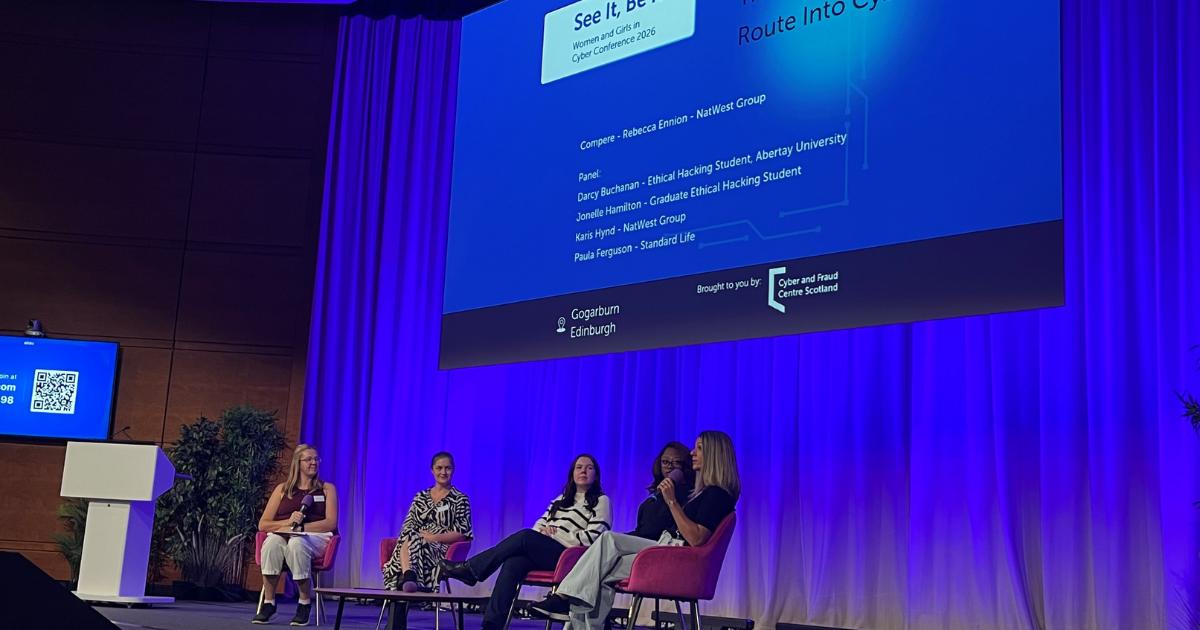
Girls from Paisley Grammar School attended the See It Be It conference, organised by Cyber and Fraud Centre Scotland, to explore the diverse career pathways available in the growing cyber sector.
The event brought together students, employers, educators, and cyber professionals to help bridge the gap between classroom learning and real-world opportunities.
Shona McAlpine, secondary computing science teacher at Paisley Grammar School, said: “Girls are already showing a real interest in coding and technology, but they don’t always realise that those skills can lead to a career in cyber.
“We want to make that connection for them.
“Activities like competitions, fun challenges and experiences like this conference shows pupils how creative, varied and accessible cyber security can be.”
The conference is part of a wider push to address gender imbalance in the industry and encourage more young women to consider roles in cybersecurity.
At Paisley Grammar, while the coding club is thriving, the cyber club has struggled to gain similar traction—despite the overlap in skills and interests.
Shona hopes events like See It Be It will help change perceptions and broaden horizons for her students.
Jude McCorry, chief executive of Cyber and Fraud Centre Scotland, said: “There is clearly no shortage of initial interest in technology among girls and young women.
“The challenge is making sure they can see where that interest could take them.
“Cybersecurity is much broader than many young people imagine.
“It needs technical specialists, but it also needs great communicators, problem-solvers and people who are simply curious about how things work.
“Bringing pupils together with people already working in the sector allows them to see those possibilities for themselves.
“If a young person leaves See It Be It thinking, ‘I didn’t know I could do that,’ then we’ve started to break down one of the barriers holding our industry back.”
Speakers at the event shared a range of career journeys, from computer science and software engineering to the armed forces, recruitment, and data analysis.
Employers also highlighted the value of skills such as curiosity, communication, adaptability, and resilience, alongside technical expertise.
Despite the sector’s rapid growth, women remain underrepresented, making up just 16% of the UK’s cyber workforce.
The See It Be It conference also featured a keynote address from Andrew Elliot, deputy director at the Department for Digital, Culture, Media and Sport.
Elliot spoke about the need to spark girls’ interest in cybersecurity early and highlighted the launch of the TechFirst Girls Competition, part of the rebranded TechFirst programme—formerly known as CyberFirst.
While national schemes play a vital role, the conference stressed that building future talent is a collective effort.
Industry professionals were encouraged to engage directly with schools by offering work experience, speaking at careers events, and introducing students to people working in the sector.
Cyber and Fraud Centre Scotland hopes these connections will help more pupils across the country discover the full range of opportunities in cyber, and empower young women to see themselves as part of Scotland’s future cyber workforce.















Leave a comment