
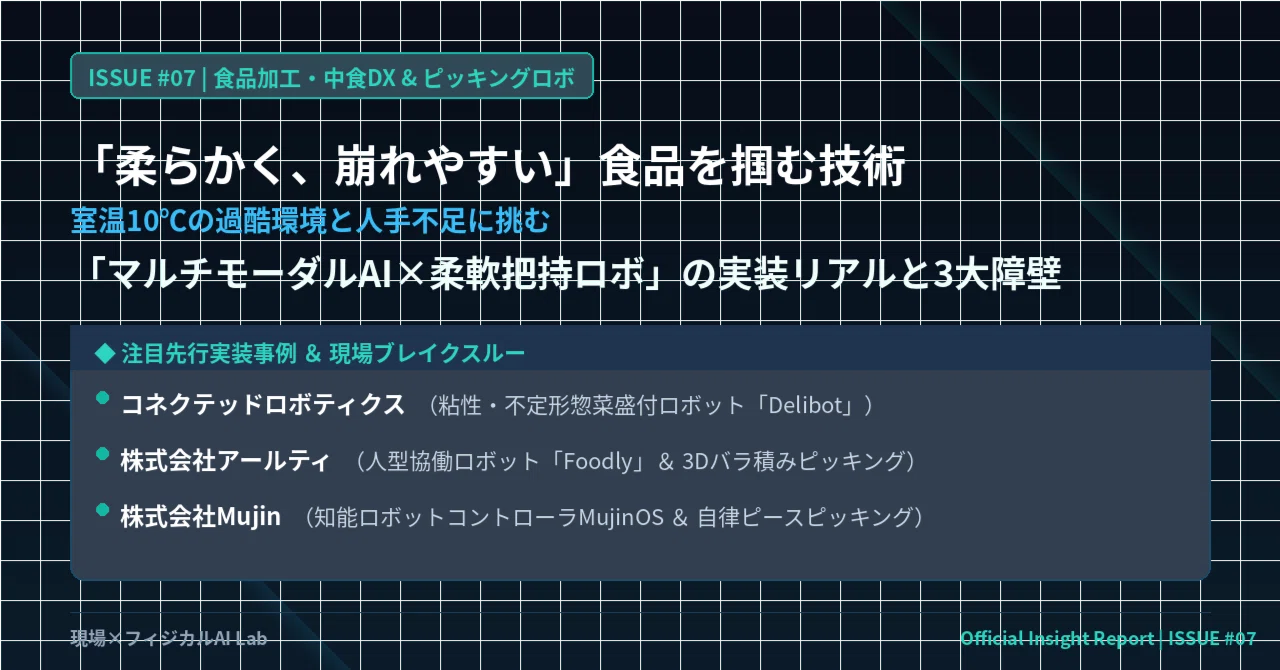
1. Introduction: The ‘Quiet Emergency of the Food Industry,’ Which Employs the Largest Number of Workers in the Manufacturing Sector
The ‘food manufacturing industry,’ which silently supports the Japanese dining table, is actually a massive industry that employs the largest number of workers (approximately 1.4 million) among all manufacturing sectors, surpassing the automotive and electrical industries. Among these, the ‘ready-meal (nakashoku) industry,’ which produces bento boxes, rice balls, and side dishes for supermarkets and convenience stores, has grown into an essential life infrastructure with a market size exceeding 11 trillion yen, driven by the increase in single-person and dual-income households.
However, the front lines of these food processing and side-dish factories are currently facing an unprecedented structural crisis.
The environment in food factories is extremely harsh. To maintain the freshness of ingredients and prevent bacterial growth, the room temperature is kept at around 10°C, and operations starting from 3:00 AM or late at night are routine. In these conditions, workers, clad in dust-proof clothing, stand in front of cold conveyor belts, continuously plating fried chicken or potato salad into containers at a pace of one per second.
Due to this heavy labor and the low-temperature environment, the effective job opening-to-application ratio for part-time workers consistently exceeds 3, and chronic labor shortages and high turnover rates threaten factory operations. Comments such as ‘Even when we post job openings, we can’t gather enough people, forcing us to slow down the lines’ and ‘Accepting foreign technical interns is also reaching its limit’ have now become everyday occurrences at food processing sites nationwide.
Why have industrial robots, which have been so effective in automotive and semiconductor factories, failed to take root in food factories? It is because the physical constraints of food—being ‘irregular (different shapes for each individual item),’ ‘flexible (crushed if gripped too hard, dropped if too weak),’ and having ‘surface oil/viscosity (slippery)’—were the biggest obstacles for conventional industrial robots.
In this article, we analyze the front lines of food robotics, which have finally begun to plate food alongside humans through the evolution of ‘multimodal AI’ that fuses vision and touch, and flexible soft grippers, as well as methods to break through the three major barriers hindering their introduction.
2. Advanced Implementation Examples: Physical AI That Picks Irregular Food Without Crushing It
Example 1: Connected Robotics Inc. (Side-Dish Plating Robot ‘Delibot’ Series)
Connected Robotics, which leads the robotization of the food industry, offers the ‘Delibot’ series, a robot that accurately weighs and plates viscous and irregular side dishes like potato salad and macaroni salad to a target gram weight.
At manufacturing plants for major food supermarkets like MaxValu Tokai, plating potato salad was the process that required the most personnel and expertise. It is a site where weight is prone to fluctuation due to the unevenness of the scooped ingredients (the ratio of potato chunks to mayonnaise) and where worker fatigue is severe.
Delibot uses a proprietary weighing algorithm and a special screw mechanism to pick viscous ingredients at high speed and uniformly without crushing them, plating them into containers at a specified weight (within ± a few grams). This reduces the plating process, which previously required 2-3 people, to 1 person or less, achieving stable 24-hour manufacturing tasks.
– Source/Official Information: Connected Robotics Inc. Official Website
Example 2: RT Corporation (Humanoid Collaborative Robot ‘Foodly’)
Robot development startup RT Corporation offers ‘Foodly,’ a humanoid collaborative robot dedicated to food factories.
The biggest feature of Foodly is that it does not require large-scale safety fences and can ‘work on the same line alongside part-time employees.’ A 3D camera and deep learning AI mounted on its chest instantly recognize individual items (instance segmentation) such as fried chicken, cherry tomatoes, and broccoli from trays of bulk-loaded ingredients.
For ingredients that differ in shape and tilt one by one, it infers the optimal approach angle and gripping position in real-time, and gently picks and places them with a robot hand that complies with the Food Sanitation Act. It is equipped with a collaborative safety design that stops instantly upon contact with a human, achieving on-site implementation where it takes on one position in place of a person without modifying existing belt conveyor lines at all.
– Source/Official Information: RT Corporation Official Website
Example 3: Mujin, Inc. (Intelligent Robot Controller and Food Piece Picking)
Mujin, Inc., a world leader in the intelligence of industrial robots, is deploying ultra-high-speed piece picking and returnable container depalletizing to food and logistics sites using its autonomous control platform, ‘MujinOS’.
Conventionally, to make a robot grasp an object, CAD data (prior 3D master registration) of the target object was required. However, in food logistics where new products are introduced almost daily and soft bags and boxes are mixed together, prior registration is impossible.
Mujin’s intelligent technology uses 3D vision AI to recognize the posture and center of gravity of food packages in real-time, even for items seen for the first time, and picks them along the shortest trajectory while automatically avoiding obstacles (container walls or adjacent workpieces). By completely eliminating prior teaching (instruction work), it establishes automation for sorting and boxing in food lines with high-mix, variable-volume production.
– Source/Official Information: Mujin, Inc. Official Website
3. The ‘Three Major Barriers’ in Food Processing Sites and Practical Breakthrough Methods
To succeed in automating food factories, it is necessary to clear the extremely strict on-site discipline unique to production lines.
Barrier 1: [The Wall of Grasping Irregular and Flexible Objects] Errors due to individual differences and fragility
Fried foods with brittle coatings, slippery raw meat, and sticky side dishes cannot be grasped by general rigid metal hands, leading to the collapse or dropping of the ingredients.
[Practical Breakthrough Method: Fusion of Multimodal AI Inference and Flexible Soft Grippers]
It integrates not only visual information from cameras (appearance and contours) but also tactile feedback from pressure sensors inside the hand. It detects hardness from the repulsive force at the moment of touching the food and controls the force to the limit of not crushing it in millisecond units. In addition, by adopting silicone soft grippers that expand and contract with air pressure or non-contact suction pads, it transports ingredients stably without damaging them.
Barrier 2: [The Wall of Hygiene and Cleaning (IP69K)] HACCP compliance and harsh daily water washing
In food sites, thorough washing with sodium hypochlorite or high-pressure hot water (80°C or higher, 100 atm) is mandatory after work. Ordinary industrial robots will immediately fail due to water ingress and corrosion.
[Practical Breakthrough Method: Food Hygiene Grade (Stainless Steel/IP69K) and Fully Waterproof Jackets]
The robot arm itself is designed with all-stainless steel and dust/waterproof standards (IP69K) without gaps or exposed screws, or it is equipped with disposable food-grade waterproof and chemical-resistant Teflon jackets. A sanitary design that eliminates irregularities that become breeding grounds for bacteria is an absolute requirement for on-site introduction.
Barrier 3: [The Wall of Task Speed and Line Tact] Keeping up with skilled part-time employees (1–1.5 seconds/piece)
Skilled workers calmly handle 40 to 50 servings per minute using their eyes and hand sensations. If the robot’s task speed is 3 seconds/piece, it becomes a bottleneck for the entire production line.
[Practical Breakthrough Method: Parallelization of Multiple Heads and ‘Hybrid Division of Labor Between Humans and Robots’]
Instead of trying to replace the entire process with one robot, a hybrid division of labor is established where the robot is entrusted with routine weighing, rough serving, and counting, while humans handle the final delicate ‘appearance and serving adjustment.’ Also, by picking two items at once with dual arms or multi-grippers, complete adherence to the line tact is achieved.
4. ‘Solution and Support’ Actions Readers Can Take Now
-
① For Executives and Factory Managers of Food Processing and Delicatessen Manufacturing Companies
Before drawing up a multi-hundred-million-yen concept for full automation of the entire line, narrow it down to ‘one process’ where the burden on workers is greatest and the turnover rate is highest (e.g., weighing and serving potato salad, placing fried chicken into trays), and try introducing a collaborative robot (rental or PoC framework). By creating a track record of labor saving in one process, you can reduce the psychological resistance of on-site part-time staff and demonstrate a solid ROI for horizontal expansion. -
② For Local Governments, Food Industry Promotion, and Commerce and Industry Personnel
Utilize the Ministry of Agriculture, Forestry and Fisheries’ ‘Productivity Improvement for Food Manufacturing Industries (Labor-Saving Technology Introduction Support Project)’ and the Ministry of Economy, Trade and Industry’s ‘Manufacturing Subsidy (Labor-Saving Framework/Product Catalog)’ to actively publicize robot introduction subsidy frameworks to local small and medium-sized food processing factories. Preventing business closures due to labor shortages is the most important defense measure to protect the destinations (downstream) of local agriculture and fisheries. -
③ For Robotics/AI Engineers and Side-Job IT Talent
Because the food manufacturing industry is the area that has been kept furthest from digitalization until now, it is an untapped market where the introduction effect (labor-saving impact) appears most clearly. Engineers who can understand not only image recognition but also coordination with PLC (control devices) and sanitary requirements can acquire overwhelming demand and high market value.
5. Editor’s Postscript (Owner’s Note)
Behind the words ‘warmth of handmade,’ our daily diet is supported by the struggles of part-time employees who continue to move their freezing hands in cold factories early in the morning.
The mission of food robotics is not to replace craftsmanship, but to liberate humans from harsh, repetitive labor and shift them toward more creative product development and quality control.
In the next issue (Issue 8), we will focus on forestry sites, which account for approximately 70% of Japan’s land, and deliver the latest on the implementation of ‘Forestry DX x Smart Forestry/Forest 3D Measurement’ to tackle the harsh work on steep slopes and labor shortages. Please look forward to it!
















Leave a comment