

AI offers significant opportunities for cities but how can leaders ensure that the technology delivers real benefits?
A recent Global Government Forum report, Making AI work for people and places: Five priorities for cities, explores how local governments can turn the potential of AI into better public services, stronger resilience and economic value.
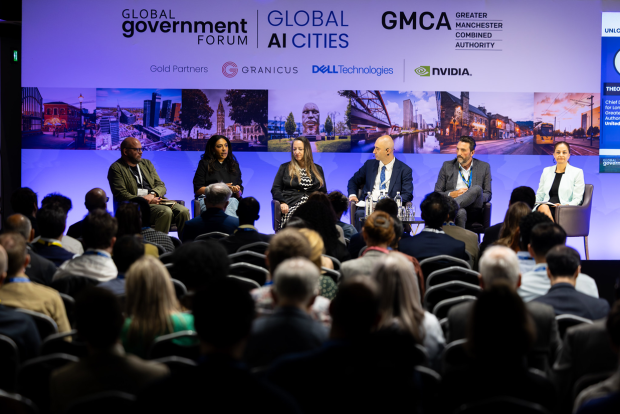
The report draws on discussions at the inaugural Global AI Cities 2026 event in Manchester, which brought together more than 300 local government leaders from over 50 cities. Organised by Global Government Forum and co-hosted by the Greater Manchester Combined Authority, the event highlighted practical examples of AI in action, alongside the importance of starting with the problems cities need to solve rather than the technology itself.
In her foreword to the report, Bev Craig, leader of Manchester City Council, urged leaders to continue asking the central question: “How can we make sure that AI, innovation and economic progress deliver for the people and places we serve?”
Five priorities emerged from the discussions: starting with public value, not AI; treating trust as infrastructure; strengthening data foundations without waiting for perfection; prioritising digital resilience; and building future-ready capability across the whole city.
This first chapter extract examines how cities are using AI to boost productivity, move from reactive to preventative services and capture the economic benefits of innovation – and why demonstrating tangible improvements for residents must remain the ultimate test of success.
Download the report: Making AI work for people and places: Five priorities for cities
Improving the citizen experience

City leaders at the event were clear that AI should not be a solution looking for a problem. Across the two days, they repeatedly framed AI in terms of citizen-centric improvements and outcomes, rather than deploying technology for the sake of it.
Key areas identified included citizen experience, resilience and economic growth.
For cities facing rising demand and constrained budgets, one of the most immediate opportunities of AI identified was to increase productivity – such as automating repetitive work, accelerating analysis and freeing up staff to focus on tasks where human judgement matters.
Examples shared during the event ranged from using AI to reduce the burden of time-consuming manual inspections, including for housing modifications and tree maintenance, to helping staff navigate specialist information in complex areas and bringing together information they would otherwise have to retrieve manually from multiple systems.
Central government speakers also highlighted the opportunity to build shared tools “once rather than fifty times over”. One example tool in the UK, Extract, turns decades-old handwritten planning records into usable geospatial data, saving planning officers hours of work.
Transcription was shared as an example of AI freeing up time and attention from note-taking to understand “what kind of service does this person really need?”.
The speaker described it as “AI helping humans to be human and improving public services that way”.
Zehra Öztürk, deputy chief information officer for the City of Hamburg in Germany, said the goal is that residents experience faster or better services. “We don’t so much try to better the experience of citizens by using AI upfront, [and making it visible] for them. What we try to do is get the internal processes better, so the citizens can feel a change,” she explained.
Hamburg used robotic process automation to manage an increase in housing benefit applications following a legal change, focusing on “repetitive, high volume tasks” so staff could concentrate on more complex cases.
For Öztürk, a key message was the need to fix underlying processes to improve citizen experience rather than apply the latest technology: “It’s like when you have an old car with a not working motor and you paint it in Ferrari red – it doesn’t get you a Ferrari.”
An emerging theme at the event was that cities will need to become more rigorous in measuring whether AI and digital transformation genuinely deliver efficiency gains rather than simply assuming that they will.
Register for Global AI Cities 2027: 24-25 May, Manchester.
From reactive to preventative
Potentially more transformative is AI’s ability to help cities anticipate problems rather than simply respond to them. Several speakers described the role of data and AI in strengthening resilience.
One local government leader described how better use of data can give authorities a “fighting chance of spotting pressure building in a household, a family, or a neighbourhood”, allowing services to intervene before problems escalate.
Peter Boulton, network director for highways at Transport for Greater Manchester, described AI-enabled “smart junctions” that analyse traffic sensor data in real time, distinguish a bus from a car and adjust signal priority accordingly. Combined with a digital twin of key corridors, the technology is moving the authority “from a reactive way of managing the network to more predictive and proactive management”, with the aim of improving journey reliability, safety and traffic flow.
Tiffany St James, chief AI officer for the Liverpool City Region Combined Authority, highlighted MetaCity Liverpool, a digital twin created by drone and photogrammetry (which takes reliable measurements from images). The digital twin can help identify where solar panels would be best placed, map crime hotspots using open data, and monitor air quality to support better transport planning.
Other initiatives and pilots include multilingual digital avatars for interactive wayfinding; visual language models to make better use of CCTV cameras; and digital twins to support evidence-based transport planning.
Read more: ‘Groundhog Day’: NHS leaders say AI success depends on learning from past digital mistakes
Cities as AI makers, not just takers
The potential benefits extend beyond public services to the wider city economy.
Liz Scott MBE, director of the Turing Innovation Catalyst Manchester, argued that cities should not simply consume technologies developed elsewhere. “We want to use the models, we want to use the tools that are available… We also need to be AI makers; we need to capture that value for our UK cities and our UK economy,” she said.
She pointed to Manchester-founded Teachmate, now supporting more than 400,000 teachers across the UK and Europe, as an example of locally developed AI innovation scaling beyond its home city.
Speakers highlighted the role of venture programmes, incubators, accelerators, collaborative research and development, skills initiatives and university partnerships in helping local ideas become scalable products and businesses. Cities are also investing in digital infrastructure such as high-speed connectivity and access to computing capability.
Stefano Marta, head of the OECD’s Smart and Sustainable Cities Unit, cited research by the OECD that identified seven conditions underpinning AI-driven urban innovation, encompassing governance, financing, citizen engagement, data, capacity, infrastructure and connections to existing local innovation systems.
This reinforces that cities cannot generate economic value from AI simply by adopting more tools: they need to purposely create the conditions in which innovation can emerge, scale and remain connected to the local economy.
Start with the problem, not AI
Despite the range of opportunities, speakers repeatedly cautioned against assuming that AI is automatically the answer.
Theo Blackwell, chief digital officer for London, warned against “solutionism”, adding that “just because it’s called AI doesn’t mean you need to empty your mind about designing a good digital service”.
The principle that the starting point is the problem a city needs to solve and the public value it wants to create was echoed throughout the event.
Realising AI’s potential in cities therefore depends on much more than the technology itself. The discussions throughout the event coalesced around the themes explored in the report chapters: trust, good data and governance, digital resilience, and the skills and organisational capability to put AI to effective use.
Takeaways
- Start with the problem or opportunity, not the technology. Define the problem, intended outcome and needs of residents before deciding whether AI or technology is the right solution.
- Use AI to augment people, not simply automate work. Some of the most immediate gains come from removing repetitive and administrative tasks, freeing staff to focus on judgement, relationships and higher-value work.
- Look beyond efficiency to prevention and better outcomes. AI and data can help cities move from reactive service delivery towards anticipating needs, identifying emerging pressures and intervening earlier.
- Build once and reuse where possible. Common challenges across public services create opportunities to develop shared tools and capabilities rather than duplicating investment across individual organisations.
- Capture the wider value of AI locally. Cities can be AI makers as well as takers by creating the conditions for local innovation to emerge and scale – connecting universities, businesses, investment, skills and digital infrastructure.
Download the report: Making AI work for people and places: Five priorities for cities














Leave a comment