
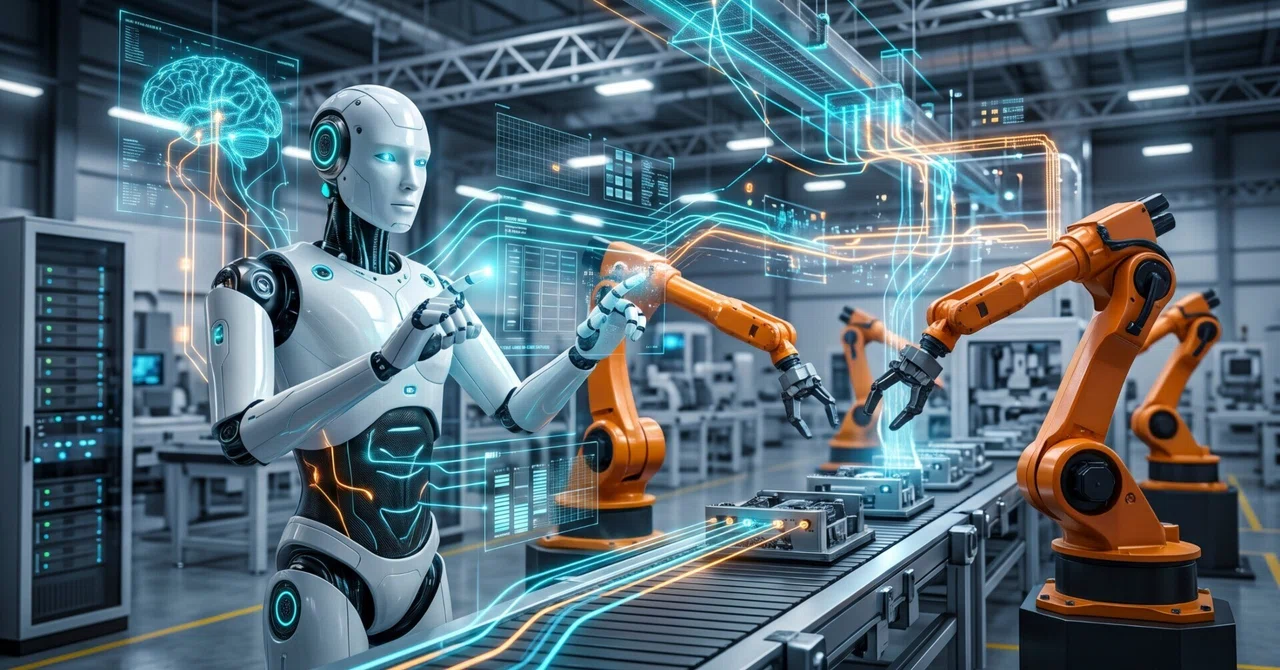
The era of ‘Physical AI’ has arrived, where generative AI is breaking out of the digital space of text and images to expand its application range into machines that move in the real world. This technology, which integrates intelligence like generative AI into robots and automobiles to recognize surrounding conditions and act autonomously, is now rapidly transitioning from the development stage to the demonstration stage.
The ‘Industry Map in 5 Minutes’ series unravels the structure of every industry. This time, we focus on ‘industrial robots,’ where demand is steady due to increased capital investment in semiconductors, and ‘humanoid robots,’ which are in the spotlight due to advancements in AI and hardware. We will thoroughly explain the trends of all participating companies and their complex correlation map.
1. Market Reality: The Shock of the Chinese Market Growing 10x in 10 Years & Market Share Reversal
The market size for industrial robots reaches 204.1 billion yen in domestic shipments (2025) and 542,000 units installed globally (2024). The biggest tectonic shift currently occurring in this market is the ‘rise of China’.
-
China, which accounts for over 40% of the global market, and the next market to watch: the US
-
The number of industrial robots in operation worldwide has expanded by approximately 3.2 times over the last 10 years, but the majority of that growth was driven by the Chinese market, which grew about 10 times over the same period. China is now the largest market, accounting for over 40% of the world, and the US, with its high labor costs and strong appetite for automation investment, is seen as the next market to watch.
-
-
In 2024, Chinese local manufacturers reversed the market share of foreign companies
-
The Chinese industrial robot market was once the exclusive domain of foreign manufacturers from Japan and Europe, but triggered by the COVID-19 pandemic, local manufacturers grew rapidly, centered on small SCARA robots and collaborative robots. In 2024, the market share of Chinese companies surpassed that of foreign companies (over 50%) in terms of unit sales. With the entry of local players, price competition has intensified, making it difficult for foreign manufacturers to generate profits.
-
-
China’s national strategy ‘Embodied Intelligence’ and over 200 humanoid robot companies
-
In 2026, the Chinese government designated ‘Embodied Intelligence,’ centered on humanoid robots, as a ‘future industry’ alongside quantum technology and others. There are said to be over 200 humanoid robot-related companies in China, and 2025 is positioned as the ‘first year of mass production’.
-
-
Key technical keyword: ‘VLA (Vision-Language-Action model)’ The development race for ‘VLA,’ an AI model that handles everything from a robot understanding human words like ‘pick that up’ and the situation, to executing the action, is intensifying, centered on the US and China. Expectations are high for its use not only in factories but also in logistics, services, and autonomous driving.
2. The ‘Correlation Map’ of Giant Tech x Robot Companies: Who is partnering with whom?
In the world of Physical AI, semiconductor and cloud platformers, traditional robot manufacturers, and rapidly growing startups and major automakers are building a massive network through investments, acquisitions, and partnerships.
-
NVIDIA’s ‘House’ Strategy: Winning No Matter Who Comes Out on Top
-
NVIDIA, which holds an overwhelming share of AI semiconductors, is deploying an end-to-end ecosystem including ‘training GPUs’ for model development, simulation tools for verification and data synthesis in virtual spaces (‘Omniverse’, ‘Isaac Sim’, ‘Cosmos’), edge computers for inference (‘Jetson Thor’), foundation models (‘Isaac GR00T’), and AI development environments (‘CUDA’). While offering simulation tools and foundation models for free and as open platforms, it invests in and partners with numerous US startups such as NVIDIA Physical Intelligence, Skild AI, and Figure AI, ensuring it remains the ‘house’ that profits from increased demand for its core GPU business regardless of which robotics company wins. In Japan, Macnica Holdings and Ryosan Ryoyo Holdings serve as distributors providing GPUs and technical support, and domestic venture Telexistence has also been selected for a development program promoted by NVIDIA and AWS (Amazon Web Services).
-
-
SoftBank Group’s Massive 820 Billion Yen Acquisition and Investment Network
-
SoftBank Group, led by Masayoshi Son, which has accelerated AI infrastructure investment from semiconductors to data centers, is pouring massive capital into physical AI as its next frontier. In October 2025, it shocked the world by announcing the acquisition of the robotics business of Swiss heavy electrical giant SoftBank Group ABB for approximately 820 billion yen (acquisition expected to be completed in 2026). Furthermore, it has led a large funding round for US startup Skild AI, and is also collaborating domestically with Yaskawa Electric.
-
-
Google (DeepMind) Talent Incubation and Strategic Partnerships
-
Its subsidiary, Google DeepMind, has announced the foundation model ‘Gemini Robotics’ and has formed strategic partnerships with US-based Boston Dynamics and Apptronik. Additionally, Google itself began collaborating with Japan’s FANUC in 2026. Furthermore, it serves as a breeding ground for influential startups, with Google alumni founding Physical Intelligence and DeepMind alumni founding Generalist AI.
-
-
On-site implementation and capital alliances by major automakers and e-commerce giants
-
Robots that operate in the physical world have extremely high affinity with the automotive and logistics industries, and companies are competing to form partnerships. Toyota Motor Corporation is collaborating on development with Toyota Research Institute through the Boston Dynamics (a subsidiary of South Korea’s Hyundai Motor Company) and has introduced humanoid robots from Agility Robotics at its Canadian plant. Amazon has also introduced Agility Robotics robots into its own warehouses. Among European players, Germany’s BMW has partnered with Figure AI for pilot implementation in its factories, and Germany’s Mercedes-Benz has partnered with Apptronik for factory utilization (note that the US’s OpenAI has terminated its partnership with Figure AI and sold all of its holdings). Additionally, there is active movement among EV manufacturers themselves, such as the US’s Tesla and China’s XPeng, to develop humanoid robots.
-
-
Expansion of the Chinese Tech Alliance (Alibaba, Tencent, Huawei, Midea Group) Internet giant Alibaba Group is expanding its generative AI ‘Qwen’ into robot development, and through cloud services and investments, is supporting Unitree Robotics (Tencent has also invested, and Macnica Holdings supports its Japan expansion) and XPeng Motors. Additionally, China’s largest FA manufacturer, Shenzhen Inovance Technology and the startup Agibot were both founded by former Huawei employees. In M&A, China’s Midea Group acquired 100% of Germany’s KUKA, and China’s Nanjing Estun Automation also acquired Germany’s CLOOS.
3. Complete Chaos Map Coverage: Summary of Features for All Appearing Companies and Organizations
From here on, we will introduce all players appearing in the industry map by category.
■ The ‘Global Big 4’ Industrial Robot Manufacturers and Major Players in Japan, Europe, the US, and China
-
FANUC [6954] (Global Big 4): Characterized by its yellow exterior, it handles articulated robots and NC equipment ranging from large to small, and holds the top market share in North America (Revenue: 857.8 billion yen, of which the robotics division is 378.6 billion yen, operating profit: 183.7 billion yen). Starting in 2026, it is collaborating with Google to accelerate the improvement of versatility through AI strategy.
-
ABB (Switzerland, Global Big 4): Characterized by its white exterior, it holds a high market share in Europe (Robotics division revenue: 362.3 billion yen, division profit: 44 billion yen). It has canceled the planned spin-off and listing of this division and is scheduled to complete its sale to SoftBank Group in 2026.
-
Yaskawa Electric [6506] (Global Big 4): Characterized by its blue exterior, its pillars are industrial robots and servo motors (Robotics division revenue: 247 billion yen, division profit: 20.4 billion yen). It is focusing on expanding sales of the GPU-equipped AI robot ‘MOTOMAN NEXT’ and is collaborating with SoftBank.
-
KUKA (Germany, Global Big 4): A specialized robot manufacturer with a high market share in Europe, particularly for automotive applications (Division revenue: 186.6 billion yen). It came under the umbrella of China’s Midea Group in 2016 and is developing the Chinese market.
-
Kawasaki Heavy Industries [7012]: A long-established company that announced the first domestically produced industrial robot in 1969, and it holds the world’s top market share for semiconductor wafer transfer robots (Precision Machinery & Robotics division revenue: 259.1 billion yen, division profit: 14.3 billion yen). It is also developing the surgical support robot ‘hinotori’ and the humanoid robot ‘Kaleido’.
-
Mitsubishi Electric [6503]: Develops numerous factory automation (FA) related products such as PLCs and CNCs.
-
Seiko Epson [6724]: Boasts a world-leading position in SCARA (horizontal articulated) robots used for parts transport and other tasks.
-
Universal Robots (Denmark): A world leader in collaborative robots, it is a subsidiary of the major US semiconductor inspection equipment manufacturer Teradyne [TER].
-
Inovance Technology (Shenzhen): Founded by former Huawei employees, it is China’s largest FA manufacturer, covering everything from inverters to industrial robots, PLCs, and servo motors (revenue: 1.0554 trillion yen, net profit: 118.1 billion yen).
-
Estun Automation (Nanjing): A Chinese manufacturer strong in large robots, it is also active in M&A, such as the 2019 acquisition of Germany’s CLOOS (segment revenue: 93.5 billion yen).
■ Manufacturers of ‘Critical Components (Precision Reducers)’ that support robot movement
-
Harmonic Drive Systems [6324]: Holds over 70% of the global market share for small precision reducers for industrial robots and is also focusing on humanoid robots (revenue: 59.5 billion yen, operating profit: 2.5 billion yen). In 2025, it made Waseda University-originated venture Tokyo Robotics a wholly owned subsidiary.
-
Nabtesco [6268]: Holds approximately 60% of the global market share for medium-to-large precision reducers for industrial robots (component segment revenue: 79.3 billion yen, of which precision reducers account for 78.6 billion yen, segment profit: 5.4 billion yen).
-
Leader Harmonious Drive Systems: China’s largest manufacturer of small precision reducers (revenue: 13.3 billion yen, net profit: 2.9 billion yen).
-
Laifual Drive: China’s second-largest manufacturer of small precision reducers (revenue: 6.1 billion yen, net loss: 3.9 billion yen).
■ Domestic emerging companies, industry-academia collaborations, and AI implementation players
-
KyoHA (Kyoto Humanoid Association): An industry-academia collaboration organization established in 2025 for the development of domestic humanoid robots, with participation from Waseda University, Murata Manufacturing [6981], and others.
-
AIROA (AI Robot Association): Launched in 2025 for the development of domestic robot foundation models, with participation from Toyota Motor [7203], Fujitsu [6702], and others.
-
Tokyo Robotics: A venture originating from Waseda University that researches and develops humanoids and robot arms (fully acquired by Harmonic Drive Systems in 2025).
-
Mujin: A software venture founded in 2013 that develops robot controllers equipped with proprietary AI. It has seen a series of adoptions in logistics and has partnered with Fast Retailing [9983] and Accenture.
-
Telexistence: Deploys remote-controlled robots that handle beverage stocking and bagging tasks at convenience stores, utilizing operation data for AI training. It is a notable venture selected for development programs by Nvidia and AWS.
-
Macnica Holdings [3132]: As a domestic distributor for Nvidia, it is strengthening its AI product lineup beyond servers and is also supporting the domestic rollout of robots made by China’s Unitree.
-
Ryosan Ryoyo Holdings [167A]: As a domestic distributor for Nvidia, it provides servers and GPUs and offers technical support.
■ Overseas Emerging: AI-specialized companies creating the ‘brains (AI foundation models)’ for robots
-
Physical Intelligence: A US company founded in 2024 by former Google employees that is attracting attention for its foundation model ‘$\pi_0$ (Pi-Zero)’. It has raised over $1 billion in total from investors including Nvidia, reaching a valuation of approximately 890 billion yen ($5.6 billion).
-
Skild AI: Founded by a former Carnegie Mellon University professor, it is developing the foundation model ‘Skild Brain’. It has conducted large-scale fundraising led by SoftBank Group, with a valuation reaching over 2 trillion yen ($14 billion).
-
Generalist AI: Founded in 2024 by former Google DeepMind employees, it is developing its flagship foundation model ‘GEN-1’ (valuation 320 billion yen / $2 billion).
-
Toyota Research Institute: Established by Toyota Motor Corporation in Silicon Valley in 2016, it conducts research in AI, robotics, autonomous driving, and more.
-
Google DeepMind: A research organization under Google, also known for ‘AlphaGo’, which has announced the foundation model ‘Gemini Robotics’.
■ Overseas Emerging & Major: US, European, and Chinese players leading humanoid robots (hardware)
-
Figure AI: A US company established in 2022 that works on the ‘Figure’ series of bipedal robots for factories and warehouses. It has raised funds from Nvidia and others, reaching a valuation of approximately 6 trillion yen ($39 billion), and has a track record of deployment in German BMW factories.
-
Boston Dynamics: A veteran company with over 30 years of history, known for its humanoid ‘Atlas’ and quadruped ‘Spot’. It is under the umbrella of South Korea’s Hyundai Motor and collaborates with Toyota and Google DeepMind.
-
Tesla [TSLA]: Announced the humanoid robot ‘Optimus’ in 2022, aiming to utilize AI and battery technology cultivated through its EVs for use in its own factories and for mass production.
-
Apptronik: Develops the ‘Apollo’ humanoid robot for logistics and manufacturing sites, and has partnerships with Germany’s Mercedes-Benz and Google DeepMind.
-
Agility Robotics: Founded in 2015, it deploys the ‘Digit’ humanoid robot for logistics and manufacturing sites, with implementation cases at Amazon warehouses and Toyota’s Canadian plant.
-
1X: A Norwegian company aiming to support tasks in homes and living spaces, developing the ‘NEO’ humanoid robot.
-
Unitree Robotics: A Chinese company known for its affordable prices starting from a few million yen, handling the ‘G1’ humanoid and quadruped robots (Sales: 39.9 billion yen, Net Profit: 6.7 billion yen, Units Sold: 5,500). Backed by Alibaba and Tencent, it was approved for listing on the Shanghai Stock Exchange in June 2026.
-
AGIBOT: Founded in 2023 by engineers from Huawei, it develops robots in multiple forms, such as the ‘Expedition’ humanoid series, and has built a large-scale data collection base in Shanghai (Units Sold: 5,000).
-
UBTECH Robotics: Founded in Shenzhen in 2012, it operates from home and education to industrial sectors, aiming for mass production of the ‘Walker S2’ industrial humanoid robot (Sales: 46.8 billion yen, Net Loss: 16.4 billion yen, Units Sold: 1,079).
-
XPeng [XPEV]: An emerging Chinese EV manufacturer backed by Alibaba, currently developing the ‘IRON’ humanoid robot.
Summary: From digital to the real world, can Japanese manufacturing strike back with AI?
Until now, Japanese companies like FANUC, Yaskawa Electric, Harmonic Drive Systems, and Nabtesco have led the global market in industrial robots and precision reducers. However, the rules of the game are about to change significantly due to price competition from aggressive local Chinese manufacturers and the rapid evolution of ‘Physical AI x Humanoid Robots’ centered in the US and China.
Whether existing robots can be equipped with advanced AI to increase versatility and expand the market outside of factories (into logistics, services, and homes) will be the biggest factor in determining future success. We cannot take our eyes off future developments, such as how the SoftBank Group’s acquisition of the ABB robotics division and collaborations between Toyota, FANUC, and others will bear fruit.
Thank you for reading until the end!
In this ‘5-Minute Industry Map’ series, we will continue to explain the latest trends in various noteworthy industries and the complex relationships between companies in an easy-to-understand manner.
To ensure you don’t miss future articles, please register (follow) our note account! Also, if you found this article even slightly useful or interesting, please click the ‘Like’ button at the bottom of the article, as it will be a great encouragement for future writing!!
Look forward to the next industry analysis!















Leave a comment