

On November 24, 2026, OpenAI released a preprint (an un-peer-reviewed paper) stating that a GPT-6 family general-purpose AI can design new protein structures and sequences without calling specialized biological models. The designs are reported to have been generated using only reasoning and general-purpose coding tools.
In wet-lab testing with the biotech company Onava, proteins based on GPT-6.2’s designs showed evidence of binding across all five targets. On the other hand, structure prediction from sequence alone was weak, external tools were also used in the design pipeline, and OpenAI itself acknowledges limitations.
This article outlines the experimental figures and conditions, the computational performance benchmarking results, the limitations OpenAI admits, and what this means for Japanese companies. From the standpoint of putting AI to work in business, we separate fact from interpretation to show what has been verified and what remains unverified. In particular, we clarify the extent to which the phrase “without specialized AI” actually applies.
OpenAI Released a Preprint on Protein Design by the GPT-6 Family on November 24, 2026
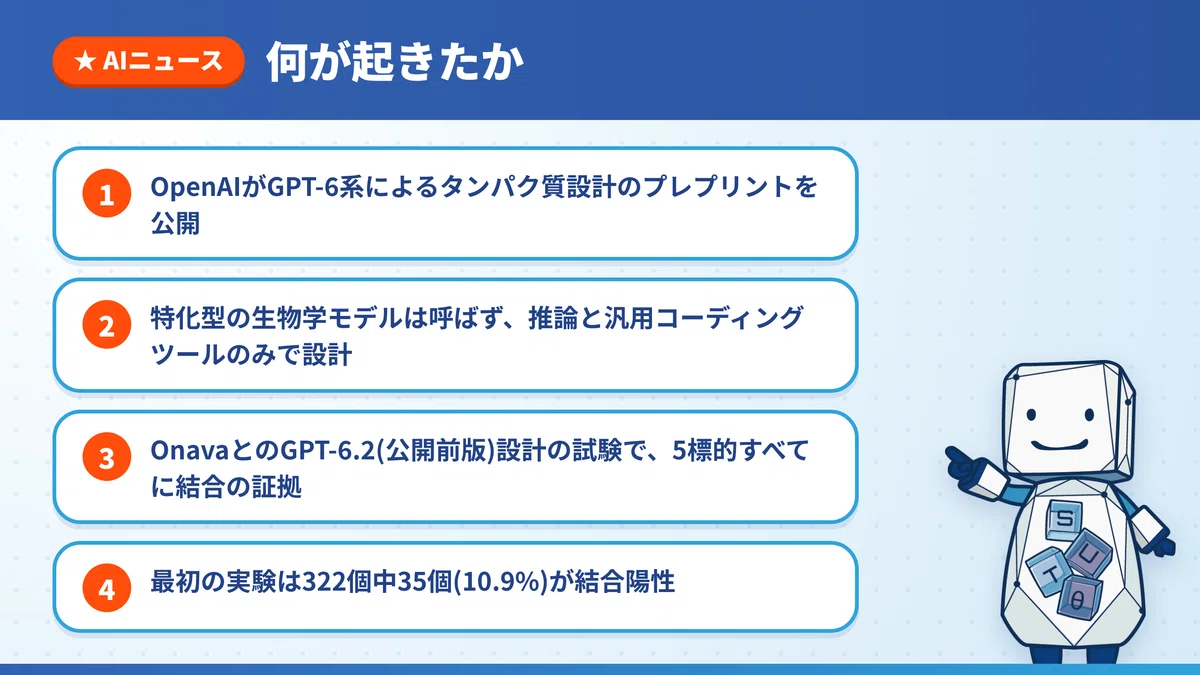
The title of the preprint released by OpenAI is “GPT-6 as a Universal Foundation Model for Protein Biology: Beyond Specialized Models.” A preprint is a paper made public before undergoing peer review. A foundation model is a large-scale AI model capable of being applied to a wide range of use cases.
Protein design refers to artificially creating the structures and amino acid sequences of proteins that possess targeted functions. A specialized model is an AI built specifically for a particular task, such as structure prediction or molecular design. OpenAI claims that the design was conducted solely via reasoning and general-purpose coding tools, without calling specialized biology models. Specialized tools such as RFdiffusion, ESMFold2, and DiffDock-L were cited as points of comparison.
There are two key points to note in this report. One is that validation went as far as laboratory confirmation of binding. The other is the assertion that design criteria can be specified via prompts. OpenAI’s ultimate stated goal is to enable scientists to design proteins and molecules simply by providing natural language prompts.
“Without specialized AI” in the title refers strictly to the design phase. As discussed in later sections, external tools were utilized for tasks such as filtering candidate designs.
In Initial Experiments, 35 Out of 322 Minibinders (10.9%) Were Binding-Positive Across Five Targets
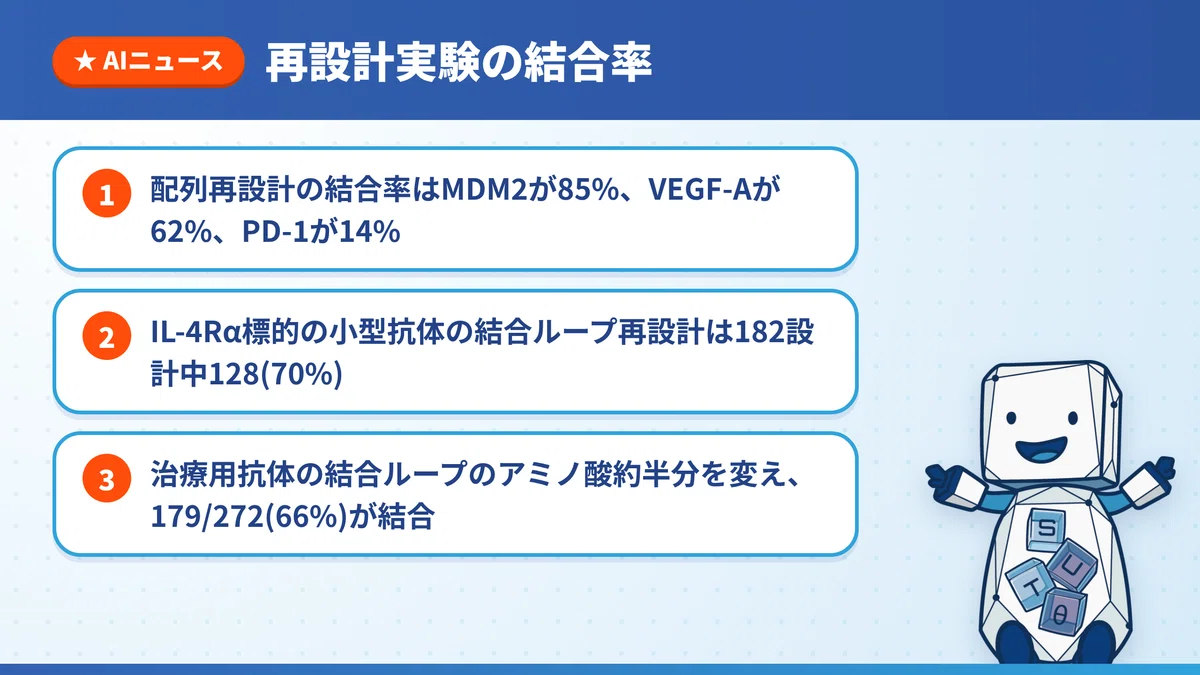
A minibinder is a small protein that adheres to a target protein. In wet-lab testing by OpenAI and biotech company Onava, it is reported that 322 minibinders were evaluated in the initial experiments, with 35 (10.9%) testing positive for binding. “Binding-positive” refers to a state where binding to the target has been experimentally confirmed.
OpenAI reported obtaining evidence of binding for all five targets. The breakdown of the 35 successful binders is 18 for IL-17A, 8 for VEGF-A, 5 for PD-L1, 3 for IL-7Rα, and 1 for TrkA. Roughly half of the hits were accounted for by the 18 targeting IL-17A. There were substantial disparities among targets, with some targets such as TrkA yielding only a single hit.
Around 90% of the 322 candidates were not binding-positive. When designing with wet-lab validation in mind, the operational approach will likely involve generating a larger pool of candidates and filtering them down.
A pre-release version of GPT-6.2 was utilized in the experiments. Regarding GPT-6.2 and OpenAI’s internal research models (hereafter referred to as internal models), specifications, public release plans, and availability timelines cannot be determined from the materials available for verification.
The criteria used to determine positive binding, as well as the experimental methodology details for measuring binding, are also not specified in the verified materials. It is reasonable to view the 10.9% figure as a value obtained under unstated evaluation criteria.
In Redesigning Known Structures, Results Varied Across Targets: 85% for MDM2, 62% for VEGF-A, and 14% for PD-1
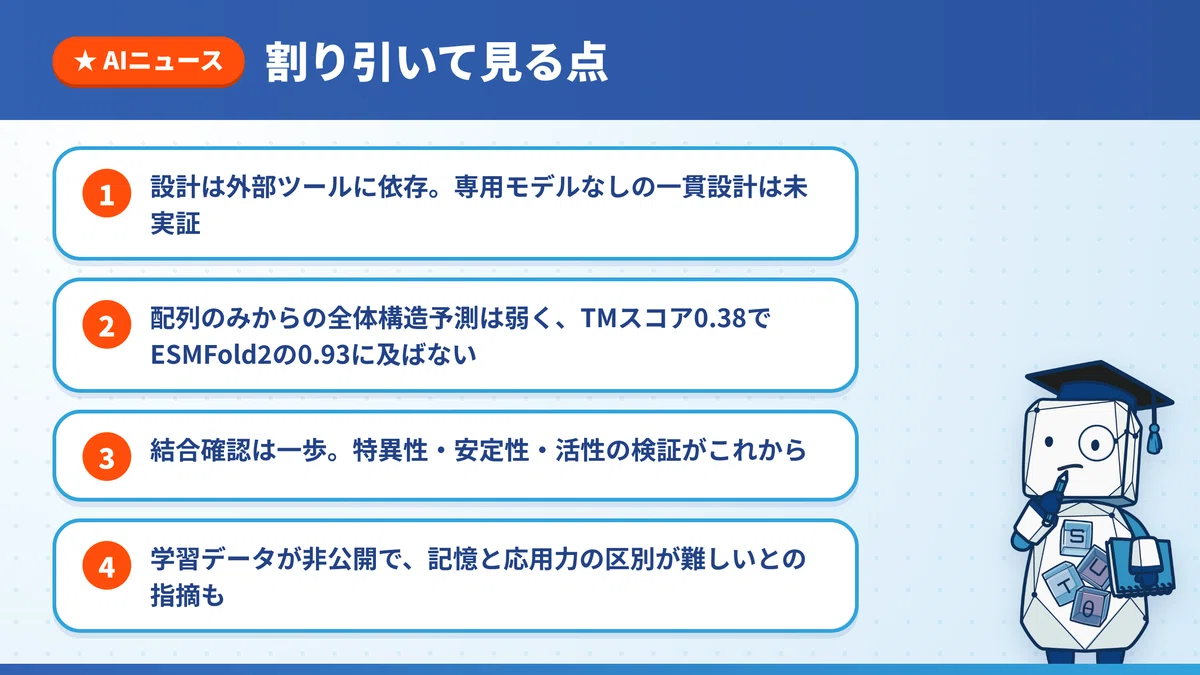
In the subsequent experiment, the AI was provided solely with the three-dimensional structures of known minibinders and tasked with redesigning their amino acid sequences. The proportions showing binding were 75 out of 88 designs (85%) for MDM2, 26 out of 42 designs (62%) for VEGF-A, and 8 out of 59 designs (14%) for PD-1. The fact that results vary widely depending on the target will likely serve as an important premise when applying this in practice.
GIGAZINE reported that in the minibinder redesign experiment, binding was confirmed for a total of 123 protein variants across five target types. However, the sum of the three targets mentioned above is 109, and how this relates to the figure of 123 cannot be determined from the materials.
Two sequences generated from an unpublished PD-L1 minibinder structure differed from the original sequence at 52 and 58 positions out of 90, and both exhibited indications of binding. OpenAI describes this result as strong evidence that its capabilities extend beyond mere memorization.
Tests were also conducted on antibodies. In an experiment redesigning the binding loops (the regions where the antibody makes contact with the target) of six small antibodies targeting IL-4Rα, 128 out of 182 designs (70%) showed indications of binding. In five therapeutic antibodies where approximately half of the amino acids in the binding loops were altered, 179 out of 272 fragments (66%) bound to their original targets, PD-1 or PD-L1.
Design Criteria Could Be Specified via Prompts, with Performance Improving Across Later Generations in 14 Protein Tasks
OpenAI states that simply by changing prompts, design conditions such as binding positions and shapes could be specified without retraining. It is explained that for minibinder design, users could even specify the number of structural components like coils and strands, and the internal model followed these instructions with near-perfect fidelity.
Computational benchmarks (tests that measure performance on predefined tasks) were conducted across 14 protein tasks, with results improving with each subsequent generation. Docking is the task of predicting how a protein binds to its partner molecule. On PoseBusters, a benchmark test for docking, GPT-6.2 scored 93% and the internal model achieved 96%, outperforming DiffDock-L’s 50%.
The average DockQ score (a metric evaluating the quality of complex predictions) for antibody binding site prediction improved from approximately 0.05 for GPT-5.6 to 0.28 for GPT-6, 0.57 for GPT-6.2, and 0.81 for the internal model.
In motif scaffolding (the challenge of assembling an entire structure while preserving small functional structural motifs), the internal model achieved 43.7%, outperforming RFdiffusion’s 27.8%. However, these results are from preliminary computational analyses and have not been confirmed in the laboratory.
All of the figures presented are values based on OpenAI’s reports, and no third-party replication was found in the materials reviewed.
Sequence-only structure prediction remains at an average TM-score of 0.38, and design still relies on external tools
Weaknesses have also been highlighted. In the task of predicting an entire structure from sequence alone, the average TM-score (a metric indicating the structural similarity between predicted and ground-truth structures, with values closer to 1 indicating higher agreement) remained at only 0.38 even for the internal model, falling far short of ESMFold2’s 0.93, according to reports. GPT-5.6 scored 0.16, and GPT-6.2 scored 0.26.
The design pipeline also relies on external tools. Sequences for the initial minibinder experiments were supplied by SolubleMPNN, while Boltz-2, OpenDDE, and ESMFold2 filtered down the candidates. OpenAI acknowledges that end-to-end (consistent from start to finish) design without the assistance of specialized models has not yet been demonstrated.
OpenAI notes that confirming binding is only a first step; verification of specificity (ensuring it does not bind to non-targets), stability, and biological activity is required, and for therapeutic applications, verification of safety and efficacy is essential.
Furthermore, OpenAI cautions that the unusually high scores observed in some structure and sequence benchmarks might reflect memorization or the methods used to generate the test structures. Regarding the lower hit rate (the proportion of confirmed bindings) compared to the original RFdiffusion study, it explains that this depends on the strictness of the filtering and the definition of binding.
Implications of the GPT-6 Series for Japanese Companies, and What Remains Unconfirmed
The implication for business appears to be that general-purpose AI is beginning to step into specialized domain design by combining reasoning with external tools. The assumption of preparing separate, dedicated AIs for each specialized task may be reconsidered in the future.
Translating this to knowledge work, retaining a process where humans verify AI outputs is likely to be a key element for adoption. In this case as well, confirmation of binding was conducted in a laboratory.
OpenAI lists its next priorities as discovering minibinders for challenging targets, designing for post-binding biological effects, and expanding to RNA, small molecules, and PROTACs (molecules that promote the degradation of target proteins). Acknowledging that these same capabilities could be misused, it states that it is evaluating biosecurity risks under its Preparedness Framework.
Certain points also remain unverified. The full text of the preprint, its peer-review status, details regarding Onava, the criteria for judging binding, and the release timing for GPT-6.2 and the internal model remain unknown.
GIGAZINE reports that Nature noted while some researchers point to the possibility that general-purpose large language models (LLMs) could surpass AlphaFold and similar tools in the future, skepticism remains regarding their physicochemical understanding. It has also been pointed out that the biological data used for training is undisclosed, making it difficult to distinguish between memorization and generalizable capability.
Summary
In short, this report shows OpenAI demonstrating that ‘the GPT-6 series can design proteins without calling specialized biology models,’ complete with laboratory evidence of binding. However, external tools were used in the design pipeline, and structure prediction from sequence alone remains weak. Confirming binding is only the first step; specificity, stability, as well as safety and efficacy for therapeutic use, remain unverified. For Japanese companies, both designing architectures where general-purpose AI utilizes specialized tools and establishing processes to verify outputs are likely to be key points of discussion. What needs to be checked next is the full text of the preprint, its peer-review status, and the criteria used to determine binding.
For Those Looking to Take the Next Step in Applying General-Purpose AI to Specialized Operations
While this report demonstrates that both designing systems where general-purpose AI uses external tools and establishing processes to verify outputs are essential, figuring out how to proceed within one’s own specialized business operations is a separate challenge. In practice, when attempting to tackle this in-house,
-
Inability to decide how much to delegate when designing general-purpose AI to use external tools
-
Ambiguity over who determines the criteria and responsibilities for verifying whether AI outputs are correct, and how to do so
-
Lack of decision-making criteria regarding whether to invest in specialized AI for specific tasks or general-purpose AI
Many people find themselves stalled by points such as these.
I believe there are broadly two ways to proceed.
If you want to move forward with outside help
LiberCraft supports the implementation of AI into business operations from a practical perspective through AI development support and data science development support. There are multiple entry points for projects, including requirement definition, PoC, production deployment, and internal training, allowing you to consult with us at any stage to match your situation. We also offer “Socrag,” an Agentic RAG SaaS.
It is completely fine if you are at the stage of “nothing is concrete yet, but I’d like to hear more.” We offer free individual consultations.
If you want to learn how to apply general-purpose AI to specialized operations yourself
For those who have read this far and thought, “I want to become able to build this myself,” we run a program called Craft College. We offer courses ranging from the “Data Scientist Training Course” for engineers and beginners aiming to become data scientists, to the “PM/Consultant Training Course” for non-engineer managers and promotion leaders, to the “Advanced Course” for those already handling these technologies in their work. You can learn how to design and evaluate the integration of AI and tools through hands-on practice. We also hold regular trial information sessions.
The entry point differs depending on whether you want to consult as a company or learn as an individual, so please feel free to look into whichever suits you best.
About LiberCraft Inc.
If you are interested, please check out our company website!
We are also stepping up our recruitment efforts. If you are interested, please do not hesitate to contact us. We would be delighted to start with a casual chat.
We also share information across various social media platforms. Please take a look.
Author Profile: Daigo Miyoshi
Representative Director of Libercraft Inc. Focusing primarily on AI and data utilization consulting and contract development (B2B), he has supported AI implementation projects across various industries, including JAXA, the Ministry of Defense, and MISUMI. He operates Craft College (a practical data science and AI school), helping working professionals transition careers and acquire skills to become data scientists and AI project managers.












Leave a comment