
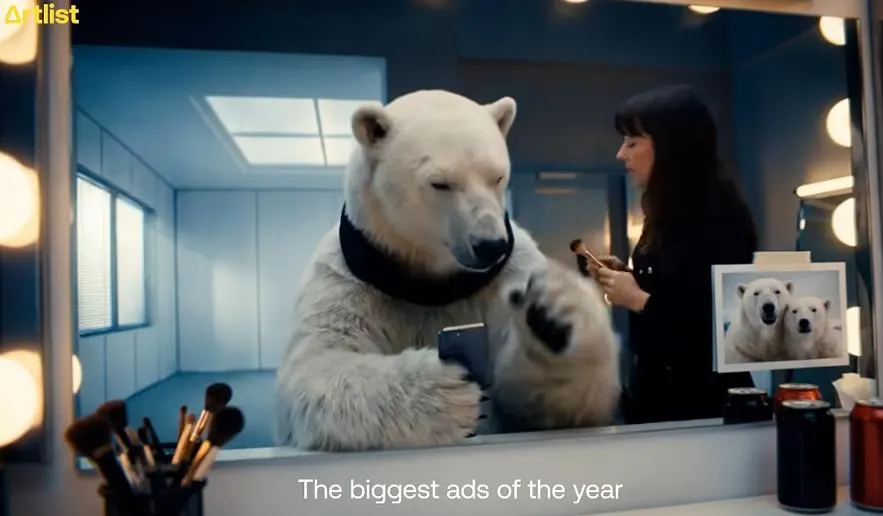

Artlist created its 2026 Super Bowl ad using artificial intelligence (AI), which is a major trend for this year’s big game.
Artlist
Forget about celebrities, humor and nostalgia. The biggest trend in Super Bowl advertising this year is using artificial intelligence to generate AI Super Bowl ads, and it heralds a new — some would say troubling — era in advertising that could be either the next big thing, or the next big flop.
One thing is clear: AI is closer to taking over advertising.
The 2026 Super Bowl is plentiful with AI ads that will air. Some brands have dabbled with the ideas before, but this year several dove in with Super Bowl commercials constructed entirely or partially by AI, including Anthropic and Meta. It’s also impacting things behind the scenes, with AI being used to run commercial breaks more efficiently.
Viewers may not notice a difference at first glance. But it’s clear this is setting off alarms and opportunity seekers on Madison Avenue.
“For the last few years, AI’s role in Super Bowl advertising has been framed mainly around production: faster edits, cheaper variations, more efficient asset creation,” says Vineet Mehra, CMO at Chime, a financial technology company. “What we’re heading into now is a moment where AI starts acting as a co-pilot for modern marketing: not just helping make the ad but helping run everything that happens once the ad is live. This includes adapting messaging in real time, monitoring cultural signals, and orchestrating experiences across channels.”
He believes advertisers could see major benefits—if the technology holds. “The Super Bowl is the ultimate stress test for this shift,” Mehra says. “It’s live, it’s loud and it moves fast. In that environment, the brands that stand out won’t just be the ones with the best 30-second spot. They’ll be the ones that can extend that moment into a broader brand story, creating experiences that live well beyond the fame and drive performance across the entire funnel.”
AI Super Bowl Ads Created By An AI Company
This year, AI has provided the chance to hijack headlines in the always-calamitous buildup to the big game. Artlist, an AI platform for video creation, unveiled its first Super Bowl ad this week with a unique angle: The company used its own tools to create the ad and did it in just five days.
Considering many companies pour millions into their creative, Artlist’s ad stands out—it claims the company spent just a few thousand on production of each of three commercials after purchasing the ad space at the last minute.
“We chose this moment to debut a Big Game ad to prove a point: the barrier between a great idea and a high-caliber production has officially vanished. By executing three distinct, broadcast-quality spots in just five days, we demonstrated that AI has shifted the creative process from a slow, linear grind to a circular one where ideation and execution happen simultaneously,” says Shahar Aizenberg, chief marketing officer at Artlist.
“The greatest benefit here is the near-total removal of friction; we saw a 90% reduction in traditional production costs. This makes the world’s biggest advertising stage ‘risk-free’ for the first time, allowing us to iterate and experiment with versions of an ad in hours that would normally take months to produce.”
AI Super Bowl Ads Go Beyond The Big Game
AI isn’t just creating ads; its biggest names are also buying them. In addition to Artlist, Google Gemini and Meta AI are back in the big game this year.
And Anthropic has a Super Bowl spot taking direct aim at competitor OpenAI (drawing some pushback from co-founder Sam Altman).
“From research that informs strategy to inspiration that pushes human creativity, AI’s role is expanding beyond a tool. It’s becoming a foundational part of the creative process – but with human-touch always at the center,” says Stephen Mariani, director, strategy at the New York Times. “The Super Bowl remains creative advertising’s biggest stage. Human influence will continue to be essential, as a part of an AI strategy that enables the people to focus their influence on what matters.”
Of course, AI’s influence can be seen in other aspects of the game, too. AI-driven traffic has been on a sharp upswing over the past year, and that will no doubt continue after the game, when people search for the most popular or funniest Super Bowl ads. Harnessing ways to get chatbots’ attention has value—so what better way than an AI ad? Plus, AI will be
“The real action this year won’t just be on TV, but around it. AI agents will increasingly handle the work that happens once the ad airs: updating digital experiences, monitoring social signals, managing communities, and reacting in real time. That layer doesn’t always get the spotlight, but it’s where a lot of the real work is now happening,” Mehra says.
“The strongest Super Bowl ads will be designed as systems, not moments. They’ll be ideas built to travel across social, online, CRM, community, and performance channels, evolving as people react in real time. Humans will still do the most important work, setting the vision, the story, and the emotional direction, while AI’s role will be that of orchestration and amplification, helping those ideas scale and stay responsive once they leave the TV screen.”
This year’s Super Bowl ads will feature a new focus on AI, from the advertisers to behind-the-scenes tech deployment.
Getty Images
Going forward, we may see this Super as “an inflection point,” Mehra says. In previous years, AI stayed behind the scenes, largely relegated to improving efficiency and optimization. Now that’s changed.
“What’s different now is where AI is being applied. We’re starting to see agentic AI systems take on real responsibility once the campaign goes live, helping brands stay present and reactive in real time,” he notes. “The real shift isn’t that AI is replacing creativity. It’s that creativity finally has infrastructure supporting it end-to-end, from idea to launch, to live execution. Once that happens, marketing stops being a series of moments and starts behaving more like a living system. And that very naturally and very fundamentally changes how marketing is executed at scale.”












Leave a comment