
Many small business owners feel like AI is far off into the future with all the talk about “AI” and “artificial intelligence” being so complicated and having to purchase expensive software. However, autonomous AI agents are now easier to access than ever and available for use in your small business. To put any AI for your small business to work, though, you first need to measure the process. Without a baseline, you will never be able to determine what’s working and calculate AI Return on Investment (ROI) for your small business.
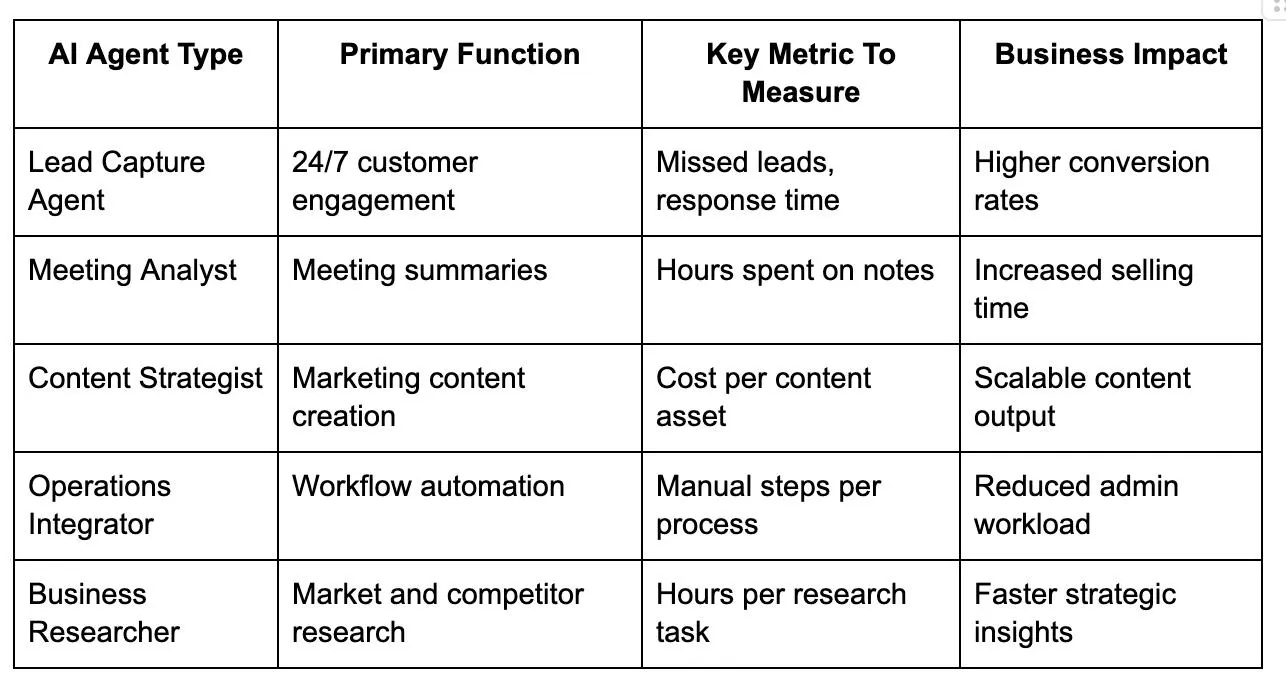
As I mentioned before, Measurement is key when using any AI automation tool. The true power of any AI automation tool comes from finding and measuring a very high-impact area where you spend both time and money. After you find that area, then you will want to deploy an AI agent. Below are 5 Autonomous AI Agent types you can use in your small business once you’ve determined the impact.
1. The 24/7 Lead Capture And Service Agent
In addition to being your website’s online store-front if your site has visitors who aren’t responding to them, you’re losing potential. A Customer Service Agent (AI) works as an “always on” Front Desk Assistant, greeting visitors, answering common questions, and generating leads around the clock.
According to a PwC study, 54% of Companies utilizing AI Agents reported an improvement in their customers’ experiences, therefore, implementing conversational AI agents into your business will be one of the fastest ways to improve productivity.
Measure First
How many leads do you miss after hours? How long does it take for someone to respond to a new inquiry on your website? How much revenue is lost from delayed or missing follow-up responses.
The Right Tools
With platforms such as High Level, businesses can utilize conversational AI and voice-based AI agents across multiple channels, so no inbound lead goes unnoticed.
2. The AI Meeting Analyst
Teams spend a lot of time at meetings but when it comes to making major decisions, teams will forget what was discussed and most likely document actions poorly. The team uses an AI to analyze the conversation during a call, this AI is silent during the call and documents the conversation for the team so they can be free to discuss rather than write down every single detail. This method gives you instant benefits to automate your AI workflows.
Measure First:
Track the amount of time you have spent documenting meeting summaries and follow up emails. For example, If a sales person spends 30 minutes documenting their notes after ten weekly sales calls, that is 5 hours of time spent away from selling each week.
Right Tool:
Tools like Fathom can automatically record, transcribe and document meetings and take action items from those meetings and sync with the teams CRM or project management platform.
3. The On-Demand Content Strategist
A lot of what drives modern marketing today is still content, but that is a huge time and resource drain for small teams. An AI content agent will function as a junior copywriter and help you get past writers’ block and increase your ability to produce content at scale while maintaining the quality and consistency you want.
Measure First:
How much time does it take to create a blog post, email campaign or a series of social media posts? Assign a dollar amount to each hour of content creation to establish your current content production costs.
Right Tool:
While there are a number of tools available that can create text, more advanced models such as Claude have been developed to produce more sophisticated content in line with a particular brand voice, they are ideal partners when creating strategically important content.
4. The Digital Operations Integrator
Administrative overhead can arise when employees are forced to transfer information between systems (that) are not connected. A digital integrator in the form of an AI Workflow Automation Agent connects applications and automates routine processes that take away from productive time. Avoiding unchecked AI Agent Sprawl is another important reason for this step.
Measure First:
Identify at least one repetitive task you perform for a client, i.e. client onboarding. Document each part of your manual process and add up all the time it takes to complete the task from beginning to end.
The Right Tool:
For those who require more flexibility than most automated tools provide but do not want the high cost of an Enterprise solution, open source solutions such as n8n will allow you to create your own custom workflows without the expense of an Enterprise Solution.
5. The Autonomous Business Researcher
Beyond simply automating tasks, the most advanced forms of autonomous AI will be able to perform complex multi-step research and analysis that previously took a lot of human labor and would therefore be a place in which you get exponentially greater value from your money when you purchase an AI for your small business.
First Measure:
Determine how much time is spent conducting market research, competitive analysis, and/or lead prospecting. It is these types of high-time-consuming tasks that should be automated.
Right Tools:
Platforms like Abacus DeepAgent allow businesses to create AI Agents with capabilities of performing deep research, complex data analysis, and even executing multiple workflows. Examples may include tracking changes at competitor websites and/or generating weekly Market Intelligence Reports.

Autonomous AI Agents For Small Businesses
Source: Institute Of Business AI
As we move into an AI-driven world, it will be less about major transformations and more about small, incremental improvements in measurable ways that ultimately add up. By identifying a benchmark and implementing the right AI Agents based on their specific business needs, small businesses can benefit from better efficiency, improved resiliency and sustained growth via smarter AI implementation.
















Leave a comment