
“After processing around a million frames, PredNet learns certain rules of the visual world,” says Watanabe. “It extracts and remembers the essential rules and among these, it may have also learned characteristics of moving objects.”
Watanabe then presented the AI model with a few variations of the rotating snakes illusion and an altered version that human brains are not fooled by, and so perceive as static. He found that the AI was tricked by the same images as humans. Watanabe thinks it supports the theory that our brains use predictive coding. In this case there are aspects of the images that are indicative of moving objects that trigger our brain’s prediction system into assuming the multicoloured snakes are in motion.
“I think PredNet’s perception is similar to human perception,” he says.
However, Watanabe and his team also found differences between how the AI and humans perceive the illusion. When we fix our gaze on one of the rotating circles, for example, it seems to stop turning whereas the other discs in our peripheral vision continue to spin. PredNet, however, always perceives all the circles moving at the same time.
“This is likely because PredNet lacks an attention mechanism,” says Watanabe. This means it is unable to focus on a specific spot on the image, but processes it in its entirety.
Although AI systems and robots may be able to mimic certain aspects of our visual system, they are still far off from being able to see the world as we do. So far, there is no deep neural network that can experience all the illusions that humans do, says Watanabe.
In some ways this shouldn’t surprise us.
“ChatGPT, for example, might seem to converse like a human but its underlying DNN functions very differently from the human brain,” says Watanabe. “The key similarity is that both systems use [some type of] neurons but how they are structured and applied can be vastly different.”
More like this:
• What puzzles reveal about our own minds
• We built a nasty game to test AI’s ability to apologise
• What happens when an AI takes an inkblot test?
Some researchers are trying to combine AI with the weirdness of quantum mechanics to better simulate how humans perceive certain illusions.
Previously, researchers have used concepts from quantum mechanics to explain our perception of the Necker cube, a famous ambiguous figure illusion where a cube appears to randomly switch between two different orientations.
Classical theories of physics would predict that the cube should be perceived in one way or another. But in quantum mechanics, the cube could be in two states at once until our brain chose to perceive one. Think of the famous Schrödinger’s cat thought experiment, where a cat trapped in a box with a mechanism that could kill it is both dead and alive until someone looks inside.
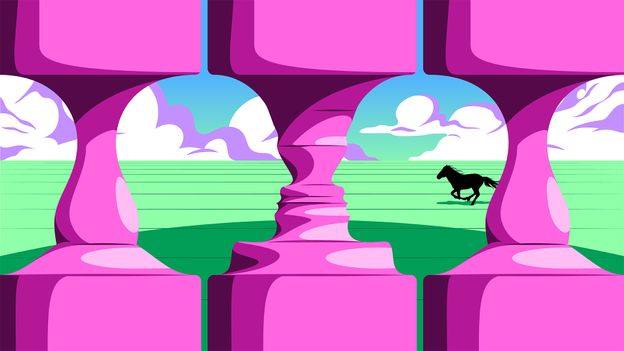
Inspired by this work, Ivan Maksymov, a research fellow at Charles Sturt University’s Artificial Intelligence and Cyber Futures Institute in Bathurst, Australia, developed a model that combined quantum physics with AI to see if it could simulate the way we perceive the Necker cube and a similar illusion called Rubin vase, where we see either a vase or two faces in profile. He designed a deep neural network that processes information using a phenomenon called quantum tunnelling. The system was then trained to recognise the two illusions.
When one of the illusions was input into the system, it would generate one of the two interpretations. Maksymov found that the AI would regularly switch between each of them over time – much as humans do. The time intervals of these switches were similar too.
“It’s quite close to what people see in tests,” he says.














Leave a comment