
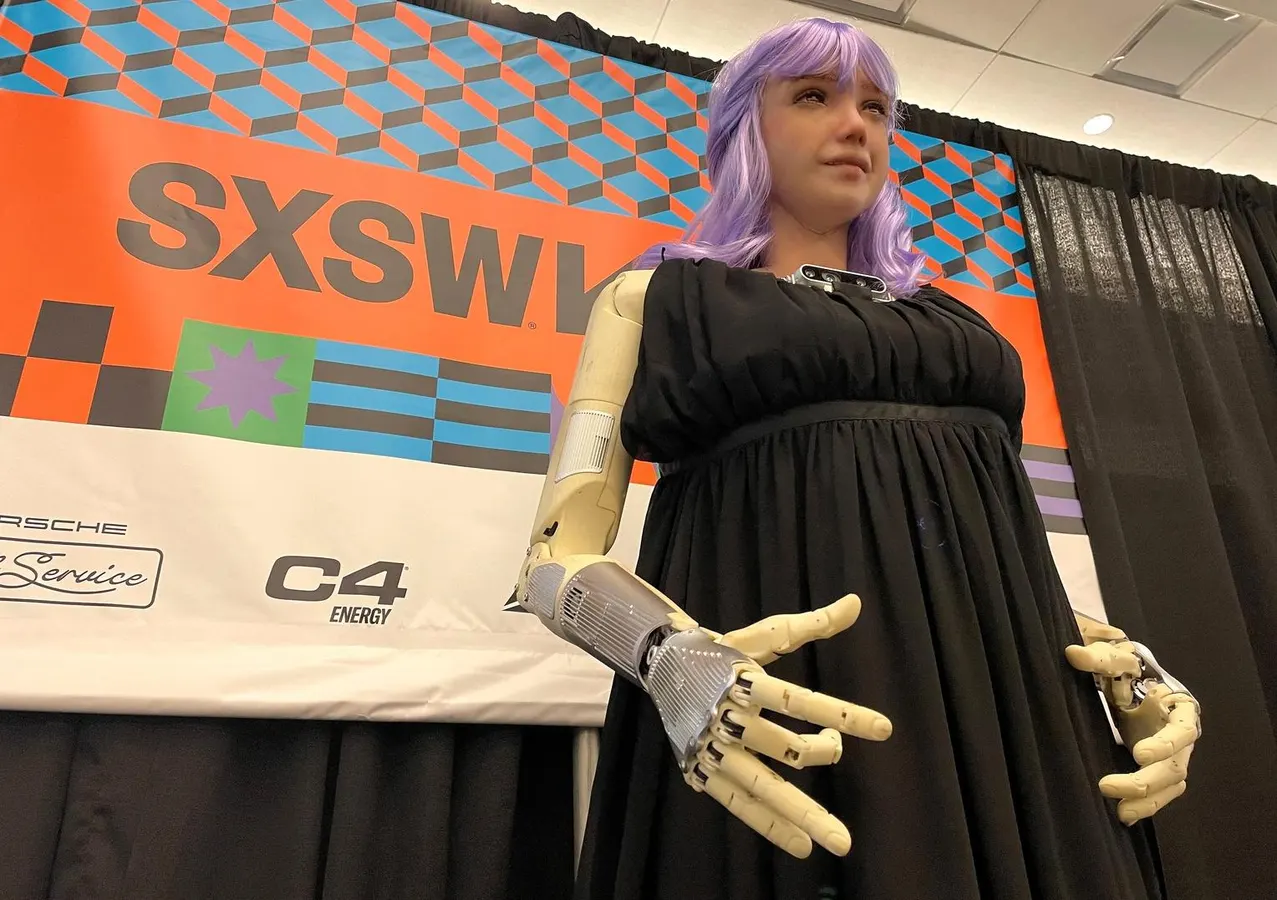

Desdemona, a humanoid robot designed by Hanson Robotics and endowed with expressiveness and interactivity to teach AI to understand and care about people, is displayed at a SXSW conference titled “How to make AGI beneficial and avoid a robot apocalypse” in Austin, Texas, on March 12, 2024. David Hanson – founder of Hanson Robotics and who designed Desdemona, a humanoid robot that functions with generative AI – brainstromed about the plus and minuses of AI with superpowers. AI’s “positive disruptions can help to solve global sustainability issues, although people are probably going to be just creating financial trading algorithms that are absolutely effective,” he said. Hanson fears the turbulence from AI, but pointed out that humans are doing a “fine job” already of playing “existential roulette” with nuclear weapons and by causing “the fastest mass extinction event in human history.” (Photo by SUZANNE CORDEIRO / AFP) (Photo by SUZANNE CORDEIRO/AFP via Getty Images)
AFP via Getty Images
Fears of AI taking away revenue from software and other companies — dubbed the SaaSpocalypse — are sending their stock prices plunging 20% or more, as I noted earlier this month.
Between late 2024 and early 2026, AI chatbot fears have erased $1.1 trillion from software, education, legal and media stocks, with the selloff accelerating dramatically in early 2026.
Some are profiting from this decline. For example, hedge funds making highly leveraged bets have earned $24 billion shorting software stocks. “Trading is very much ‘get me out’ style selling,” Jefferies equity trader Jeffrey Favuzza told me.
Last weekend a blog post by Citrini Research added further fuel to the bonfire, the Wall Street Journal reported. The post, written by researcher James van Geelen — which accumulated 3,148 likes and 652 shares within 48 hours — appeared as a fictional macro memo from June 2028, looking backward at how AI caused an economic catastrophe.
With Nvidia reporting earnings later today, can it avoid the AIpocalypse?
The Lost Value Flowing From Citrini Research’s Report
Software and other stocks have lost tremendous amounts of value. For example, Chegg has lost 99% of its value, Duolingo has fallen 74% from its peak, HubSpot has declined 75%, and even Thomson Reuters has suffered a near record single-day drop.
The Citrini Research report helped trigger an additional $285 billion wipeout in a single session, noted Ai2Invezz. The report highlighted concepts that seemed to resonate with nervous investors including:
- Ghost GDP. The report described output that appears in national accounts but never circulates through the real economy because machines don’t spend on discretionary goods, according to TradingView.
- Intelligence Displacement Spiral – a negative feedback loop which AI capabilities improve, companies cut workers, displaced workers spend less, and margin pressure pushes firms to invest more in AI, reported TechCrunch.
- Death of Habitual Intermediation – this concepts suggests AI agents will replace businesses built on human friction — such as DoorDash and Visa’s interchange fees – resulting in hypothetical 2028 unemployment at 10.2% and an S&P 500 down 38%, noted TradingView.
A day after the Citrini report technology and other stocks – DoorDash fell 7%, IBM (-13%), AppLovin and MongoDB (-8%), and American Express (-6%) – all lost ground. In addition to the report, Anthropic’s Claude COBOL modernization announcement and a warning from Nassim Taleb, known for his Black Swan concept, contributed to these declines, noted Bloomberg.
One analyst expressed amazement at the market’s reaction. “It is a remarkable reaction,” Jonestrading chief market strategist Michael O’Rourke told Bloomberg. “I have seen this market exhibit incredible resilience in the face of actual negative news. Now a literal work of fiction sends it into a tailspin.”
Why Have Software And Other Stocks Plunged?
Software and other stocks have plunged due to fears AI will cost incumbents their revenue.
The fear is that knowledge-economy companies — providing services such as education, legal research, stock photography, customer relationship management, customer support — will lose their revenue to AI chatbots that provide equivalent services at near-zero marginal cost.
A few companies have demonstrated this premise. For instance, education company Chegg’s revenue fell 39% in a single year after ChatGPT launched, noted Stocktitan. Harvey AI reached $190 million in annual recurring revenue serving lawyers, according to LegesGPT, which could be threatened by Anthropic’s Claude Cowork real-time legal contract review, per CNBC. Finally, Zendesk’s AI resolves 80% of tickets autonomously, reported TechCrunch.
These cases have empowered narrative vortex that has wiped out the value of all knowledge-economy stocks — even those growing revenue between 20% and 40%, noted CNBC. Moreover, crowded short positions create a negative sentiment feedback loop “where falling prices generate bearish headlines, which attract more shorts, which push prices lower still,” wrote Seeking Alpha.
Will Nvidia Stock Be Decimated By The AIpocalypse?
Nvidia stock could suffer unless the company beats expectations and raises guidance significantly. Expectations for Nvidia’s report are high since its largest data center customers are planning to spend $700 billion this year.
Analysts set a price target implying 20% upside. They expect Nvidia to report a 68% revenue increase to $66 billion for the fiscal fourth quarter, according to LSEG, with 63% revenue growth in the April quarter to $72 billion, according to CNBC.
Investors should be looking at the following questions:
- Will Nvidia beat and raise – with more optimism in its 2026 growth forecasts than investors are already expecting?
- Will Nvidia provide details on the shipment date and backlog on its new Vera Rubin line of chips?
- Will Nvidia provide revenue forecasts of how much revenue will flow from the company’s $20 billion acquisition of assets from Groq, an AI inference chip startup?
- Will Nvidia give investors an optimistic, specific forecast for China revenue?
If the answer to all these questions is yes, then Nvidia stock could rise after the market opens Thursday.
What Analysts Are Saying
However some analysts question whether this will happen.
One is concerned about whether competition is eroding Nvidia’s market share. “We are looking for any hints or specifics around products we should expect from Jonathan’s team and how this acquisition will augment NVDA’s accelerator business,” Wedbush analysts wrote, according to CNBC.
“With concerns around increased competition from ASIC solutions, in our view, being one of the greatest drags on NVDA’s performance, we believe a strong Groq related roadmap could meaningfully allay investor concerns,” the analysts added.
Another questions whether Nvidia can stabilize its margins, provide a solid delivery schedule for its Blackwell chips, and offer a bullish view on China, analysts have set an aggressive bar for Nvidia, and good may no longer be good enough, OANDA’s Zain Vawda said, according to Seeking Alpha.
“Investors should look past the headline EPS and focus on the Blackwell delivery schedule and gross margin stability,” Vawda added. “These factors will determine if Nvidia can revive the ‘AI trade’ or if the market will continue to rotate into value-oriented sectors. Commentary regarding China remains a wildcard.”
Over the longer run, unless Nvidia can bet and win on a new growth curve beyond AI, investors worried about the Citrini nightmare scenario will realize that all the lost jobs, lower income, and decelerating economic growth will ultimately bite Nvidia in the jugular.















Leave a comment