
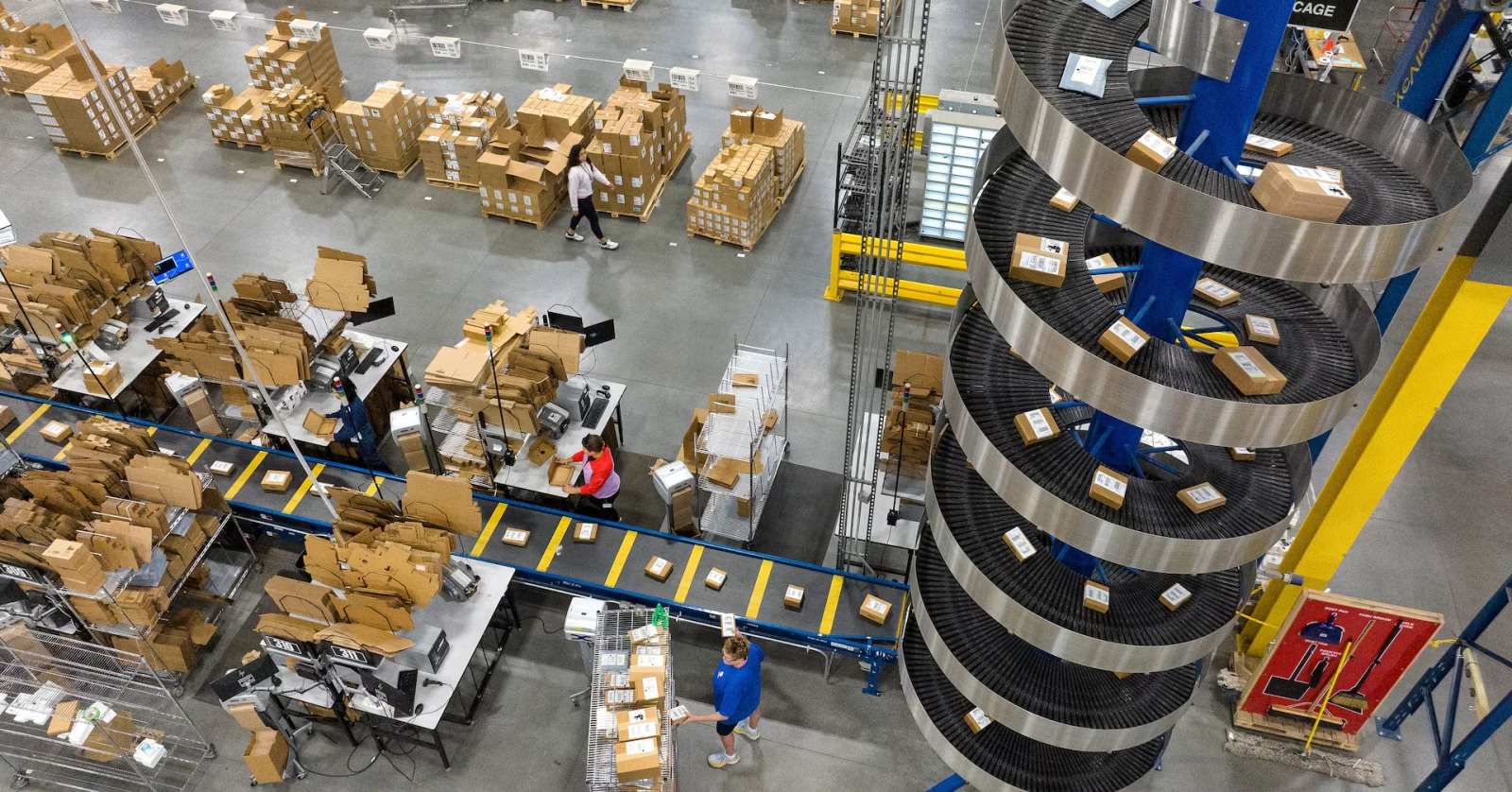
January 12 – Logistics is an industry where artificial intelligence has huge potential to drive greener practices. That’s because of the sector’s complexity, the large number of different actors involved and the amount of actionable data that is generated at every stage of transporting goods from producer to end-consumer.
Another push factor is growing demand from customers for more sustainable logistics, because the vast majority of brands’ emissions occur in their supply chains.
“The potential for AI to drive sustainable practices in the freight logistics industry is vast,” the report says, though it flags up barriers that will have to be overcome to ensure it realises its full potential.
Sam Stark is CEO of Green Project Technologies, a supply chain emissions calculator. He says “Logistics is one of the best examples of where profit and sustainability meet, because being more efficient is being lower-carbon.”
The logistics value chain generates “a tonne of data, from fuel consumption to the amount of energy used in the warehouse,” adds Stark. “Every single invoice is a useful data point that gives an insight into emissions and cost. At the moment, the information that is coming in is leading to fairly high-level recommendations, but we will be able to get much more granular in future.”

Machine learning also allows businesses to predict the best load distribution to reduce the number of trips each vehicle makes, and when to carry out maintenance to maximise fuel efficiency.
PSA is one of the world’s largest port operators, with more than 70 deep sea, rail and inland terminals operating in 45 countries. The Singapore company has integrated AI across nearly all aspects of its operations, says Pramod Verma, PSA’s head of data science, data governance and robotic process.
“AI-driven solutions now facilitate accurate predictions of vessel arrivals and cargo volumes, as well as the reservation of yard space weeks in advance, enabling more effective planning of manpower and resources,” he says.
“Terminal productivity improves, vessel turnaround times are shorter, and container movements are planned with better precision. The logistics ecosystem sees fewer empty trips and lower fuel use.”
He adds that customers benefit from improved visibility, faster co-ordination, and more predictable cargo flows. “AI also allows PSA to find new opportunities, such as digital logistics services and smart supply chain insights, which can become future revenue drivers.”
Tom Moore, founder of ProvisionAI, explains the productivity gains that can be achieved by using AI to optimise truck loads at ports. “On average, you can get 4-10% more product on a truck while ensuring it is legally loaded. We have one client that does 4,000 loads a week, so these very granular decisions can add up to big savings over the course of a year.”
AI is also creating new opportunities for companies in related fields. Quarterhill, a transportation technology company specialising in tolling systems, enforcement and intelligent infrastructure, is now helping logistics companies, too.
“Logistics companies are dealing with a lot of the same issues as the public road network,” says Tyler Haichert, senior design engineer. “The logistics companies started bringing problems to us.”
When assets get damaged or stolen, for example, a lot of effort goes into allocating repair costs or working out who is responsible. AI can help to identify where on a journey the damage or theft occurred. Knowing where problems arise and rectifying them reduces waste, fuel costs and, ultimately, emissions, Haichert says.

Worker safety is another tangential area that can bring emissions savings, says Sergio Barata, vice-president for EMEA at Netradyne, a provider of fleet-management software.
“There is a strong link between safer driving and lower emissions. … Aggressive driving behaviours such as speeding, harsh braking and rapid acceleration can increase fuel consumption by 10–40% in stop-and-go traffic and 15–30% at highway speeds.”
AI technologies that use real-time data from vehicle cameras, sensors and onboard systems, give fleet managers insights into the factors influencing fuel use and road safety, while AI-powered coaching technologies analyse driver behaviours and deliver alerts to eliminate wasteful habits and encourage safer driving.
AI can even tell the difference between unavoidable idling in heavy traffic and unnecessary idling when parked. Given that a heavy-duty truck idling for 1,800 hours a year burns about 6,500 litres of fuel, costing over 9,000 pounds per year, significant savings are available.
Further big improvements are likely as agentic AI, where AI systems can make decisions autonomously and talk to other AI systems, becomes more widespread.
“The industry is moving towards more agentic AI platforms, which can take information from different systems,” says ProvisionAI’s Moore. “Traditionally, the big problem with AI is the industry’s siloed approach. Planning, warehousing and transport don’t necessarily work together. Agentic AI is really bringing it all together.”

AI is still in the early stages of disrupting supply chains, says Shibu Raj, chief information officer at logistics group Geodis Americas. “There’s a lot of misunderstanding because everyone thinks AI is chat-based. But we use it for process optimisation, in conjunction with robotics.” He adds that the marriage of AI and logistics will not fulfil its potential until the quality of the data improves.
Quarterhill’s Haichert agrees. “The capabilities of the technology when it comes to sharing data are coming up against some old-fashioned thinking. The tools are already there, but they don’t have access to the information.
We’re still in a situation where everyone is in their own silo and is not prepared to share their data, which makes it really hard for the next company in the supply chain to do any proactive planning.”
There is also a tendency to overhype the impact of AI, he says. “There’s a lot more to solving new problems than just calling it AI. You also need hardened systems with well-designed, appropriate hardware. The supporting software is there to ensure the system is usable and effective.”
“It’s a learning curve for the industry,” Haichert adds. “There are a lot of outdated processes still.”
Opinions expressed are those of the author. They do not reflect the views of Reuters News, which, under the Trust Principles, is committed to integrity, independence, and freedom from bias. Ethical Corporation Magazine, a part of Reuters Professional, is owned by Thomson Reuters and operates independently of Reuters News.

















Leave a comment