
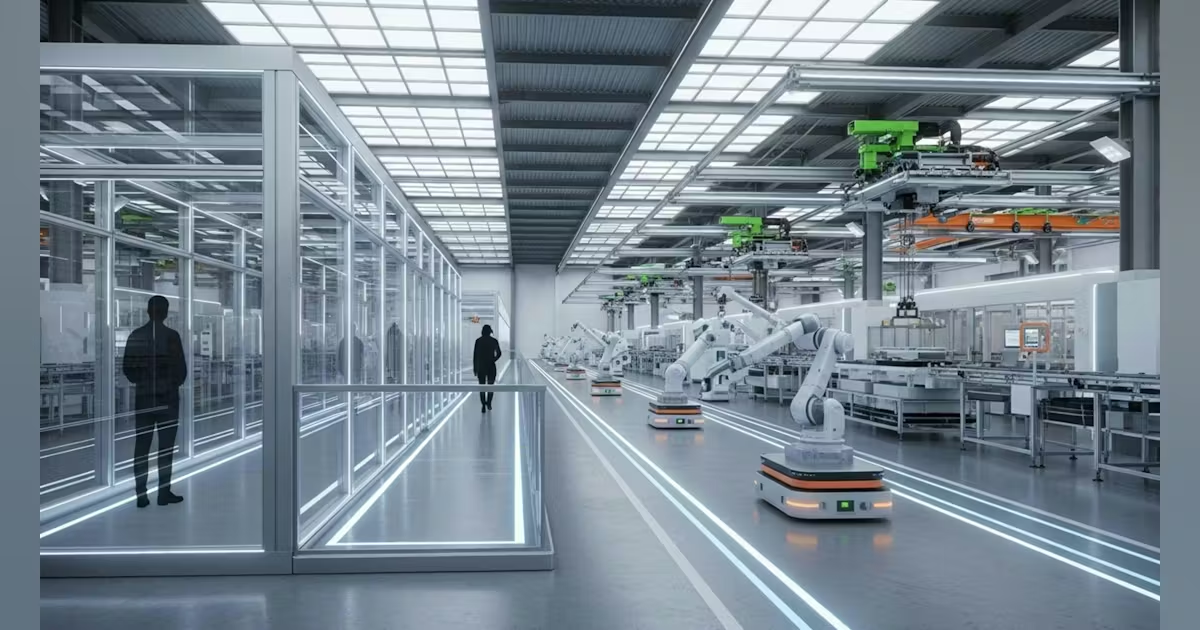
In everyday networking, a small delay doesn’t matter much. But in automation, where inputs from sensor data and output in the form of motor driving — all being handled within a very narrow timeframe (e.g., automotive manufacturing lines, sorting centers) — even a delay of a few milliseconds can cause things to fall out of sync.
EtherCAT was designed for real-time performance. The host device sends out a frame of data. Each slave device reads and writes data while the message flows through the network. When the frame reaches the end, it loops back to the master with all updated information.
Because everything happens on the fly, the communication is extremely efficient, with almost no delay. The communication line from the last device on the device tree can be looped back to the host machine to provide redundancy in cabling if there’s a splice or cut in the chain.
Communication of safety functions over the same physical interface using a safety-certified software stack such as Twinsafe and FSOE provides an added advantage. In case there’s a need for a safety intervention in operation, the host system, through the physical medium of EtherCAT, can initiate safe states within the actuators to come to a safe position and prevent any major incidence. With the AMR safety standard leaning toward IEC 61508, this becomes a key aspect in large-scale adoption of robots.
Hardware Stack Considerations
While EtherCAT offers plenty of advantages, there are a few factors to consider when it comes to choosing your hardware stack. Not all sensors support EtherCAT, and incorporating the functionality requires additional space and power. Most of the available devices are supported either through CAN or UART; EtherCAT needs another board for conversion.
Other considerations are the type of CPU cores and operating system of your host machine, specific timing requirements, network interface card (NIC) on the physical layer, and the need for cable redundancy in your network topology.
Only time will tell how quickly EtherCAT is adopted as the mobile robot population rapidly expands. Nonetheless, its intent is to help promote the safety and ease of use for these robots.















Leave a comment