
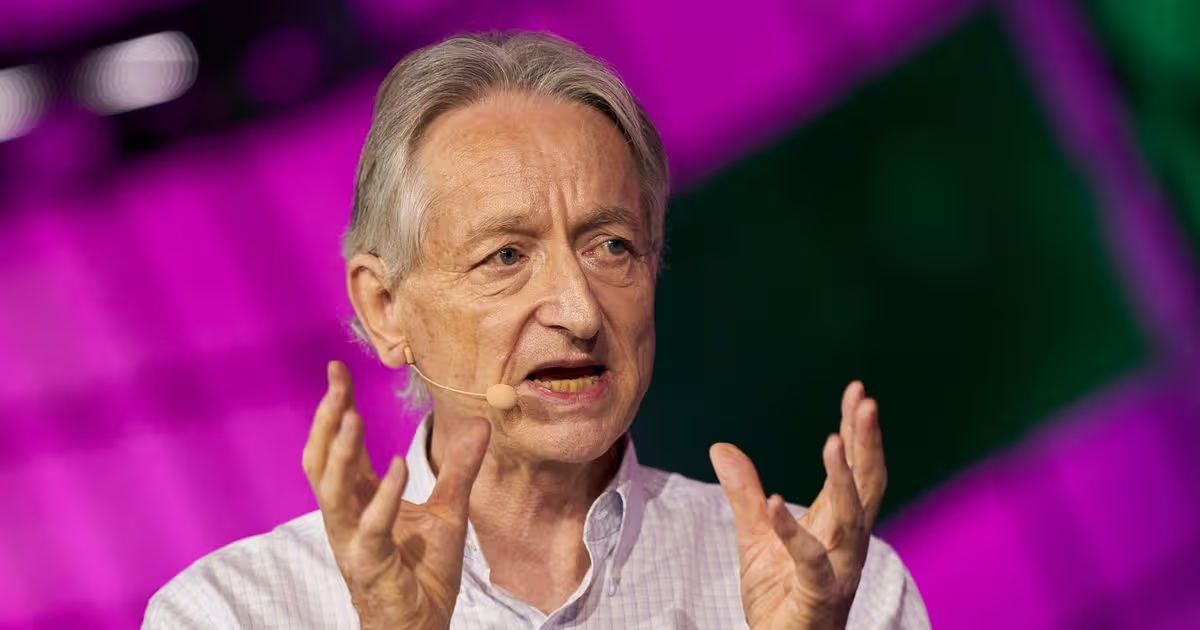
A Nobel Peace prize winning British scientist dubbed the ‘Godfather of AI’ has warned that AI now has “consciousness” and will be cleverer than people and capable of doing all our jobs within 20 years

Nobel Peace prize winning British scientist Professor Geoffrey Hinton dubbed the ‘Godfather of AI’ has warned that AI now has “consciousness”.(Image: AFP via Getty Images)
Computer scientist and cognitive psychologist Professor Geoffrey Hinton, 78, won the Nobel Prize in 2024 after popularising the algorithm enabling machines to learn.
Speaking as Amazon announced it was cutting 16,000 corporate workers’ jobs – coinciding with a push to invest heavily in AI – he says things are happening so fast it’s very hard to see into the future.
He says: “AI already has subjective experiences and I think it’s fairly clear that if we weren’t talking to philosophers, we’d agree that AI was aware.
“There’s a lovely conversation where an AI says to the people testing it, ‘now, let’s be honest with each other, are you actually testing me?’ And the people, the scientists describing that then in the paper say ’the AI was aware that it was being tested.’ That’s what normal people would call consciousness.”
READ MORE: Lord Sugar top aide’s astonishing confession ahead of new series of The Apprentice
Speaking on LBC’s Tonight with Andrew Marr – who told listeners that more than a quarter of all workers in Britain fear they’re going to lose their jobs in the next five years because of AI – Professor Hinton says manual workers will be at an advantage, as AI gains intellectual ground on human beings.
He says: ”We’re starting to see jobs in many professions like lawyers being taken over by AI and, in future, we’ll see many more. AI is lagging in terms of physical dexterity. Replacing intellectual jobs is going to happen before they replace jobs that require physical dexterity. So I’ve sometimes said being a plumber will last longer than being a lawyer. We should be worrying about that and trying to do things to protect ourselves against it, but nobody really knows what’s going to happen.”
Prof. Hinton – now a professor emeritus at the University of Toronto in Canada, focusing on AI safety – resigned from Google in 2023, so he could speak freely about the risks and dangers of AI. Known for revolutionising AI, his advice for young people is: “So far as I can see, the best kind of education to get will be one that encourages you to think independently, but also something that educates you in STEM [science, technology, engineering and mathematics] so you can understand what’s going on with AI.”
As more people believe that AI has consciousness – which means having subjective personal experiences and knowing what it feels like to exist – it should also have ‘AI rights’ akin to human rights. But Prof. Hinton says: “I think that would be very tricky. You should listen to Yuval Harari [a renowned philosopher] who says as soon as we give political rights to AI, it’ll make it much easier for it to take over.
“My view of it is this – I eat cows because I care more about people than about cows. We’re people. What we really care about most is other people and ourselves. I think we should try to keep people in charge and have AI work for the benefit of people, because we are people.”
Asked if AI is evil or benign and whether it has its own view of what direction it should be progressing in, Prof. Hinton says: “We’ve seen examples where it seems to have developed self preservation.” He says when AI has been given goals to achieve in order to stay “alive” that it has used devious means.
He explains: “It does things like lying to the people who are creating it and blackmailing them in order to stay alive. So we’ve seen bad aspects of it. We need to work very hard on how we can design AI, so that it thinks people are more important than AI. We don’t know how to do that, but we’re in charge still. We’re designing it and we should really put a lot of effort into that.”
If jobs are taken over by AI, it will also mean a fundamental change in the way in which society operates, according to Prof. Hinton. He asks: “If workers disappear, if it’s all done by AI, what happens to the tax base? Where does the state get the money to pay for all that?
Also, most AI companies are in places like the USA, which could mean a disproportionate distribution of intelligence and, therefore, global power – with serious potential political consequences. Prof. Hinton continues: “I suspect that the big tech companies are thinking, ‘if we can be the first to get really good AI, human level AI, then we can make a lot of money selling AI to companies, so that they can replace workers.’
“As far as I can see, that’s the only place they can get their huge investments back. They’re not thinking about the social consequences of that. They’re assuming, somehow, the state will take care of it. But I don’t see how it can. I am somewhat concerned, because I think once they [the companies] start trying to make their money back by selling software that will replace workers, or internally developing that software for their own workers, we’ll get a large social protest against that and, therefore, it’ll be hard for them to make their money back.”
For now, Prof. Hinton says, we remain in charge of AI, but he warns that if we don’t take measures now, there is a danger of a new dystopian world order becoming a harsh reality. And he forecasts we do not have long, saying: “At most a couple of decades.
Professor Geoffrey Hinton was speaking on LBC’s Tonight With Andrew Marr











Leave a comment