
Put down the pen and paper and shelve the spreadsheets and enterprise resource planning (ERP) software. Artificial intelligence (AI) and advanced machine learning are the next-generation tools for demand forecasting in distribution.
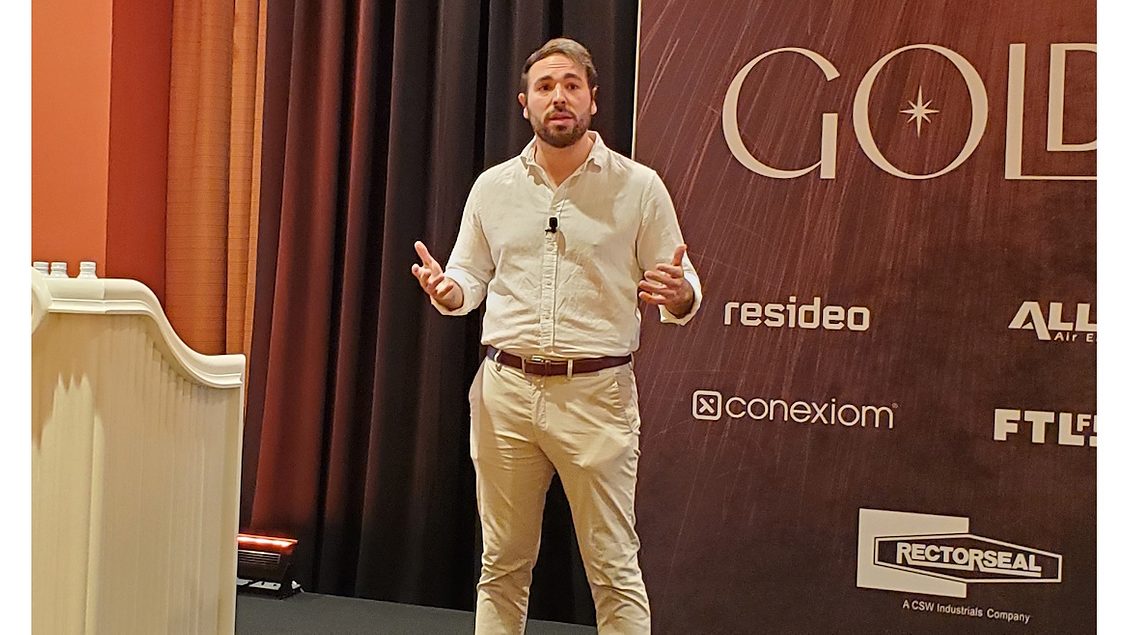
That was the message that Conor Leen and Matt Rojas, co-founders of the machine learning software firm Lantern, brought to the recent Heating, Air-conditioning & Refrigeration Distributors (HARDI) conference in Las Vegas, Nevada.
“Machine learning is here. A couple of years ago, this sort of technology was just in the hands of the tech giants we used to work with,” Leen, president of Lantern, told distributors during the conference at The Wynn, a Vegas resort. “What’s really exciting for this industry is, with the state of technology, anyone in this room can benefit from it.”
Advanced machine learning, Rojas and Leen said, offers accurate demand forecasting by analyzing product data points and accounting for factors like seasonality, pricing fluctuations, carrying costs, regional weather patterns, freight costs, and even the purchase minimums manufacturers set before providing no-extra-charge shipping. And machine learning is continuously improving, they said, producing increasingly accurate forecasts as it gets familiar with how a distributor operates.
Lantern, based in San Francisco, California, is focused on applying machine learning to demand forecasting in product distribution. Rojas and Leen founded the company after meeting as graduate students at Stanford University.
At Stanford, the pair undertook a research project on HVACR distribution, interviewing more than 200 distribution professionals. When distributors were asked about their biggest challenge, Leen said, demand forecasting was often mentioned.
“We heard things like, ‘My forecasting is inaccurate, so I buy a ton of inventory because I’d rather be safe than sorry,’” said Rojas, Lantern’s CEO. “We heard, ‘I miss sales all the time, [and] ‘My warehouses are full of inventory that I can’t sell.’”
Looking for quick answers on air conditioning, heating and refrigeration topics?
Try Ask ACHR NEWS, our new smart AI search tool.
Ask ACHR NEWS
Following the interviews, the two partnered with 10 HVACR distributors, most of them HARDI members, and collected their product data.
“Machine learning is a really good fit for problems with lots of data. Distributors have lots of data that’s useful for demand forecasting,” Leen said. Data doesn’t need to be perfect, Rojas said, as machine learning will clean and organize it.
The pair used the distributors’ data to build a machine learning model to predict demand, “and the results were amazing,” Leen said, “so much so that they asked us to build a product for them.”
Machine learning-based forecasting, the two said, solves distribution issues such as dead inventory, stockouts — being completely out of a product customers want — and the need for emergency product transfers.
“This is pretty much what every leading company in Silicon Valley uses today to do any sort of predictive analysis, and it can recognize really complex patterns hidden within the data of your business,” Rojas said. “It’s custom fit for your business, and it’s always improving.”
Rojas outlined six key features of machine learning:
• It is “perfect for recognizing seasonality” in demand, whether it’s weather-related seasonality or not. Machine learning can even come to recognize patterns within a single season, Rojas said.
• It is sensitive to how demand can change when prices change. “Machine learning is really good at … picking up this relationship between price and demand for every item at every location, for every one of your customers,” Rojas said.
• It applies transfer learning, meaning it analyzes the relationships between products and, for example, can predict that when demand for Product X rises or falls, demand for Product Y will change similarly, while demand for Product Z won’t change.
• It uses sales patterns to come up with product lifecycle analyses.
• It provides anomaly filters to make “educated guesses” about whether a demand spike is an outlier or the beginning of a new sales pattern.
• It is continuously improving as it learns more about a particular distributor.
“Machine learning models generally perform well on day one. … That’s the worst it’ll ever do,” Rojas said. “Every day that it’s in production, it learns more and more about the patterns of your business, and so then, like, theoretically, over time, it’ll reach near-perfect accuracy.”
Leen added that machine learning for distribution can also make use of macro-level data on HVACR, such as HARDI, or the government might provide.
“It can actually contextualize these high-level insights to your business,” he said.
As distributors discuss ways to employ AI, Leen said later, “We think that demand forecasting should be very top of that list. There are gains in reduced inventory, improved sales, better working capital, and that can really go straight to the bottom line of your business.”














Leave a comment