
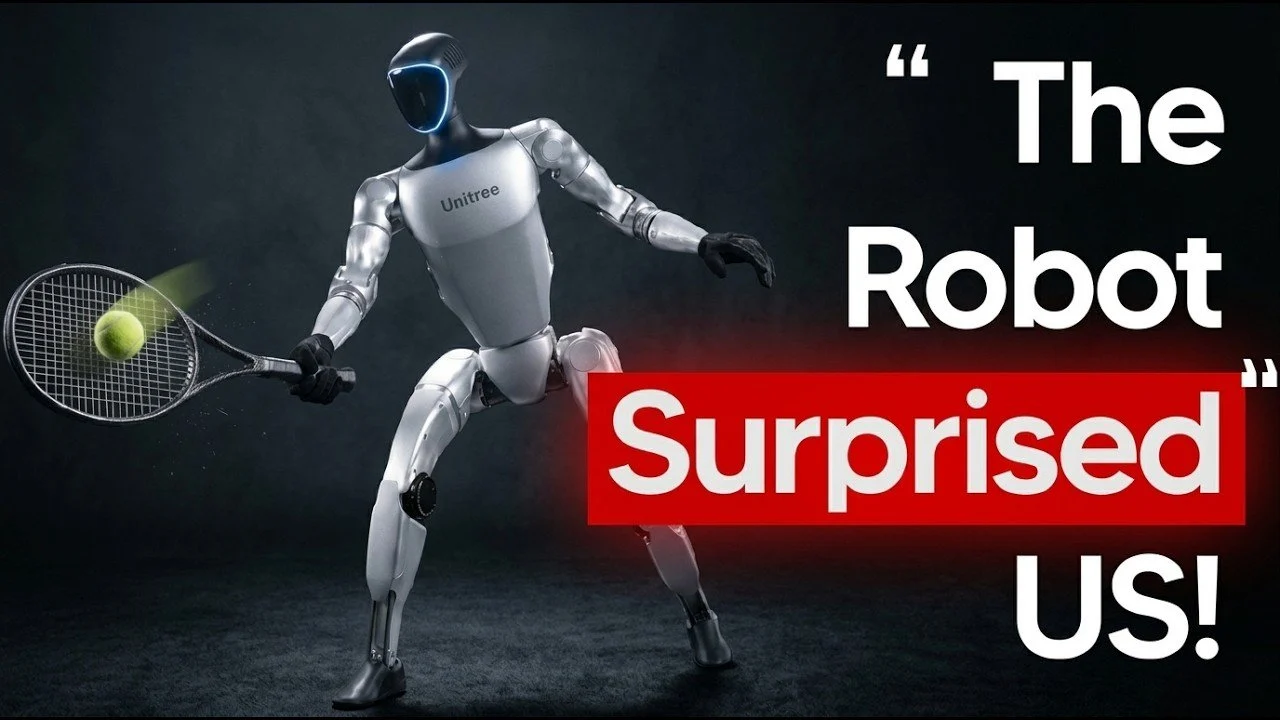
Chinese researchers have introduced the Unitree G1, a humanoid robot designed to play tennis, showcasing a significant step forward in robotics. Standing at 127 cm with 29 degrees of freedom, the Unitree G1 combines advanced mechanics with a unique 3D-printed connector that enables precise racket handling. What sets this robot apart is its reliance on an AI system called “Latent,” which learned tennis movements from just five hours of motion capture data from amateur players. Through this approach, the Unitree G1 demonstrates how robots can adapt human-like movements to tackle the demanding, fast-paced nature of tennis. AI Grid highlights how this development bridges the gap between human motion and robotic execution.
Explore how the Unitree G1’s training in simulated environments prepared it for real-world gameplay, achieving a 91% success rate for forehand strokes. Gain insight into the challenges of tracking high-speed tennis balls and coordinating split-second decisions, as well as the broader implications for robotics beyond sports. From industrial tasks to creative applications, this overview examines how the principles behind the Unitree G1 could shape the future of humanoid robots in dynamic and unpredictable environments.
Humanoid Robot Plays Tennis
TL;DR Key Takeaways :
- Chinese researchers developed the Unitree G1, a humanoid robot capable of playing tennis, showcasing advanced AI and robotics integration for complex physical tasks.
- The Unitree G1 features 29 degrees of freedom and a 3D-printed connector for precise racket handling, allowing it to perform intricate tennis movements.
- Using an AI system called “Latent,” trained on limited motion data from amateur players, the robot achieved a 91% success rate for forehand strokes and 78% for backhand strokes.
- The technology demonstrates broader applications beyond tennis, including industrial tasks, sports and creative activities, by using low-cost, incomplete data for training.
- Future developments aim to enhance autonomy with onboard sensors and explore multi-agent scenarios, paving the way for versatile robots in diverse environments like healthcare and disaster response.
The robot, named Unitree G1, stands at 127 cm and features an impressive 29 degrees of freedom, allowing it to perform intricate and dynamic movements. A key innovation lies in its 3D-printed connector, which allows the robot to securely grip and maneuver a full-sized tennis racket. This design ensures the precision and agility required for tennis, a sport where even minor mechanical errors can significantly affect performance. The combination of advanced mechanics and intelligent design makes the Unitree G1 a standout example of humanoid robotics.
Why Tennis Challenges Robotic Systems
Tennis is a uniquely demanding sport for robots due to its fast-paced and unpredictable nature. Successfully playing tennis requires a combination of advanced motion control, real-time decision-making and sensor integration. Key challenges include:
- Tracking tennis balls moving at speeds of up to 30 meters per second with high accuracy.
- Coordinating full-body movements to execute forehand and backhand strokes effectively.
- Making split-second decisions to adapt to the rapid dynamics of gameplay.
These requirements push the boundaries of robotic engineering, making tennis an ideal testbed for evaluating the capabilities of humanoid robots.

Here is a selection of other guides from our extensive library of content you may find of interest on Humanoid Robots.
The Role of AI in Mastering Tennis
To address these challenges, researchers employed an AI system called “Latent”, specifically designed to learn athletic skills from imperfect human motion data. Unlike traditional AI models that depend on extensive, high-quality datasets, Latent was trained using just five hours of motion capture data from five amateur tennis players. This limited dataset, collected in a confined space, was sufficient for the AI to translate human movements into robot-compatible actions. As a result, the Unitree G1 can execute complex tennis strokes with remarkable accuracy, showcasing the potential of AI to bridge the gap between human motion and robotic execution.
From Simulation to Real-World Performance
The training process began in a simulated environment, where randomized variables were introduced to mimic real-world imperfections. This approach prepared the robot to handle unpredictable scenarios during live gameplay. When tested in real-world conditions, the Unitree G1 achieved:
- A 91% success rate for forehand strokes.
- A 78% success rate for backhand strokes.
These results highlight the effectiveness of combining virtual training environments with adaptive AI systems. By bridging the gap between simulation and reality, researchers have demonstrated how robots can achieve high levels of performance in dynamic, real-world tasks.
Broader Applications of the Technology
The success of the Unitree G1 extends beyond tennis, showcasing the potential for robots to learn from incomplete and low-cost data. This capability reduces the reliance on expensive, high-quality datasets and opens the door to a wide range of applications, including:
- Sports such as soccer or parkour, where agility and coordination are critical.
- Industrial tasks like warehouse operations, disaster recovery, or precision assembly.
- Creative and precision-based activities, including dancing, martial arts, or even medical procedures.
By demonstrating adaptability across diverse tasks, this research paves the way for more versatile and cost-effective robotic systems capable of operating in various environments.
Future Developments in Humanoid Robotics
Looking ahead, researchers aim to enhance the robot’s autonomy by replacing external motion capture systems with onboard cameras and sensors. This transition would enable the Unitree G1 to operate independently, eliminating the need for external tracking infrastructure. Additionally, future research will explore multi-agent scenarios, such as robots playing doubles tennis or collaborating in team-based activities. These advancements could significantly expand the robot’s capabilities, allowing it to perform both individual and cooperative tasks in increasingly complex environments.
The potential for humanoid robots extends far beyond sports. With continued advancements in AI, mechanics and sensor technology, robots like the Unitree G1 could play a pivotal role in industries ranging from healthcare to disaster response, offering innovative solutions to real-world challenges.
Media Credit: TheAIGRID
Disclosure: Some of our articles include affiliate links. If you buy something through one of these links, Geeky Gadgets may earn an affiliate commission. Learn about our Disclosure Policy.











Leave a comment