
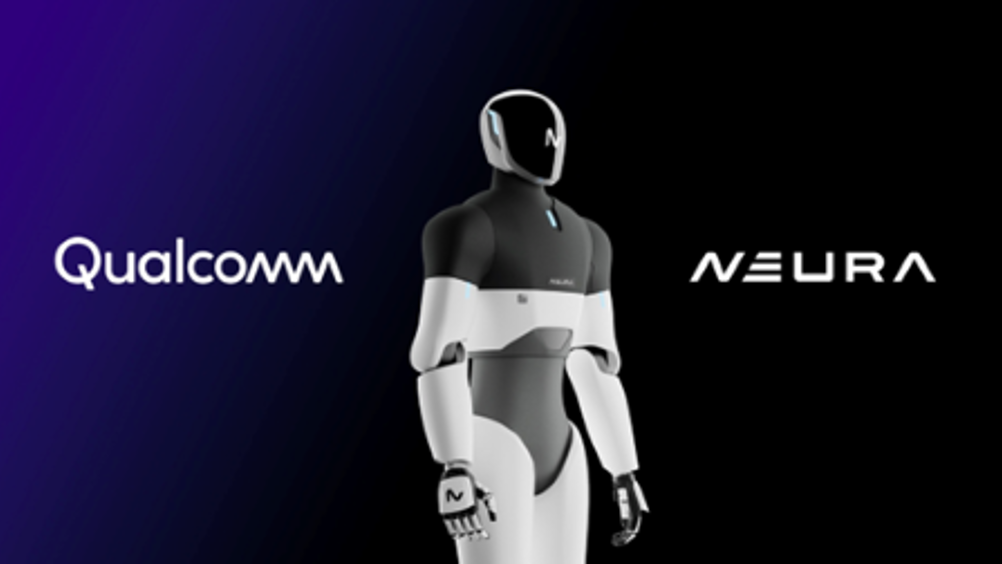
The partnership brings together Qualcomm Technologies’ capabilities in AI computing, connectivity and robotics platforms with NEURA Robotics’ hardware systems and embodied AI software. According to both companies, the intention is to enable intelligent robots that can operate safely and effectively alongside humans in industrial, service and household environments.
NEURA said the push towards cognitive and humanoid robots requires strong partnerships, noting that collaboration with major technology providers is essential to moving advanced robotics from research settings into scalable real‑world deployments.
At the core of the agreement is work on “Brain + Nervous System” reference architectures, combining high‑level cognitive functions such as perception, reasoning and planning with ultra‑low‑latency real‑time control. Qualcomm Technologies’ robotics processors, including the Dragonwing IQ10 Series, along with its physical AI acceleration, connectivity platforms and software stack, will be integrated with NEURA’s robotics hardware and embodied AI systems to develop scalable solutions.
The companies also plan to align Qualcomm Technologies’ end‑to‑end robotics architecture – incorporating heterogeneous edge compute, mixed‑criticality systems, machine learning operations and an AI data flywheel – with NEURA’s platform strategy. The goal is to support faster, more robust deployment across multiple categories of robotic systems.
As part of simplifying how AI moves from development into production, the collaboration includes work on a standardised runtime and deployment interface to streamline how AI workloads are validated, updated and managed across different robotic platforms. This is intended to help maintain reliability and determinism while reducing development friction.
NEURA’s Neuraverse platform is expected to play a central role, providing a cloud‑based environment for simulation, training, orchestration and lifecycle management of physical AI workloads. Neuraverse links cognitive robots into a shared intelligence network, enabling new capabilities discovered by one system to be shared across fleets.
The companies also plan to support a global developer ecosystem, enabling third parties to build robotics and physical AI applications that can be deployed across a range of form factors. NEURA’s robotic arms, mobile platforms, service robots and humanoid systems may serve as reference designs for testing and validation.
Both companies emphasised functional safety, real‑time responsiveness and human‑centred design as foundational elements of the partnership. The collaboration aims to strengthen the reliability, determinism and AI performance of future robotic platforms through a data‑driven engineering approach.
Commenting on the announcement, David Reger, CEO and Founder of NEURA Robotics, said, “This collaboration marks a major step toward making physical AI real: open, scalable, and trusted. By bringing together our cognitive robotics platforms and the Neuraverse ecosystem with Qualcomm Technologies’ leadership in edge AI and connectivity, we’re aiming to accelerate a future where cognitive robots operate safely alongside humans across industries and throughout everyday life.”
Nakul Duggal, EVP and Group GM for Automotive, Industrial and Embedded IoT and Robotics at Qualcomm Technologies, added, “Robotics represents one of the most demanding edge AI use cases, where decisions must happen instantly, reliably, and locally, without relying solely on the cloud for safety-critical responses. Qualcomm Technologies has a long-standing presence in robotics, and continued ecosystem development with companies like NEURA Robotics helps accelerate scalable, on-device intelligence. NEURA’s approach to cognitive robotics reflects a growing shift toward bringing perception and reasoning directly onto the device.”
The partnership aims to accelerate the commercialisation of general‑purpose and humanoid robots, with both companies positioning the collaboration as a critical step towards deploying physical AI at scale across multiple industries.















Leave a comment