Pharmaceutical Collaborative Robots Market – Global Industry Size, Share, Trends, Opportunity, and Forecast, 2021-2031
January 22, 20264 Mins read39
Share
Company Logo
Opportunities in the Global Pharmaceutical Collaborative Robots Market include enhancing operational efficiency, reducing human error in manufacturing, and accommodating skilled labor shortages. Growth is also driven by automation in personalized medicine and modular manufacturing, despite challenges with regulatory compliance.
Pharmaceutical Collaborative Robots Market
Pharmaceutical Collaborative Robots Market ·GlobeNewswire Inc.
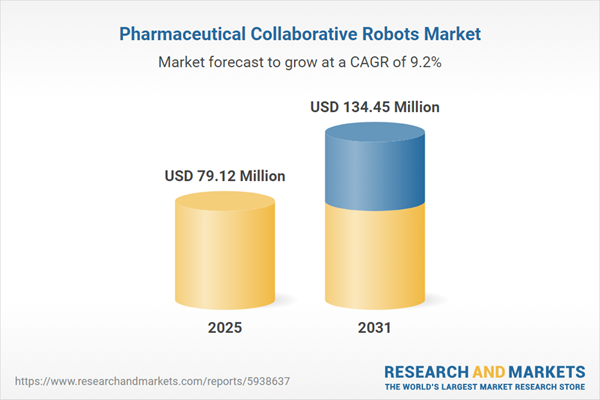
The Global Pharmaceutical Collaborative Robots Market is projected to expand from USD 79.12 Million in 2025 to USD 134.45 Million by 2031, registering a CAGR of 9.24%.
These collaborative robots are specialized automated systems engineered to function safely alongside human workers in shared environments, increasingly handling tasks such as sterile compounding, packaging, and laboratory analysis. Growth is fundamentally supported by the urgent need to reduce human error in high-precision settings, the demand for contamination-free manufacturing areas, and the necessity to offset skilled labor shortages. These operational drivers, distinct from purely technological trends, emphasize the industry’s need for efficiency and safety. Illustrating this reliance on automation, the International Federation of Robotics reported a 610% increase in sales of robots for diagnostics and medical laboratory analysis in 2024.
Despite these drivers, the rigorous regulatory compliance landscape governing pharmaceutical production poses a significant obstacle to broader market expansion. Global health authorities enforce stringent Good Manufacturing Practice protocols, which mandate extensive documentation and testing for any new automated machinery. This complex validation process frequently leads to prolonged deployment timelines and escalated implementation costs, presenting a substantial barrier for companies seeking to incorporate these collaborative systems into validated workflows.
Market Drivers
The necessity for operational efficiency and high-throughput automation serves as a primary engine for market growth, prompting pharmaceutical manufacturers to aggressively adopt collaborative robots for streamlining complex workflows like cell therapy production. This transition moves beyond mere speed, focusing on achieving significant cost reductions in personalized medicine manufacturing. For instance, a case study titled ‘Robotics transforms cell therapy’ by Universal Robots in August 2025 highlighted that deploying a new robotic cluster for biomanufacturing resulted in a 74% decrease in operational costs while substantially boosting production capacity compared to manual techniques.
Additionally, the drive to minimize human error in critical handling and quality control tasks fuels widespread adoption. In the highly regulated pharmaceutical industry, maintaining sterile conditions and ensuring zero-defect outputs are essential, and cobots address these needs by executing repetitive, high-precision tasks with unwavering accuracy. This capability is vital for mitigating contamination risks and improving product safety. As reported by RoboticsTomorrow in the February 2025 article ‘The Rise of Pharma Robots,’ integrating automation in drug manufacturing can reduce product defects by up to 80%. Mirroring this momentum, the Association for Advancing Automation noted a 22% increase in robot orders from the life sciences and pharmaceutical sector during the second quarter of 2025 compared to the prior year.
Market Challenges
The strict regulatory compliance landscape within pharmaceutical production serves as a major restraint on the collaborative robots market’s growth. Since these automated systems interact directly with sensitive drug products and essential manufacturing processes, they must adhere to rigorous Good Manufacturing Practice standards. This requirement necessitates exhaustive validation protocols, including Installation, Operational, and Performance Qualifications, to guarantee zero risk of error or contamination. The need for such comprehensive documentation and testing considerably increases implementation costs and prolongs the time required to deploy new machinery, often delaying returns on investment and discouraging the rapid integration of collaborative systems.
This regulatory bottleneck is especially significant given the rising demand for automation in the sector. According to the Association for Advancing Automation, robot orders from the life sciences, pharmaceutical, and biomedical industries surged by 46% in 2024. Although this increase in procurement demonstrates a strong intent to adopt automation, the complex and slow approval framework limits the pace at which these assets can be brought online, effectively slowing the market’s realized growth rate.
Market Trends
The deployment of automation in small-batch personalized medicine compounding is emerging as a transformative trend, fueled by the growth of Advanced Therapy Medicinal Products such as cell and gene therapies. Unlike traditional bulk manufacturing, these treatments demand the handling of patient-specific biological materials under strictly aseptic conditions. Collaborative robots are uniquely capable in this area, operating within isolated barrier systems to execute delicate liquid handling with greater consistency than human operators, thereby ensuring sterility and maintaining the chain of identity. This focus on automated personalized care is highlighted by Yaskawa Electric Corporation’s May 2024 announcement regarding the ‘Astellas Pharma Partnership,’ where a memorandum of understanding was signed to co-develop a cell therapy ecosystem integrating robotics to standardize high-precision processes.
Simultaneously, the industry is shifting towards modular and reconfigurable manufacturing cells, particularly for packaging and kitting operations. Pharmaceutical manufacturers are increasingly replacing rigid, single-purpose automation lines with flexible cobot cells capable of adapting quickly to frequent product changeovers and diverse packaging formats. This modularity enables facilities to efficiently manage high-mix, low-volume production runs, which is critical as product lifecycles shorten and SKU complexity rises. The demand for such adaptable solutions is reflected in recent data from the Association for Advancing Automation’s ‘Q1 2025 North American Robot Orders’ report, which noted that the Life Sciences, Pharmaceutical, and Biomedical sector ordered 127 collaborative robot units in the first quarter of 2025 alone.
Key Players Profiled in the Pharmaceutical Collaborative Robots Market
ABB Ltd.
Universal Robots A/S
Mitsubishi Electric Corporation
KUKA AG
Kawasaki Heavy Industries Ltd.
Yaskawa Electric Corporation
DENSO Wave Inc.
FANUC Corporation
Omron Corporation
Seiko Epson Corporation
Report Scope
In this report, the Global Pharmaceutical Collaborative Robots Market has been segmented into the following categories:
Pharmaceutical Collaborative Robots Market, by Application:
Pharmaceutical Collaborative Robots Market, by End-use:
Pharmaceutical Companies
Research Laboratories
Others
Pharmaceutical Collaborative Robots Market, by Region:
About ResearchAndMarkets.com ResearchAndMarkets.com is the world’s leading source for international market research reports and market data. We provide you with the latest data on international and regional markets, key industries, the top companies, new products and the latest trends.
Attachment
CONTACT: CONTACT: ResearchAndMarkets.com Laura Wood,Senior Press Manager press@researchandmarkets.com For E.S.T Office Hours Call 1-917-300-0470 For U.S./ CAN Toll Free Call 1-800-526-8630 For GMT Office Hours Call +353-1-416-8900

















Leave a comment