
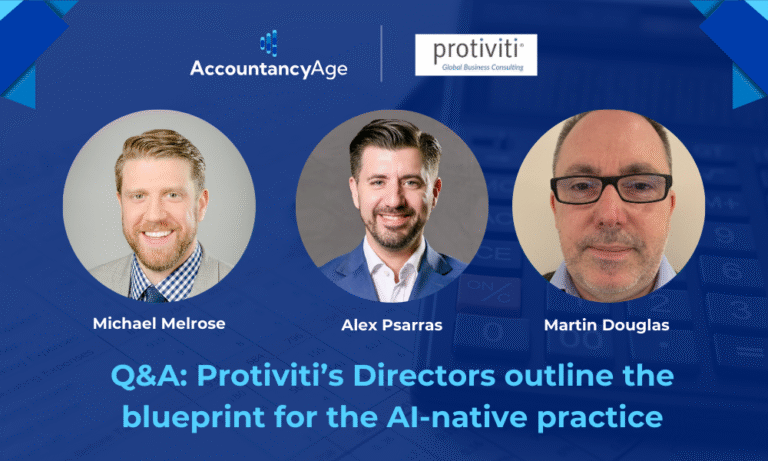
For most UK firms, the last five years were defined by “digitisation,” the often-painful migration from desktop ledgers to cloud-based ecosystems. But according to the leadership team at Protiviti, being a cloud-first firm is no longer the finish line; it is merely the baseline.

As we look toward the 2026 landscape, the industry is bifurcating into those who use AI as a bolt-on tool and those who are “AI-native.” The difference, according to Michael Melrose, is structural. “Digitised firms use cloud platforms to execute existing processes more efficiently, essentially doing the same work, faster,” Melrose explains. “AI-native firms redesign the work itself. They embed intelligence into the process so the system can anticipate, explain, and increasingly, make decisions.”
Benchmarking Maturity: The Accounting Automation Index
To help CFOs navigate this transition, Protiviti utilizes an Accounting Automation Index that moves away from vague “innovation” metrics toward hard, outcome-based KPIs. For a large finance function, the maturity of an AI-native practice is measured by the silence of its manual systems.
Key indicators now include the proportion of transactions auto-processed without human intervention and, crucially, the percentage of forecasts and accruals generated by models rather than manual spreadsheets. “We also track human effort,” says Melrose. “How much finance time is spent on interpretation and decision support versus reconciliation and data preparation? At scale, the transition shows up when finance shifts from a retrospective reporting function to a predictive one.”
The Death of the “Sample”: Audit in the Age of 100% Testing
Perhaps no area is being more radically reshaped than Internal Audit. The traditional “sample-based” approach, long the standard for manageable workloads, is being rendered obsolete by AI’s ability to perform 100% population testing. However, this shift brings a new logistical nightmare: the anomaly avalanche.
Alex Psarras warns that while AI can surface thousands of exceptions in seconds, the sheer volume can be a “double-edged sword” for firms not prepared for the output. “The number itself is rarely the story,” Psarras notes. “The work starts when auditors group exceptions into themes and trace root causes. A large exception set often collapses into one or two drivers: a control not operating as intended, a data break, or behaviour concentrated in an outcome.”
This is where the “human-in-the-loop” becomes a regulatory necessity rather than a suggestion. Martin Douglas emphasizes that while AI reduces barriers for non-technical users, the selection of data points and the assessment of data quality still require the “seasoned eye” of a professional auditor. In the UK’s increasingly stringent regulatory environment, the ability to document why a conclusion stands despite what the AI flags is the new hallmark of audit value.
Overcoming Technical Debt: The “Wrap and Renew” Strategy
For many UK CFOs, the primary hurdle isn’t a lack of ambition, but a mountain of “technical debt.” Legacy systems, often held together by manual workarounds, simply don’t “talk” to modern AI models.
The temptation is often to wipe the slate clean with a total architectural overhaul, but Melrose advises a more disciplined, pragmatic path. “The first question shouldn’t be about what technology to buy, but what problem we are trying to solve,” he says. Protiviti advocates for a “wrap and renew” approach optimising existing processes and establishing clean data pipelines before layering on AI.
Douglas adds that for high-volume organizations, this involves moving toward engineered “data pipelines” that feed curated data warehouses. This ensures that the AI is acting on “master data” that is supported by clear lineage and robust processing controls. “By establishing clean data first, we ensure AI isn’t just adding speed to noise, it becomes a force multiplier for insight.”
The Governance Mandate and the 2026 Team
The shift to an AI-native practice isn’t just a technological one; it is a governance challenge. In the UK, Provision 29 of the Corporate Governance Code sets broad expectations on risk management and internal control. AI-enabled processes sit squarely within this scope.
“The UK Corporate Governance Code is not written as an ‘AI rulebook,’ yet it sets expectations on monitoring risk and declaring the effectiveness of material controls,” the team explains. This means boards must be able to demonstrate transparency and explainability in their AI models, particularly where personal data is involved, and ICO guidance applies.
As for the “AI-Native Team of 2026,” the profile of the standard hire is changing. We are seeing the rise of the “Finance Data Scientist,” a professional who understands the tax code and the Python code in equal measure. However, Douglas points out that talent isn’t the only constraint. “Organizations will only get value if they have the basics in place first: trusted data, clear acceptable-use policies, and practical training so people can use AI safely and ethically.”
The Bottom Line: The Cost of Inaction
For those still hesitant about the investment, Protiviti points to a recent AI-enabled review of supplier invoicing. By moving from a sample-based review to a 100% population review, the firm identified significant potential overpayments that had previously gone unnoticed.
The real cost of inaction isn’t just a missed efficiency gain; it’s a failure to catch revenue leaks and a loss of ground to competitors who are realizing higher ROI through greater AI maturity.
For the UK accountant, the message is clear: the “AI-native” practice isn’t a future goal, it’s the current requirement for survival in a predictive economy.
















Leave a comment