
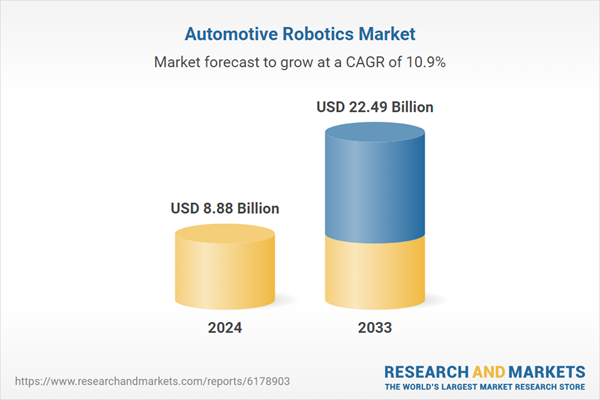

The Automotive Robotics market is poised for significant growth, projected to reach $22.49 billion by 2033 from $8.88 billion in 2024, reflecting a CAGR of 10.87% from 2025-2033. This expansion is fueled by the increasing adoption of automation in manufacturing, enhancing efficiency and precision across production processes like welding and assembling. Industry 4.0 technologies, including AI and IoT, are boosting robotics capabilities, while the rise of electric vehicles and autonomous driving tech demands more advanced manufacturing. Key players like ABB, Rockwell Automation, and Yaskawa are driving innovation and investment in robotics, leveraging technological advancements to optimize manufacturing and meet rising consumer demand.
Automotive Robotics Market

Dublin, Feb. 19, 2026 (GLOBE NEWSWIRE) — The “Competitor Analysis of Automotive Robotics Market Recent Developments, Company Strategies, Sustainability Benchmarking, Product Launches, Key Persons, and Revenue Forecasts” report has been added to ResearchAndMarkets.com’s offering.
The Automotive Robotics industry is expected to expand lucratively to an estimated value of US$ 22.49 Billion by 2033, from US$ 8.88 Billion in 2024. This expansion reflects a compound annual growth rate (CAGR) of 10.87% between 2025 and 2033.
The Automotive Robotics Market is experiencing strong growth, driven by the increasing adoption of automation in manufacturing processes to enhance efficiency, precision, and safety. Robotics play a vital role in various stages of automotive production, including welding, painting, assembling, material handling, and inspection.
As automotive manufacturers face growing demand for high-quality vehicles and faster production cycles, robotic systems help optimize workflows, reduce operational costs, and minimize human errors. Additionally, the growing integration of Industry 4.0 technologies – such as artificial intelligence (AI), machine learning, and the Internet of Things (IoT) – is revolutionizing robotic capabilities, allowing for greater flexibility and adaptability on the production floor.
The market’s expansion is also supported by the rising trend toward electric vehicles (EVs) and autonomous driving technologies, which require advanced manufacturing precision. Collaborative robots (cobots) are gaining popularity for their ability to work safely alongside humans, increasing efficiency in complex assembly processes.
Major automotive players are investing heavily in robotics and automation infrastructure to maintain competitiveness and sustainability. Moreover, advancements in sensor technology, motion control, and software systems are further enhancing robot performance, making automotive robotics a cornerstone of the future smart manufacturing ecosystem.
















Leave a comment