
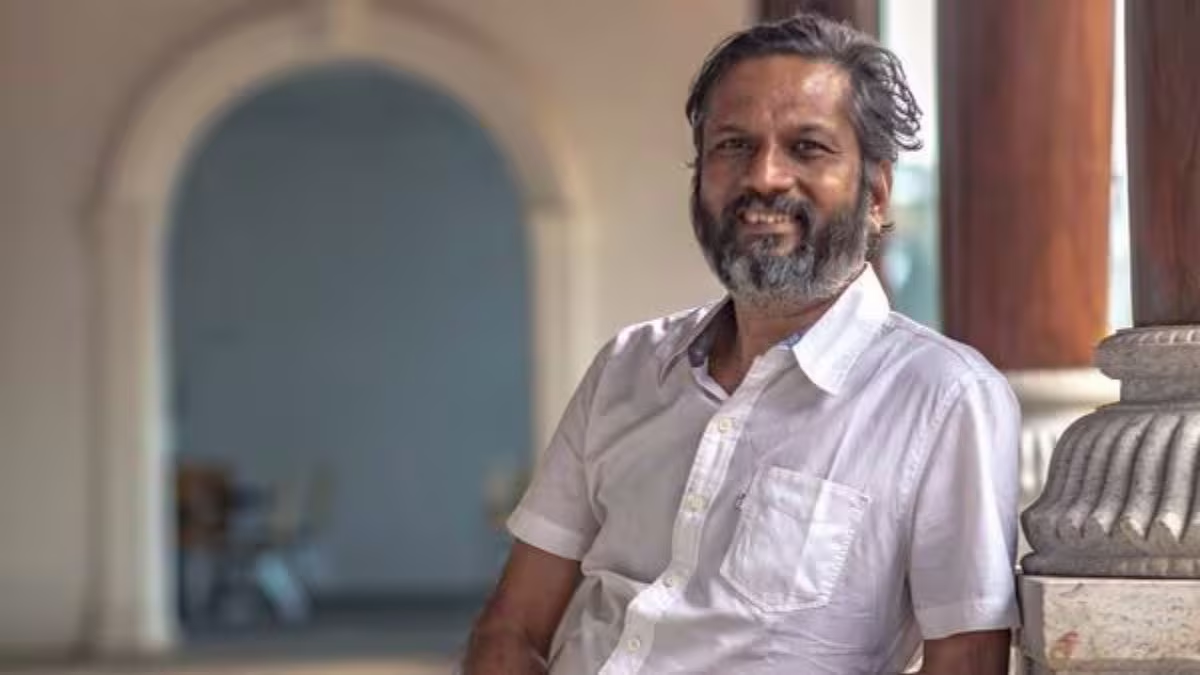
As AI continues to reshape industries and spark fears of widespread job displacement, Zoho co-founder Sridhar Vembu has offered a unique perspective on roles likely to remain resilient. In a thoughtful post on X, Vembu argued that certain human-centred occupations, driven by purpose, care, culture, and community rather than productivity or financial gain, will endure untouched by AI advancements.
Vembu’s view suggests that AI poses the greatest threat to jobs where self-worth is tied to economic output, intellectual prestige, or efficiency metrics. However, pursuits rooted in self-motivation and human connection face no such risk. He highlighted examples of activities people undertake not for high pay, but for deep personal or societal meaning, which include:
– Caring for children
– Teaching young minds
– Looking after the elderly
– Returning to farming after leaving a high-paying job
– Working as forest rangers out of love for nature
– Serving as local temple priests who perform daily rituals even without an audience
– Pursuing classical music, practicing and performing regardless of crowd size
He noted, “People who choose these paths are not motivated by money in the first place, which is precisely why AI will not diminish their sense of purpose.”
Vembu suggested that as AI drives a “massive jump in productivity” and creates abundance in goods and services, societies may reorganise around such meaningful, voluntary work. He referenced historical examples, like ancient temples sustained by societal surplus distributed by rulers, to illustrate how abundance could support non-economic pursuits.
Vembu’s post raises controversy
Vembu’s post drew responses that questioned the viability of such roles in the current economic conditions. While Vembu countered by pointing to AI’s potential to generate unprecedented surplus, shifting future challenges to distribution and consumption rather than job scarcity, his followers weren’t happy with his take. One user, @vishnuagarwal64, wrote, “Passion activities do not survive in an economic vacuum. Consider Renaissance Florence. Those artists and musicians only thrived because the Medici banking empire created massive surplus wealth to subsidise them. If AI dismantles our primary economic engines, the surplus funding those noble passions simply evaporates.”
Another follower, @vinothsunder, wrote, “Isn’t this hypocritical to advice young people to pursue low value add jobs when you as a company is trying to service global clients with AI and make money in USD and pay in INR. Our monetary value is the function of the net value we realize from the product or service we create.”
Another user @SiddarthaDevops added, “In rural areas, the reality is quite different. Nobody is ready to marry a boy who is into farming, and no father is willing to give his daughter to someone who doesn’t hold a well‑paying job. Social expectations and economic pressures shape these choices, so even though farming or other non‑lucrative work may be meaningful, it’s often undervalued when it comes to marriage and status. That’s the ground reality in many villages.”
Vembu not the only tech leader with this vision
Vembu’s outlook is no different to what the titans of the AI industry have to share. Elon Musk has envisioned a future where humanoid robots like Tesla’s Optimus eliminate the need for mandatory labour, making work optional and allowing people to pursue hobbies or passions freely, inspired by Iain M. Banks’ post-scarcity “Culture” series. Nvidia CEO Jensen Huang has similarly stated that AI will evolve jobs rather than cause mass unemployment, with machines taking over mundane tasks while humans focus on uniquely human strengths.














Leave a comment