
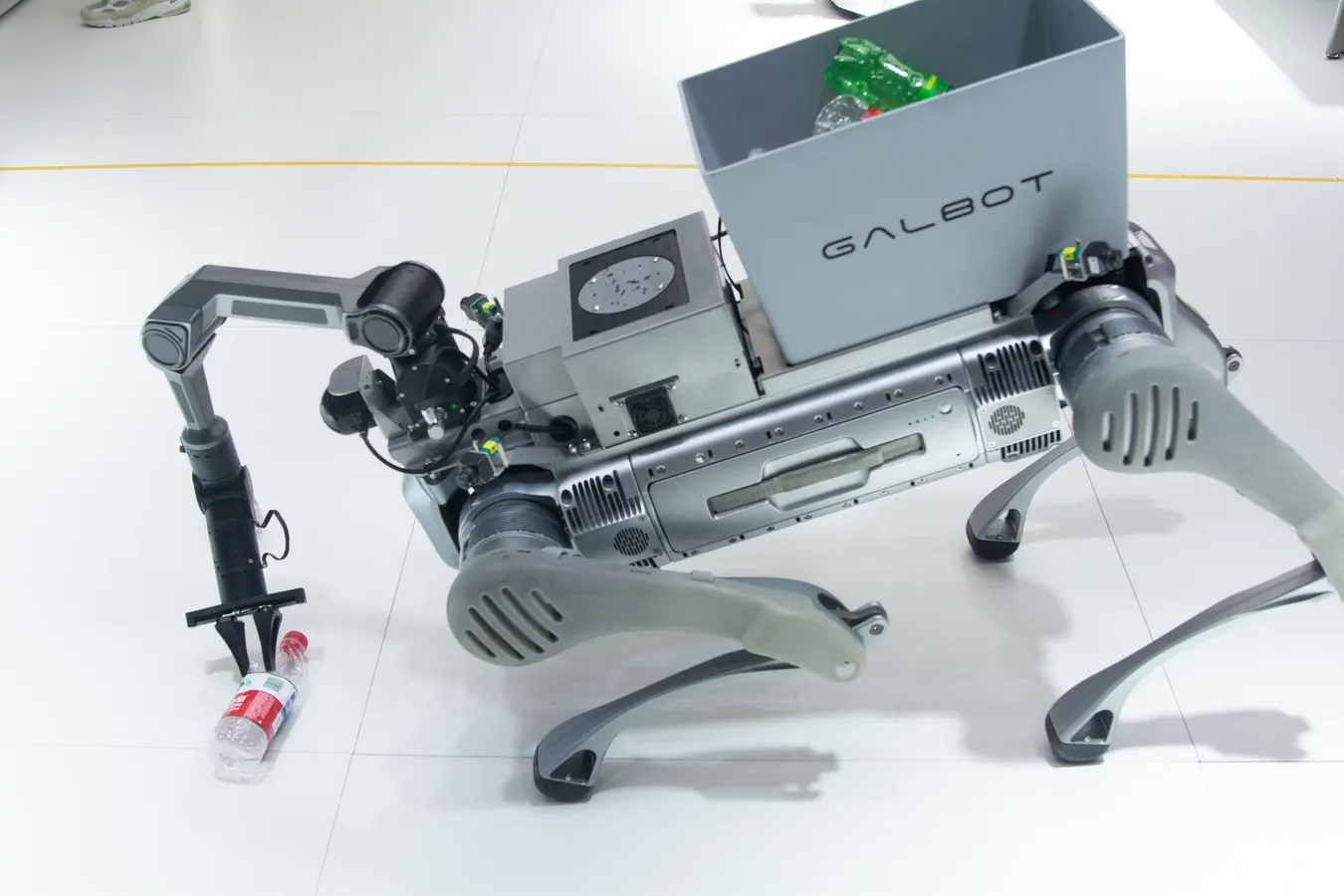

A general view shows a robot dog from Galbot picking up garbage
NurPhoto via Getty Images
What does physical AI mean for the world around us? And how will we interact with it as people?
Well, to level-set, in Beijing, robots walk around on the street, waving to people. They run marathons. They wear public safety uniforms. In short, they do things, in public. Around the rest of the world, we’re headed there, just more slowly.
With that in mind, it behooves us to think about what this is going to look like. We already have legions of academics thinking about how LLMs can learn basic physics, something that we, as humans, understand experientally, ex: throw that ball, and see where it goes.
“Physical AI systems can think and act in the real world,” writes Umair Falak at Xavor Corporation. “Machines with physical intelligence not only compute, but also interact with their physical environment. They have awareness of things like space, motion, and interaction.”
Building the AI Future
At the Imagination in Action event at Davos this January, Merline Saintile of Rocketlab talked to James Kuffner of Symbotic about the nature of such systems, and what we can expect in an age when physical AI increasingly powers things. (Disclaimer: I help to run Imagination in Action, a free conference on AI at the during the week of the World Economic Convention.)
Kuffner started out with some company metrics, which I’ll put in a little sidebar box for brevity:
- 18 years in business
- A fleet of over 20,000 robots
- Over a million autonomous miles a day
- 8.5 million cargo boxes moved per day
He gave this core definition of physical AI:
“Physical AI is really an artificial intelligence that’s embedded into a machine that can affect the physical world,” he said. “So instead of just processing data, you combine the computer that processes data to actually interact with objects in the world to create value for us. And either it could be moving people, or moving goods around the world. It could also be controlling infrastructure that is connected to all of the physical devices that we have to support life.”
When the Time Bell Rings
Kuffner then evoked quite a relevant picture:
“We’re seeing artificial intelligence allow robots to leave factories that are completely structured environments and then enter semistructured or unstructured environments.”
Imagine a flood of autonomous beings made of metal and plastic, shuffling and waddling and humping along through the factory doors, streaming out into the world, into the shops where we buy things, the places where we congregate, and even our homes. You get a really different sense of AI and what it will do in the future. We tend to have this siloed idea of AI robots working away inside of an industrial location – but what if one was standing behind you in the gas station line, or lying next to you in a hospital bed, or bothering you at the bus stop?
“Computer vision and the compute platforms are now powerful enough to allow robots to reliably solve problems that have been challenging for a long time,” Kuffner continued. “We’re really seeing, I think, a lot of positive tipping points towards reliability and robustness.”
Part of that, he explained, is the ability to handle ‘black swan’ events, unusual happenings that require more than just rote mechanical actions. But new AI systems should have that ability.
“The intelligence is really about reasoning when you have uncertainty, and there may be a longtail of low-probability things that might happen when you’re moving millions of boxes a day,” Kuffner said. “You might come across damaged packaging. You might come across spilled goods. You need to be able to build a robot and a robust system that can handle that. And so the flexibility to deal with that … is one of the strengths of having a fleet of intelligent robots, as opposed to fixed rigid conveyors.”
Yes, fixed, rigid conveyors will soon be a thing of the past.
Noting advances in integrating these systems into all sorts of human environments, including healthcare and transport, Kuffner painted a picture of AI being deeply embedded in everything that we do on a daily basis.
“We’ll see drones, we’ll see automated driving cars,” he said, “we’ll see lots of intelligent robots moving around and providing value in the market.”
The Human Side
So what do humans do in this scenario?
Saintile and Kuffner discussed upskilling, which is de rigueur, but Kuffner also talked about servant leadership in a way that I found compelling. His approach seemed to be one of supporting the human skill behind the tech, making sure that an environment is healthy and positive. And I think that mentality is going to take us a long way.
“(It’s important) to support a healthy environment where there’s psychological safety,” he said, of imagining leadership in the AI age. “That’s been one of the things that has been shown to have value, especially when you have an engineering team that needs to innovate. Create that safe space where no idea is too wild or crazy to explore … I always like to say: there’s no success or failure, there’s just success or learning.”
It might sound a bit Pollyanna-ish, but I think we will need this positivity as we tackle one of the biggest challenges (arguably THE biggest challenge) of our time.
Here’s where Kuffner doubles down on this idea, which I also like and support:
“If we can actually focus on positive tipping points, this technology would … create a flywheel of good and positivity for the planet. We need more people who are optimistic. Yes. So, relentless positive action.”
They’re Coming
From CES to the halls of diplomacy to the boardroom, physical AI is getting rolled out in strange and interesting ways. This year’s Davos event was an inflection point that I think will soon give way to a more actionable set of changes, on every street. Stay tuned.











Leave a comment